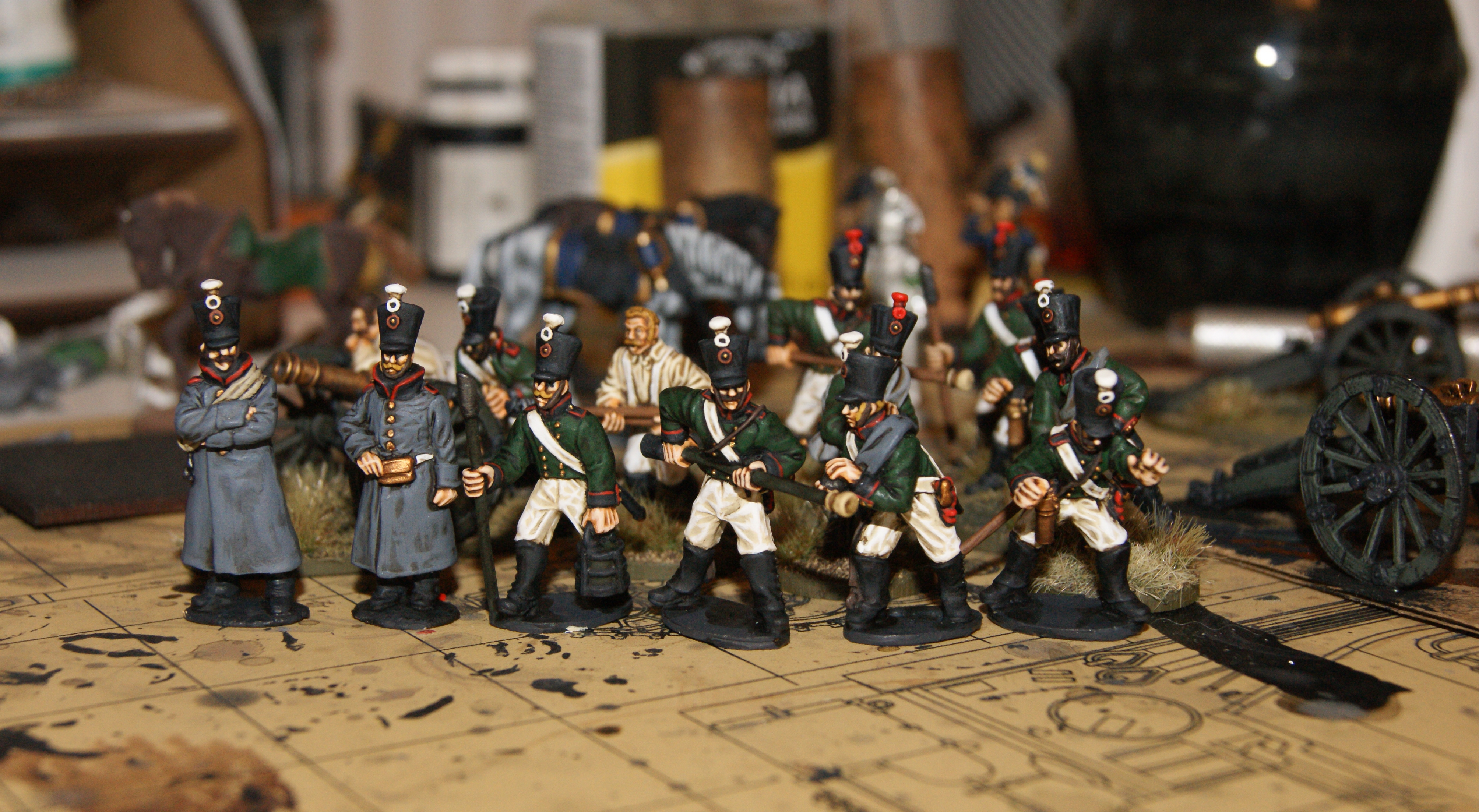

With little painting time, I have at least finished some additional figures and guns for the Russian army of 1808. I have prepared many more. The primary goal is to be able to field a battery of two guns for each of the three brigades. Two of these will be 6-pounders, the third a 3-pounder battery. At the moment I have finished three guns and crew, which is fine in itself. One gun per brigade can be good enough in game terms. I already have three limber sets, although one of them still needs some finishing touches.
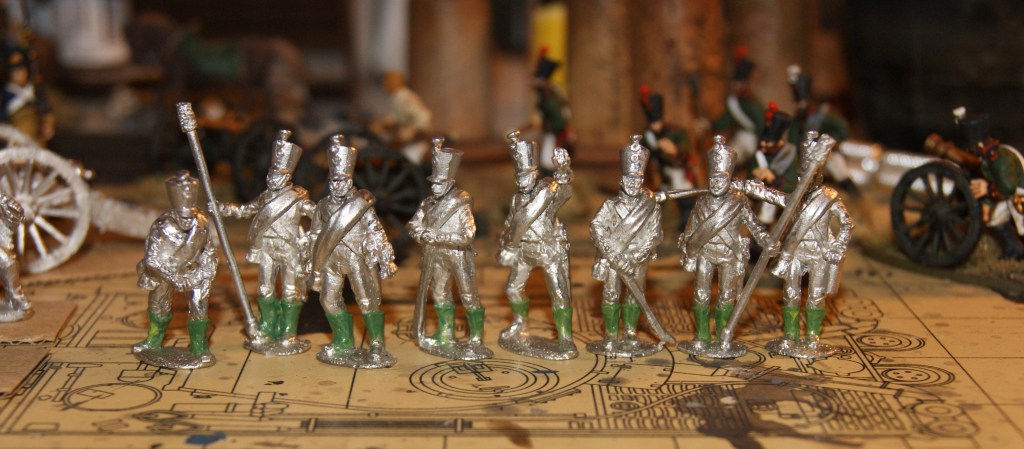
The figures are conversions from Perry and Warlord figures, with the heads of Brigade Games infantrymen. On the Perry figures in summer dress, I sculpted boots, which I think may be more appropriate. But the long white gaiter trousers which they wear were already in use in 1808 as far as I understand, so this wasnt strictly necessary. I get the feeling that such elegant white trousers would have been useless in Finland though.
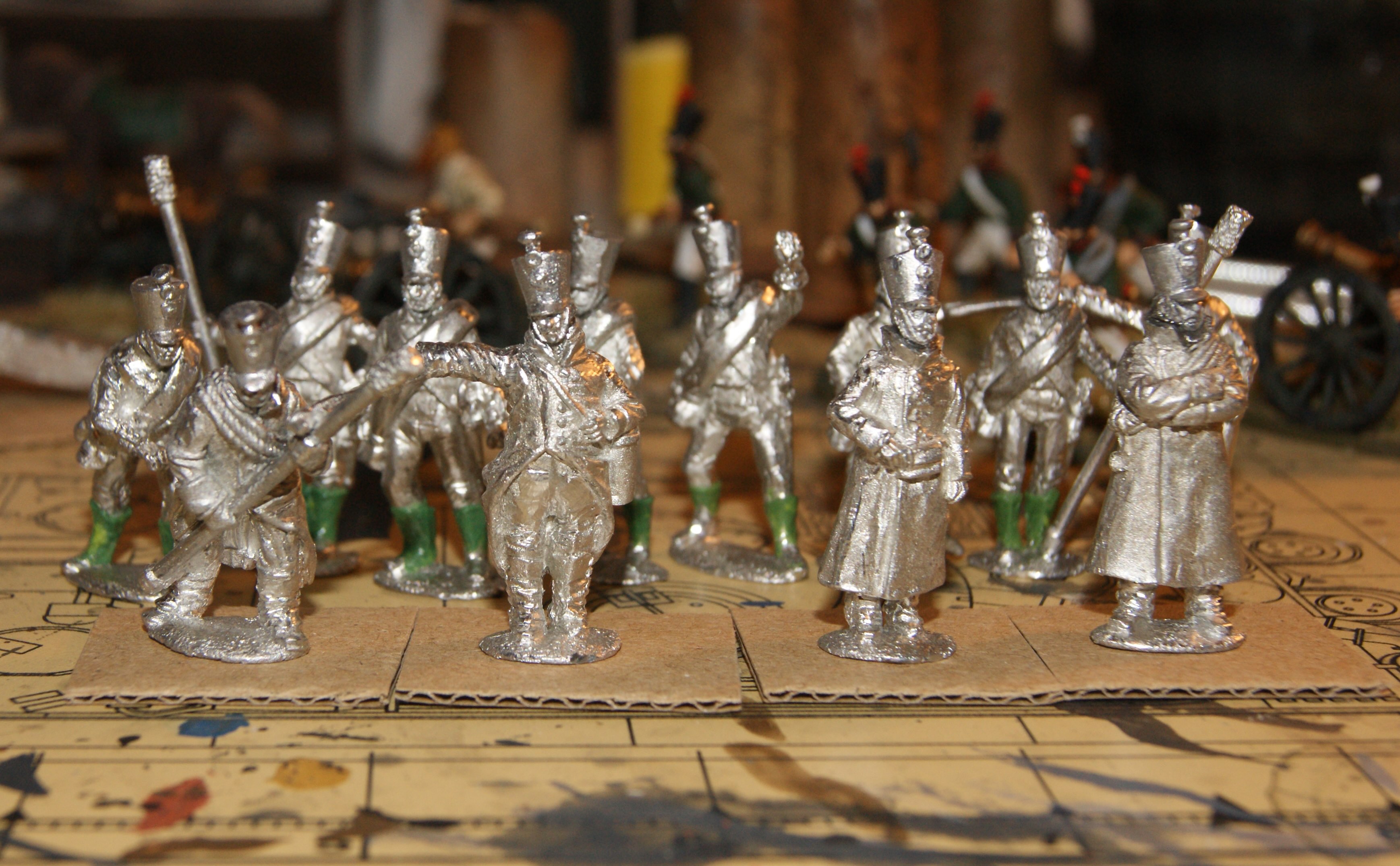
In the future, it would be nice to add a battery of 12-pounders to this collection as well. But thats about it, as I dont see me ever fielding more than three brigades at once.

Russian 12-pounders played an important part in the war in Finland, as the Swedish army never fielded any equivalent artillery and could not match their range. Exactly why no Swedish heavy artillery was used in 1808–1809 is unclear, as heavy guns were available in Finland. It may just be that those guns were considered to be no better than the new model 1804 6-pounders, which were light and mobile, yet had decent range. For that reason 12-pounders may not have been considered worth the effort. I cant recall any discussion of this in what I have read of either in primary sources or secondary literature. Theoretically, one would assume that heavy guns would have been useful at least in defending some of the prepared positions that the Swedes constructed at various places, such as Rouna, where the Russian 12-pounders seem to have been very effective. As was the case with this war in general, it seems that the Russian army proved more capable in the logistics department if nowhere else, despite the fact that the Swedes were on home ground.
 Pancratist