As I have now painted at least one unit of most of the Finnish regiments that took part in the 1808 war, I thought I would sum up what I have learnt in the process, for others to use. Below is a table summarizing the uniform colors worn and the flags carried by the different regiments. Needless to say, some details are uncertain, but I have tried to explain the difficulties in the notes further down the page. I will try to update this page as I learn more, but the basics are there. In the future, I will be looking to doing the Swedish regiments as well, but that will perhaps have to be in a separate post. Similarly, officer’s uniforms would perhaps be best treated in a post of its own.
The uniforms of the Finnish army followed the models set for the Swedish army of which it was a part, but the Finnish regiments also followed a distinct line of their own. Swedish uniforms went through a quick succession of changes between 1792 and 1809, when the war against Russia was lost and all the Finnish regiments disbanded. The major uniform changes have been categorized as the 1792, 1802, 1806 and 1807 uniforms respectively. There is in fact a 1801 model as well, but that was used almost exclusively by senior officers, so we can leave that to one side for the moment. The 1792 was, especially for the Finnish regiments, quite different from the later models. Therefore, lets start with the m/1802.
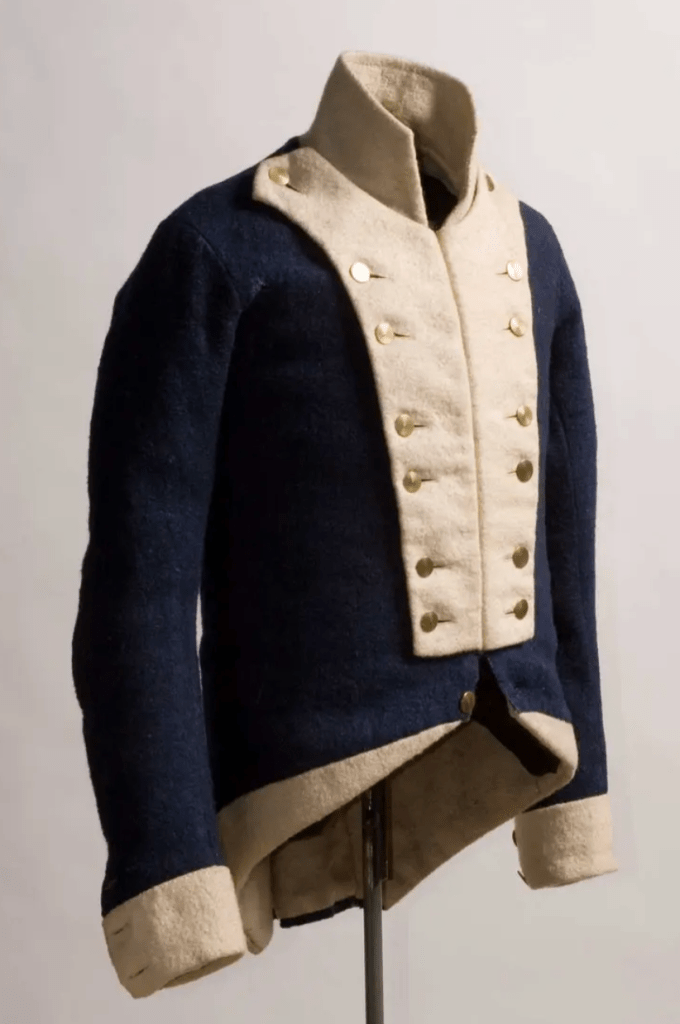
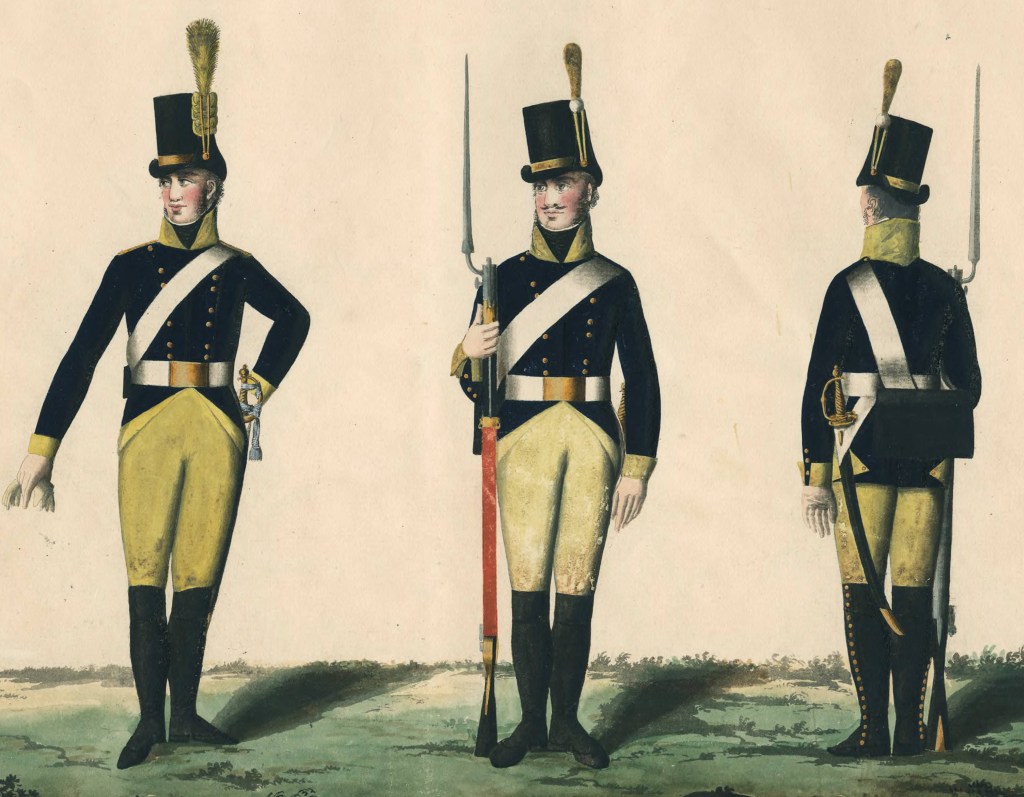
The 1802 uniform consisted of a double-breasted jacket with short trousers. Belts were white and a large brass belt-buckle was worn on the waist belt. Swedish regiments, and the Finnish Österbotten regiment, wore blue coats with different facing colors, distinguishing each regiment. The other Finnish regiments wore grey with various facings (mainly blues). The hat worn with this uniform, was the long-lived 1779 model. Among the Finnish regiments, there was one exception: the Savolax jägers wore a shako.
The colors were retained in the m/1806, in which the major changes was the single-breasted jacket and the blue-and-yellow sash which replaced the belt and buckle.
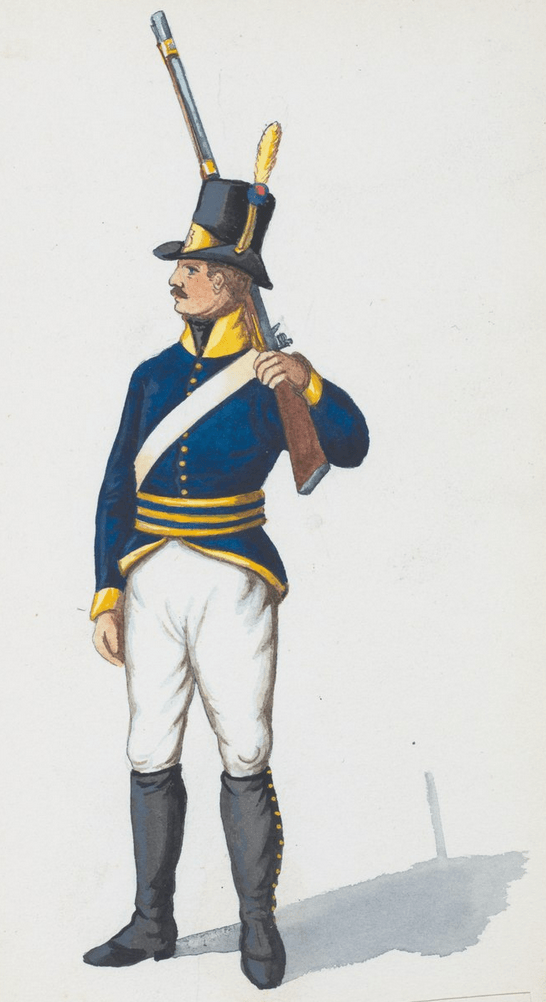

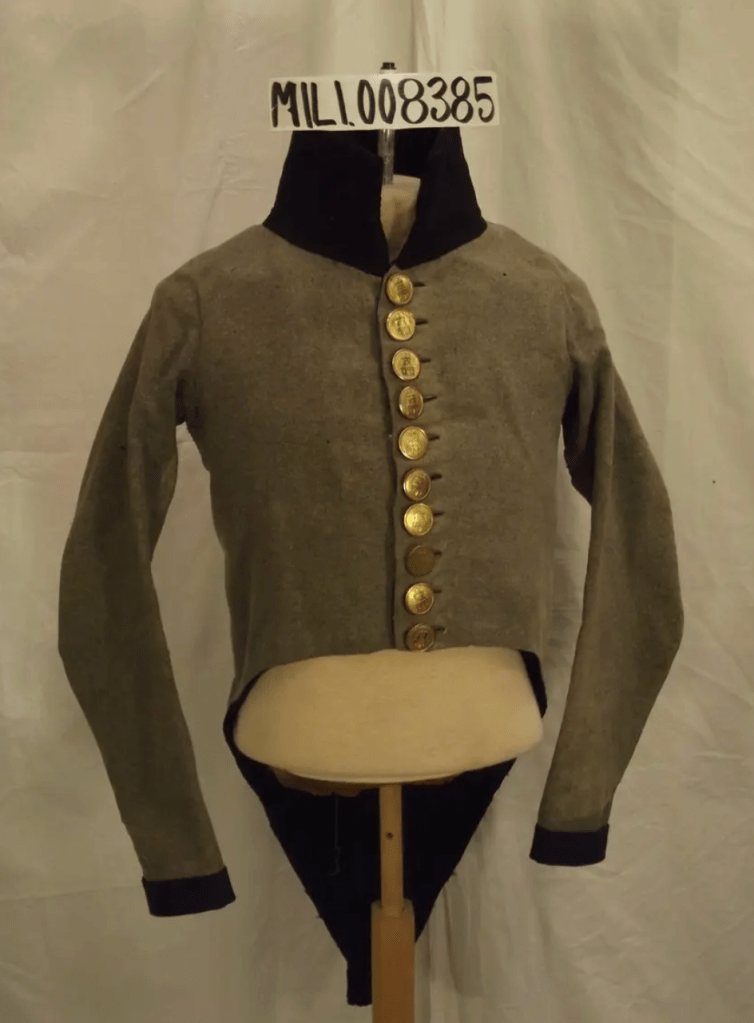
A major change was introduced with the m/1807. This uniform was meant to be universal (although guards units were excepted), with the same jacket and trousers for all regiments. It was grey with dark blue facings. Belts were black. Jägers were distinguished by a green hat plume instead of yellow. Regiments were distinguished by a regimental badge in the centre of the front of the hat.
The 1807 was unpopular. It also took time to adopt new uniforms, as old ones were to be replaced only when worn out. Therefore only a few regiments wore this uniform: the Nyland regt. seem to have done so in Finland. Some Swedish regiments did receive it, and at Sävar and Ratan, the last battles of the war (fought in northern Sweden) in 1809, this uniform was more widely worn (by Swedish regiments). But by then, it had already been decided that blue coats were to be re-introduced.
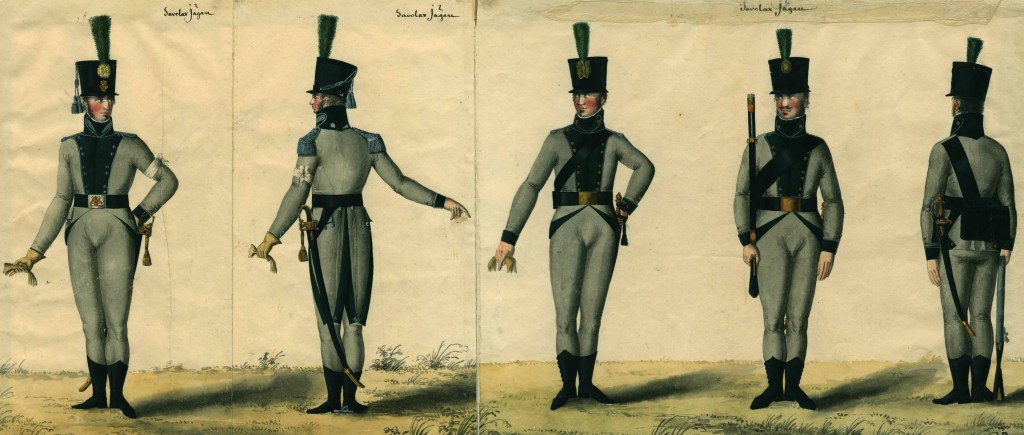

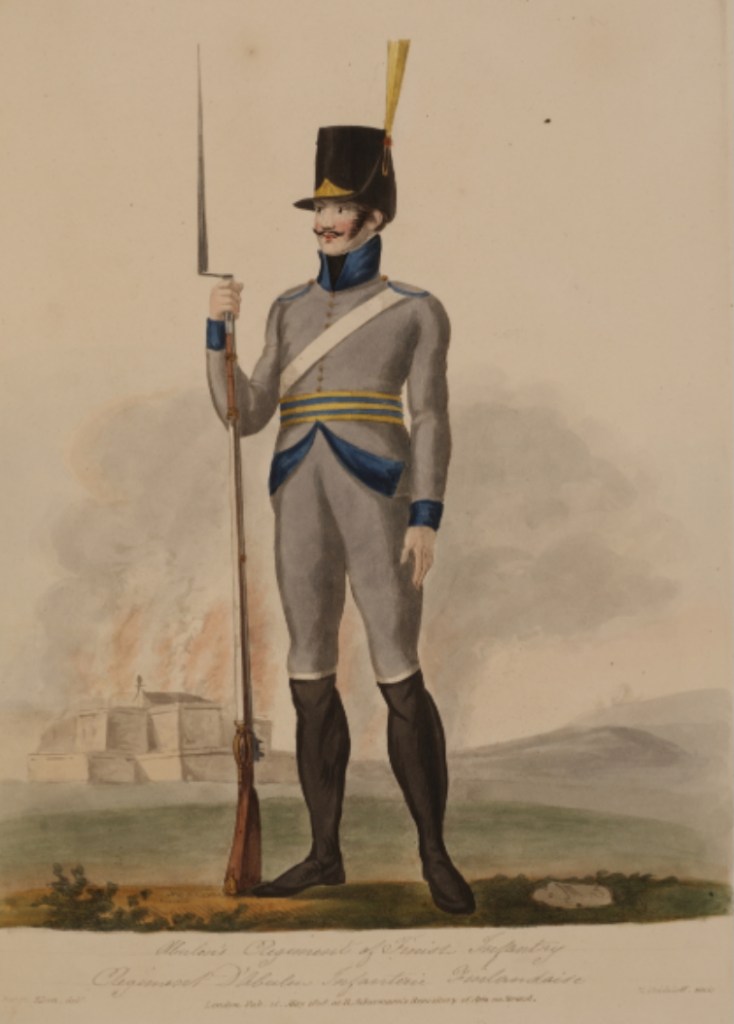

*To what extent plastrons were still worn on the uniforms in 1808 is difficult to determine in detail. The m/1806 and m/1807 uniforms had no plastron. However, many regiments still wore the old m/1802 or even m/1792 jackets. There was a general regulation stipulating that the plastrons should be removed from the old uniform jackets. This was a minor alteration to be done by the soldiers themselves. To what extent this was actually carried out is uncertain. There are few surviving examples of the uniforms in questions, and few depictions drawn from life by eye witnesses. Furthermore, the examples that do exist point in different directions. There are surviving examples of uniforms of the Åbo and Nyland regiments. The Åbo example (an officers jacket) is a m/1806 without the plastron. The Nyland (both officer and private’s uniforms) are of the m/1807. Interestingly, this means that the Åbo and Nyland regiments wore uniforms that looked pretty much exactly the same, as the m/1806 Åbo very closely resembles the 1807 uniform (which was the same for all regiments). The only significant difference was the number of buttons (10 vs 11 or something like that), which of course is so slight as to not be noticeable in miniature terms.
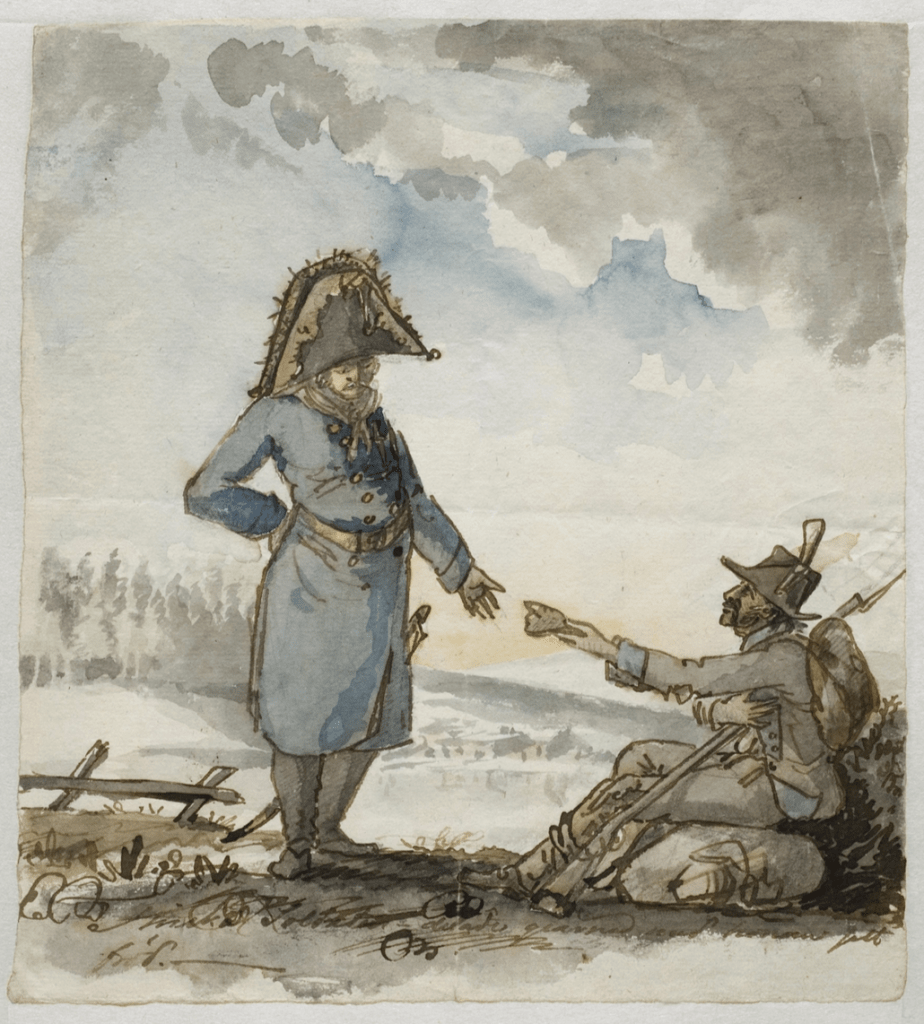
There is a water color by an artist (Per Otto Adelborg) who was an eye witness to the war. It shows general Adlercreutz being handed a piece of bread by a fatigued soldier. The soldier is clearly wearing a m/1802 uniform with the plastrons still there. (Incidentally, he also wears a backpack and not the regulation shoulder bag). As it seems from the examples mentioned above that the Nyland regiment was wearing the 1807, the soldier must belong to the Björneborg regiment. If all soldiers in his regiment wore the same style of dress, this would indicate that Björneborg wore the 1802 with the plastron. For the other regiments, I have yet to find clear examples either way. One could also say that there is a distinct possibility that the uniforms were altered in the early summer, when there was a pause in the fighting. It may be then, that the Adelborg drawing, and he made a series of them, although mostly in black and white, was made in the spring.
**Trousers were previously white in most regiments with a blue jacket, but after the campaign in Germany in 1806–1807, these proved to be impractical, as they were impossible to keep clean in the field. Therefore, all regiments were ordered to transition to grey trousers, as were already often used in practice (fatigue wear was grey). This means that most regiments with theoretically white trousers would probably have worn grey. This may well be true of the Österbotten regiment, who wore yellow trousers, as well.
***The Österbotten regiment was in a process of expansion at the time of the war. New Vasa and Uleåborg regiments were being formed. This was never fully realized, but parts of these new regiments were recruited and participated in the war. It seems that they wore the same uniform as the Österbotten regt.

****The flags used by these regiments fall into two broad types: m/1766 and m/1686, with the number corresponding to the year of introduction of the respective types. Each regiment normally carried four flags, although some guards and enlisted regiments had more. One flags was a king’s color, a white flag with the emblem of the royal house in the center. The king’s colors of the 1686 pattern had a small regional emblem in the top left corner, but otherwise all king’s colors of this pattern were the same. In the m/1766 even this small distinction was removed, i. e. all king’s colors were exactly the same (for guards regiments there were also a crown in each corner). The three other flags were so-called company colors, which were of varying colors and had a regional emblem in the center. In the m/1686, the emblem was encircled by a laurel wreath; in the m/1766 the emblem was surrounded by a crowned golden leaf frame. The emblem was generally larger in the m/1686, although with time the emblems became smaller during the course of the 18th century, well before the introduction of the m/1766. Therefore, the difference between the two types was not as great in practice as they may seem on paper (i.e., if you compare a type drawing of the m/1686 and a m/1766). There were also slight variations within these patterns, intermediate versions etc., but these are too complicated to explain here. The Björneborg regiment carried one (company) flag of the m/1766 and the other three m/1686. The Adlercreutz regt. carried King’s colors of the m/1766 with newly designed (1805) company colors of a different design. The Kajana battalion had flags of an unknown design, made in 1799.


†Adlercreutska regementet, Drottningens livregemente and Jägerhornska regementet only saw (limited) action during the siege of Sveaborg. However, some soldiers managed to escape after the surrender of the fortress and made their way into other units. Some of them may have served in their old uniforms in Gyllenbögel’s corps of volunteers.
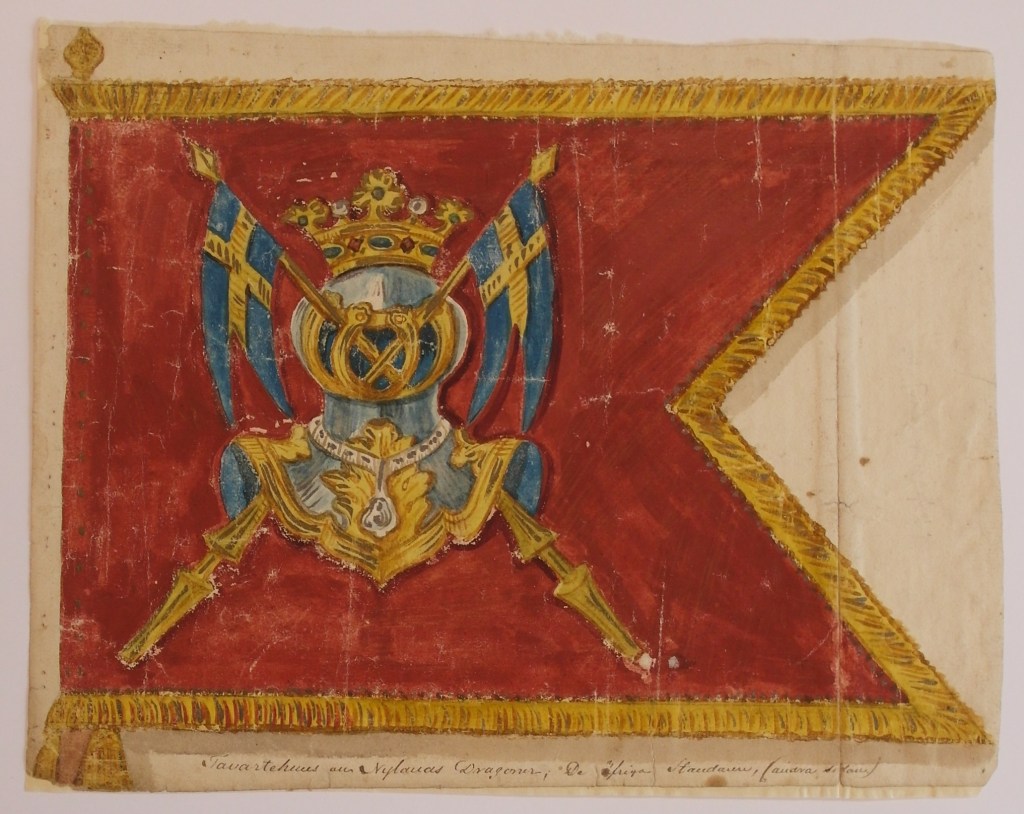
††It has recently come to my attention that the Finnish cavalry most likely did carry guidons, even though Törnquist claims that they did not. There is a very nice drawing by Adelborg, who himself led the first squadron of the Nyland dragoons at the beginning of the war. It shows a guidon being carried in 1804. I assume that the guidons for the Nyland dragoons would have been inherited from the 18th century.

Literature
Leif Törnquist, “Colours, standards, guidons and uniforms, 1788–1815”, in Between the Imperial Eagles, Meddelanden från Armémuseum, vol. 58–59 (Stockholm, 2000).
Martin Markelius, “Bestämmelser och verklighet: uniformeringen i von Vegesacks kår”, in Kronans kläder, Meddelanden från Armémuseum, vol. 69 (Stockholm, 2010).
Martin Markelius, Gustav III:s armé (Stockholm, 2020).
Erik Bellander, Dräkt och uniform: den svenska arméns beklädnad från 1500-talets början fram till våra dagar (Stockholm, 1973).
 Pancratist