I have, for a long time, planned to visit the Swedish National Archives to take a look at some material pertaining to the Finnish war there. One of the things I was interested in looking at was the contemporary uniform plates, which display the uniform patterns which were approved by the king. These plates were made in the 1790ies and early 1800s. They should be reliable in themselves, but, unfortunately there were changes to the uniforms after these were done, so there is obviously more to it than just following these as a guide to the uniforms of 1808.
Now, I still havent actually gone to the archive (which is sad!). However, I did e-mail them and ask if it were possible to order digital copies. The answer is yes, but the downside is that this is relatively expensive. Black and white paper copies are pretty cheap, but in this case I needed color, and it didnt seem to be able to get anything less than professional quality scans in full color. So, it would be very good to actually get myself down there at some point, and take some photos myself. There are a number of images and documents I would like to look at. In the meantime, I just ordered three interesting scans of uniform plates. These were of the Nyland jägers, the Adlercreutzska regt., and a plate portraying a “labor corps” of the Western Army (i. e., the Swedish army on the border with Norway). The two infantrymen’s uniforms are of regiments which I have seen very few good images of, so I was particularly interested in them. The labor corps uniform was just an oddity that caught my eye in the archive inventory.

Looking first at the Nyland jäger uniform plate, I was happy to see that my guess at the uniform (in a previous post) was mostly correct. The uniform is grey with collar, cuffs and turnbacks grey piped blue. It is clear that the musket sling is black and that the hat plume is yellow (not green, as one might expect for jägers). I did miss the blue piping on the turnbacks, but that is pretty minor. I was sort of hoping that the uniform would include a shako. However, if the battalion received shakos at a later date, the evidence from this plate doesnt really rule out the possibility that they wore them in 1808.

The Adlercreutzska uniform is also interesting, but as in the previous case, there is no real surprise here, just a confirmation that information given elsewhere is correct. It is generally interesting to see that the uniform is very similar to the Nyland jägers, and it would have been even more so when the plastron was removed, as it presumably was around 1806. In general, this regiment looks like it was meant as a jäger regiment, even though it isnt called the Adlercreutz jägers specifically, having black belts and musket slings. At around this time of course, it was decreed that all Swedish infantry regiments were to be considered “equally light”. The Adlercreutzska was newly founded (1804), and surely in that spirit. The uniform of the Adlercreutzska is also interesting in that it has a color combination that differs from all other Finnish infantry regiments in that it includes a red collar. As this regiment was very numerous among the garrison at Sveaborg (four battalions, almost 1/3 of the total), some of whom escaped to join the free corps, I will likely be painting a few figures in this uniform.
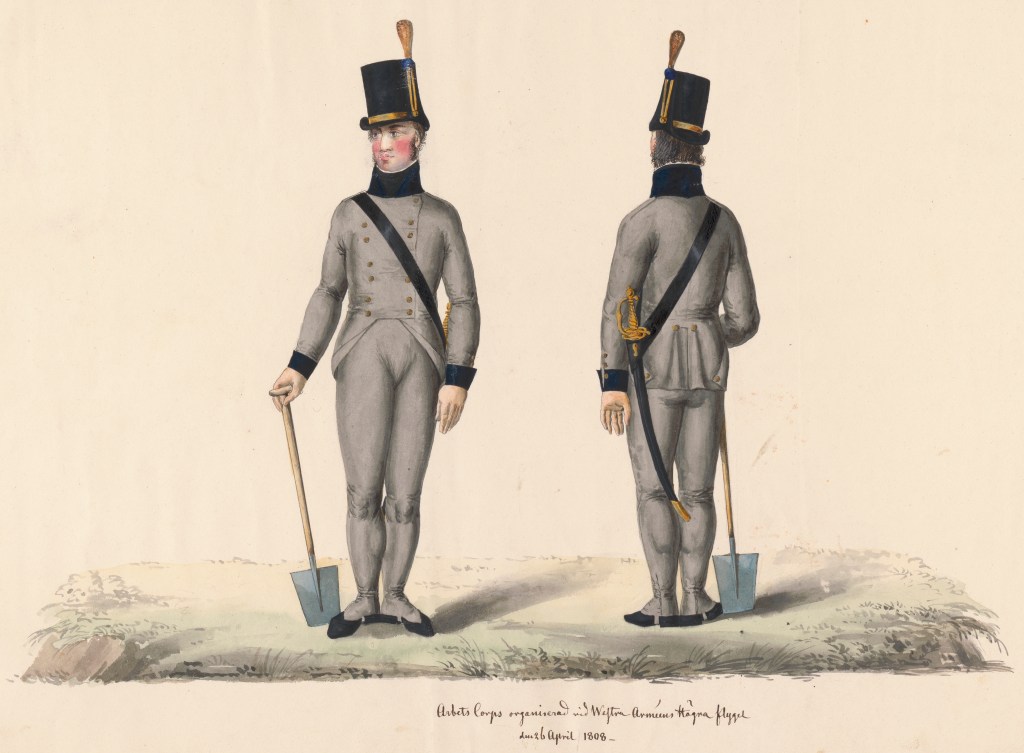
The labor corps uniform is also interesting. The jacket is double breasted, which is curious as it is dated 1808, when all other uniforms ought to have had a single row of buttons. It is also different in that the soldier wears a sword belt worn over the shoulder, instead of around the waist. By this time, the short sword and the waist belt had been dropped for the infantry. But it would be logical that these troops would have had use of short swords or huggare as they were called in Swedish. The uniform also includes different legwear, which is also worth noting. The labor corps were, as I understand it, the regular troops or workmen of the engineer corps or pioneers. Such troops were deployed in Finland too (with the Swedish division), and they would have had a lot of work to do, building, reparining or demolishing bridges, perhaps building fortified position, etc.
 Pancratist