In 1808, the Swedish army had several guards and grenadier regiments, with ever changing and sometimes confusingly similar names. However, only some of these troops took part in the war in Finland, and those that did did not play a key part. I will try to give an overview of the uniforms and flags of these regiments as they pertain to the 1808-1809 period (for the later Napoleonic period, uniforms changed, so this information will not be very useful for that period). First, I will concetrate on the foot guards.
In the Swedish literature, these regiments are sometimes grouped together under the title “Kungl. Maj:ts liv- och hustrupper”, “His majesty’s life- and household troops”, and they can be said to have had a certain status. However, among these troops were soldiers of different types, both enlisted (värvade) and alotted militia (indelta), so that some of them in practice were very similar to the regular alotted territorial regiments.
The foot guards regiments
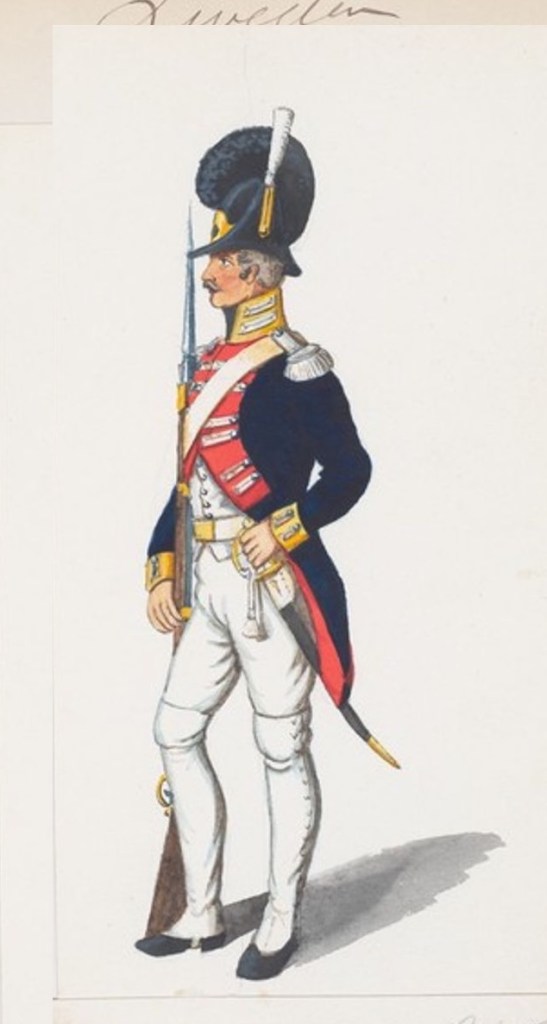
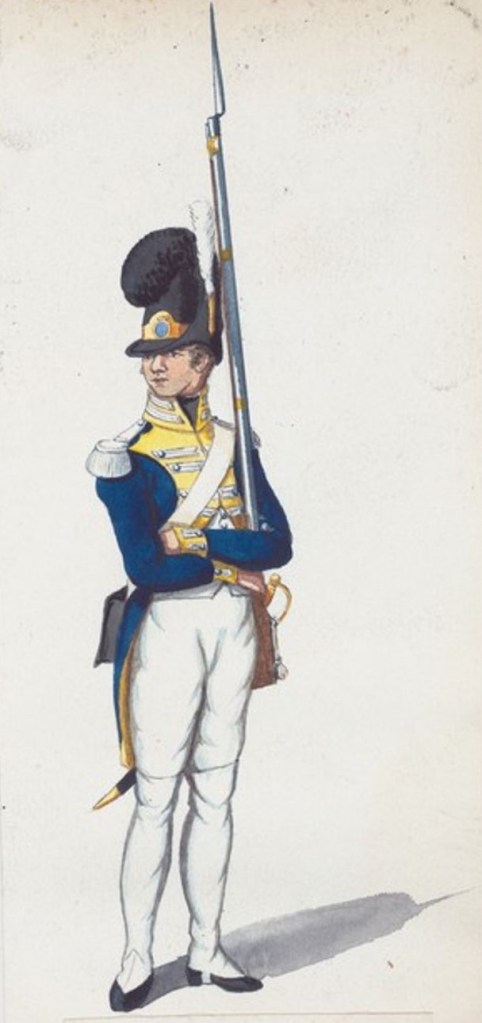
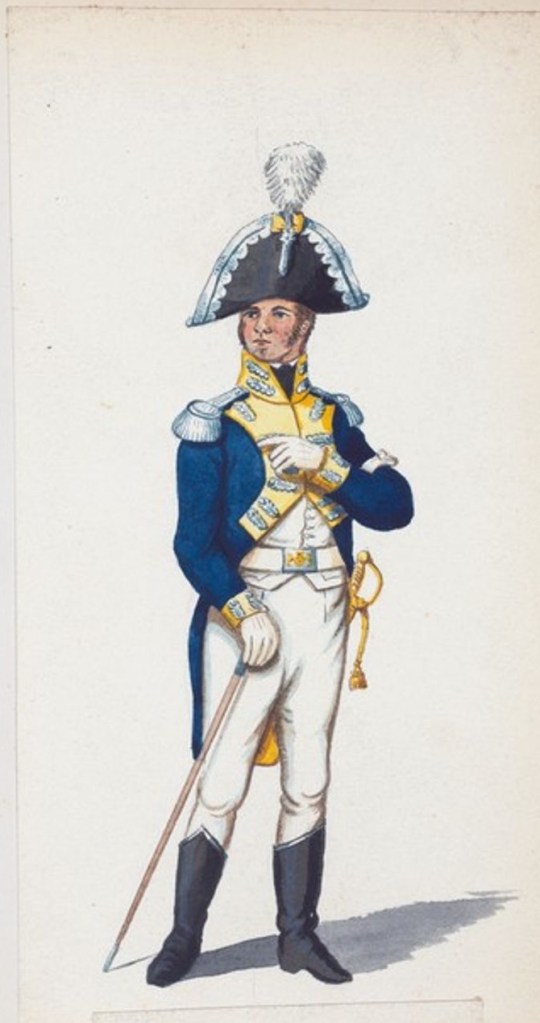
Illustration A: Private, Finnish guards regiment, 1807; Private, Life guards regiment, 1807; Officer, Life guards regiment, 1807. One might think that this uniform was the one used in 1808, but that does not seem to have been the case. In fact, the jackets portrayed here were not issued to the troops until 1812. (Vinkuijzen collection, NYPL)
At this time, there were three guards infantry regiments: Livgardet (the Life guards), Svenska gardet (the Swedish guards) and Finska gardet (the Finnish guards). Because of later name changes and traditions, Livgardet is often called Svea livgarde, as the unit was later so called. Similarly, Svenska gardet is sometimes identified with the subsequent unit Göta livgarde. In Swedish, the names (Svea) livgarde and Svenska gardet are particularly easy to get mixed up, but they are and always have been different regiments. Indeed, I myself mixed the names up when writing this article (now edited).
The history of these regiments is quite complicated, but for our purposes it is sufficient to say that Livgardet was an old unit which had been functioning under the same name and similar organization since the 17th century. The other two regiments, on the other hand, originated in various enlisted regiments that went under different names during the 18th century.
To make matters worse, these regiments were renamed already during the course of the Finnish war. The king was so displeased with their performance at the landing at Helsinge in late September 1808 that he abolished their guards status and renamed them after their respective commanders. Livgardet became Fleetwood’s regiment and the Swedish and Finnish guards were merged into one unit called af Palén’s regiment.
The guards regiments had varied in size over time. Livgardet and Svenska gardet were both organized into two battalions each up until 1806, when they were reduced by more than half. By 1808 therefore, the three regiments only had one battalion of around 530 men each. These battalions participated at the landings at Lokalax and Helsinge in September. A weak battalion of Livgardet, by this time rebranded to its modern name, Svea livgarde, also participated in the battle of Sävar in August 1809.
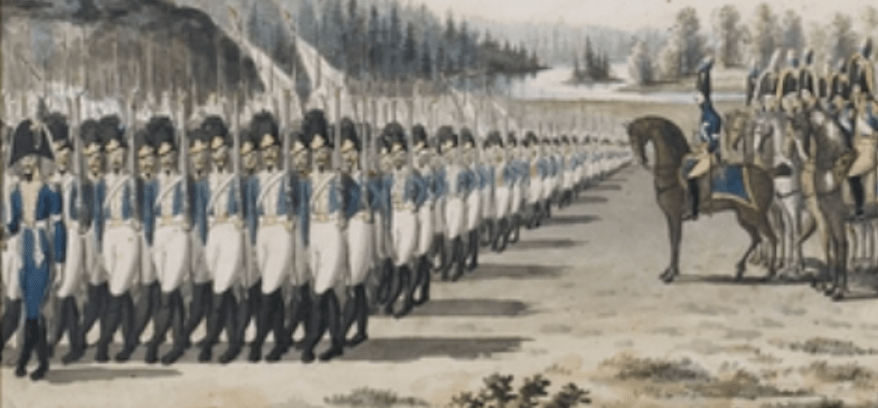
Illustration B: Guards battalions on parade before king Gustav IV Adolf on Åland, 31 July 1808. (Contemporary painting, in a Finnish museum somewhere…)

Illustration C: Official uniform plate for the Finnish guards, 1806. Note how the private on the right wears black gaiters and no epaulettes, just like the troops in the review on Åland (ill. B). (Riksarkivet/Krigsarkivet)
Uniforms
In the 1802 model, the guards regiments wore a jacket which was similar to that of the standard infantry uniform, with a few small details which distinguished them from other troops. The most distinctive feature was bands of white lace (silver for officers) on the front of the collar, on the cuffs and across the plastron. In addition, the jacket itself had longer tails than the standard Swedish infantry coatee (which was very short). The guards’ uniform also included white gaiters. However, in the field, black gaiters of the same type as those worn by the rest of the infantry seem to have been used. Similarly, the uniform jacket had epaulettes, which seem to have been omitted in the field (see illustrations B and C).
Furthermore, over time the distinctions between the regular infantryman’s uniform and that of the guards increased, as changes to the regular uniform did not affect the guards. When the plastron was removed from the regular infantry uniform in 1806, the guards retained them. And when the model 1807 uniform was introduced, all grey with dark blue facings, for all regiments, this again did not affect the guards. Neither does the change to grey trousers, in 1806, seem to have affected the guards. Apparently, the guard units also retained the older type of white waist belt, and did not use the blue-and-yellow sash of the regular infantry. Judging by the painting of the troop review on Åland, the guards battalions were still wearing the 1802 model uniform in the summer of 1808, but with the new hat. Some illustrations, such as those in the Vinkhuijzen collection (illustration A), show the uniform jacket open towards the waist, similar to French uniforms of the period. However, the offical plate of the model 1802 (illustration C) uniform as well as the Åland review (illustration B) show the jacket buttoned all the way down. Also, the waist belt seems to have been worn over the jacket (again, B and C), not underneath it (as in A). This accords well with Bellander (Dräkt och uniform (Stockholm, 1973), p. 407), who states that the new uniform with the open front was issued to the regiments only in 1812, and that the uniform and equipment depicted at Grelsby in the summer of 1808 is indeed of the 1802 model (but with the modern hats).
Another distinguishing feature of the guards was their headgear. In fact there was a plethora of different helmet- or hat-like creations for different guards and grenadier units of the Swedish army at this time, which also changed over time. The three guards regiments previously wore a bicorne, and the bicorne was still worn by officers of those regiments in 1808. However, the private soldiers wore a tall, rounded hat with a black plume which ran diagonally across the head (Illustration D). On the left hand side, the brim was folded up, and the company pom-pom and a tall white plume was fastened in a way similar to that of the regular Swedish infantry hat. The hat had a brass cordon with an emblem on the front. The emblem showed the royal emblem (three crowns inside a crowned blue oval) for the Livgardet; a lion over diagonally white-and-blue (Göta emblem) for the Swedish guard and (presumably) a Finnish lion on red background for the Finnish guard.

Illustration D: Hat, model 1807 of Livgardet/Svea livgarde. (Digitaltmuseum/Armémuseum)
All three guards regiments wore white buttons. The three regiments were distinguished by their facing colors. Livgardet wore yellow facings. The Finnish guards wore red turnbacks and plastron, but yellow collar and cuffs. The Swedish guards wore red facings. As can be seen in illustration C, the guards also had a brass plate on their cartridge box. Officer’s jackets were decorated with silver lace, while other ranks’ had plain white worsted lace bands.
Illustration B, which was drawn from life during the conflict, as far as I understand it, is interesting not only because it tells us something about how the uniform was worn in practice. It also shows an officer sporting an interesting variant of the uniform. The blue trousers do not appear in any other illustrations I have seen, as white seems to have been the regulation color for officers as well as men. There are similar trousers in other Swedish uniforms at the time (Horse Life Guards in particular), and several authors mention how officers took some liberties with regulations to deck themselves out as best they could. The officer also wears epaulettes, in contrast to the men (although mysteriously, the opposite is the case in ill. B!).
Extant uniforms
As these were guards regiments, it is not surprising that more items of clothing and equipment has been preserved from them than is usually the case in this period. The Swedish army museum in Stockholm has a large number of items which is identified being of Livgardet and Swedish guard provenance. However, the dating of these is problematic. However you look at it, the uniform jackets do not match the depictions in the plates above, if the museum datings are correct! On the other hand, there are a couple of jackets that do look very much like the one in the plate (m/1802, ill. C). Now, the uniforms of the guards did not change all that much in the years after 1809, but they changed slightly several times. So, it may be that these are indeed later jackets. But from my amateurish point of view, the livgarde uniform below looks very much like the 1802 in terms of the cut of the waist. In 1807, the jacket was open in the lower plastron. In the later model (1815), the waist was much more straight at the front.


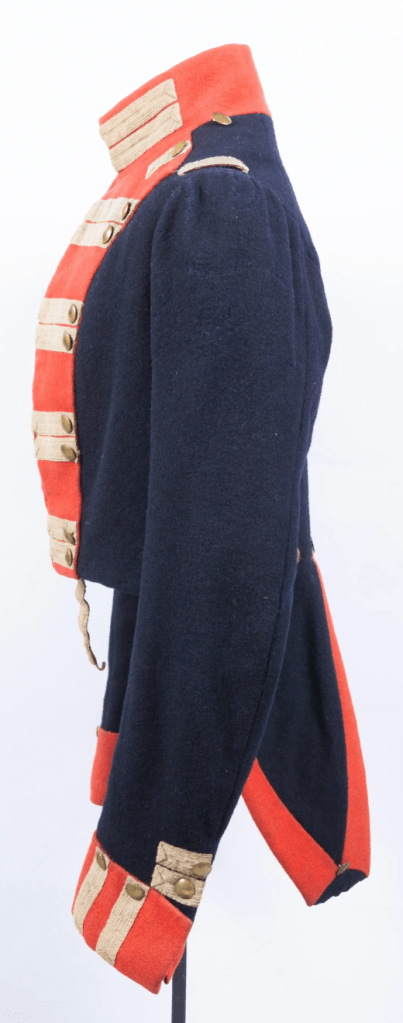


Sappers/profosser, musicians
There are also some interesting items showing the dress and equipment of drummers and sappers, or rather profosser (provosts). The profoss in the Swedish army looked like the sappers of e.g. the French army, but were really a form of military police (or executioner…) rather than an engineer or carpenter. The profoss seems to have worn opposing colors, so that the profoss of the Livgarde, with yellow facings, wore red facings and a red-shafted axe, while the profoss of the Swedish guard (subsequent Göta), which had red facings, had blue-shafted axe. The profoss also wore a bear skin hat. Some of the equipment shown below is a bit later, but I assume the principle to have been the same. The profoss jacket however, is actually of the model 1802 (according to the museum).


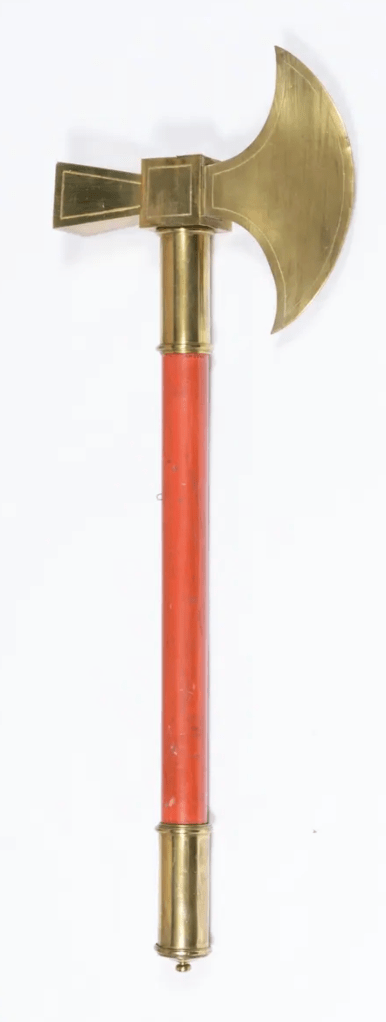
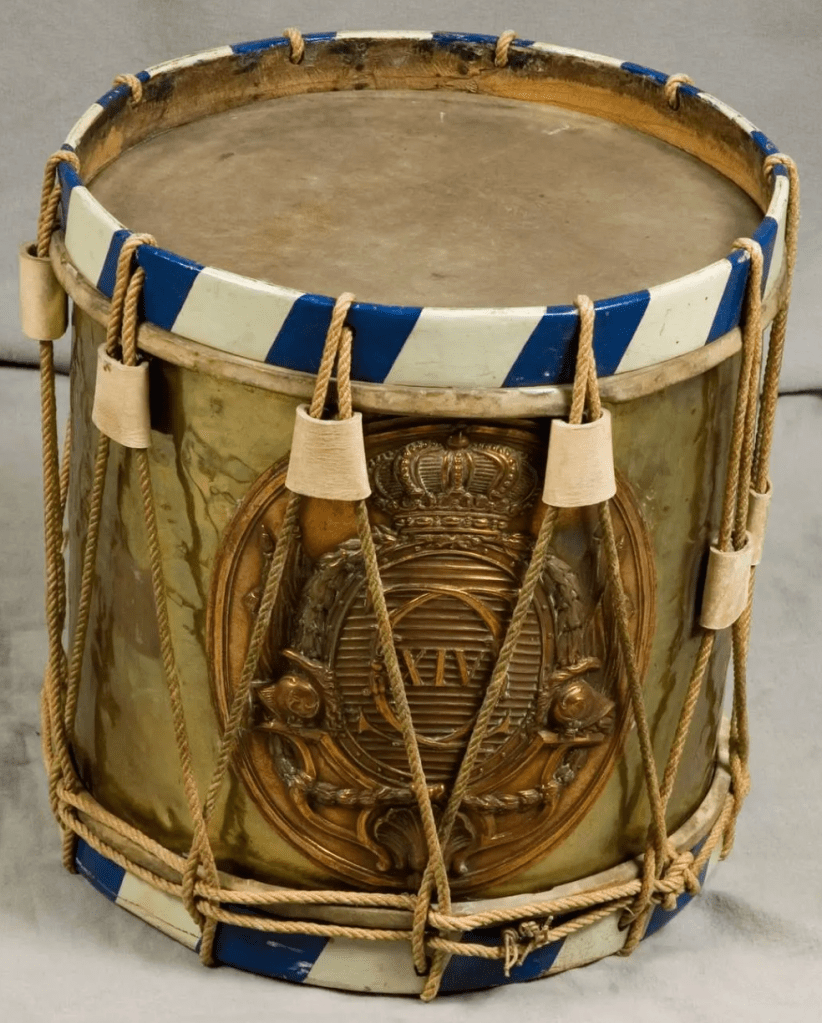


There is a distinct possibility that Livgardet/Svea livgarde received new uniforms in time for the battle of Sävar in 1809, but after their participation in Finland in 1808 (the new 1807 model replacing the 1802). However, in this case, the uniform would at least have been very similar to the old one and the hat would have been the same.
Jägers
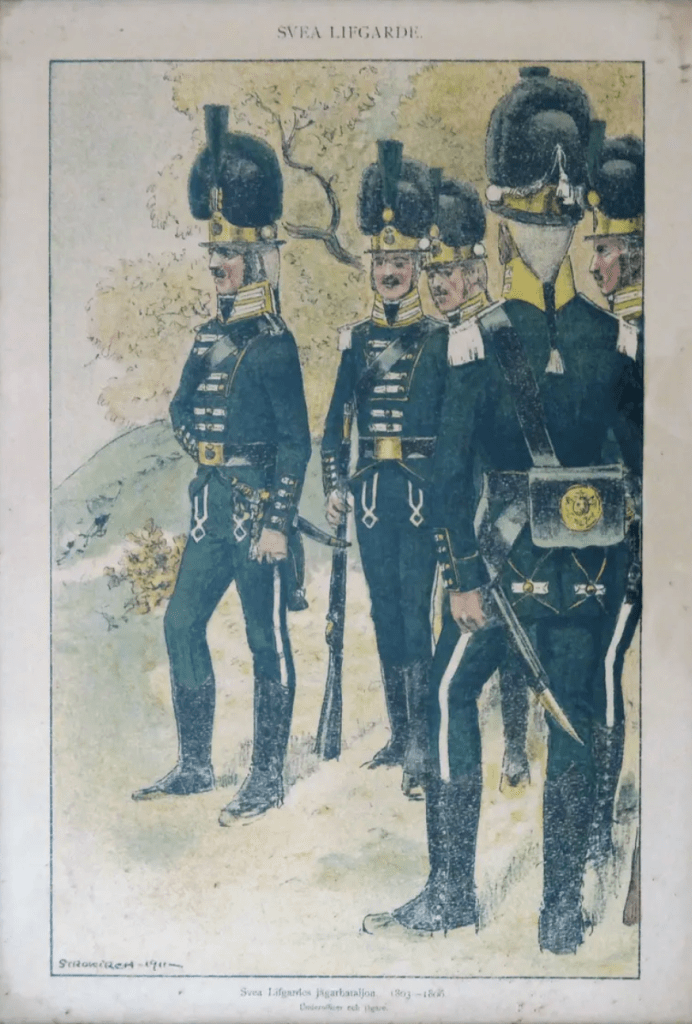
If you thought that the standard guards uniforms look a little weird, you should see the guard jägers! As with other regiments at the time, the guards regiments had their own, integral jägers. However, in contrast to regular line regiments, where the jägers were chosen on campaign and marked out with different colors to their plumes and blackened belts, the guards jägers had a (very) distinctive uniform and hat. This was green, with white facings or piping. The hat was similar to the standard guards hat, but had the plume on the front instead of on the side. I would like to thank Traveller on the Lead Adventure Forums for reminding me of the jäger uniforms.
Flags
In contrast to the uniforms, the flags for the grenadier and guards regiments are quite uncomplicated. Most of them carried flags of the same type. The king’s colors (livfana) were the same as the regular infantry, only with a small crown in each corner. The company colors featured the royal monogram instead of the royal emblem, but were otherwise the same as the king’s colors.
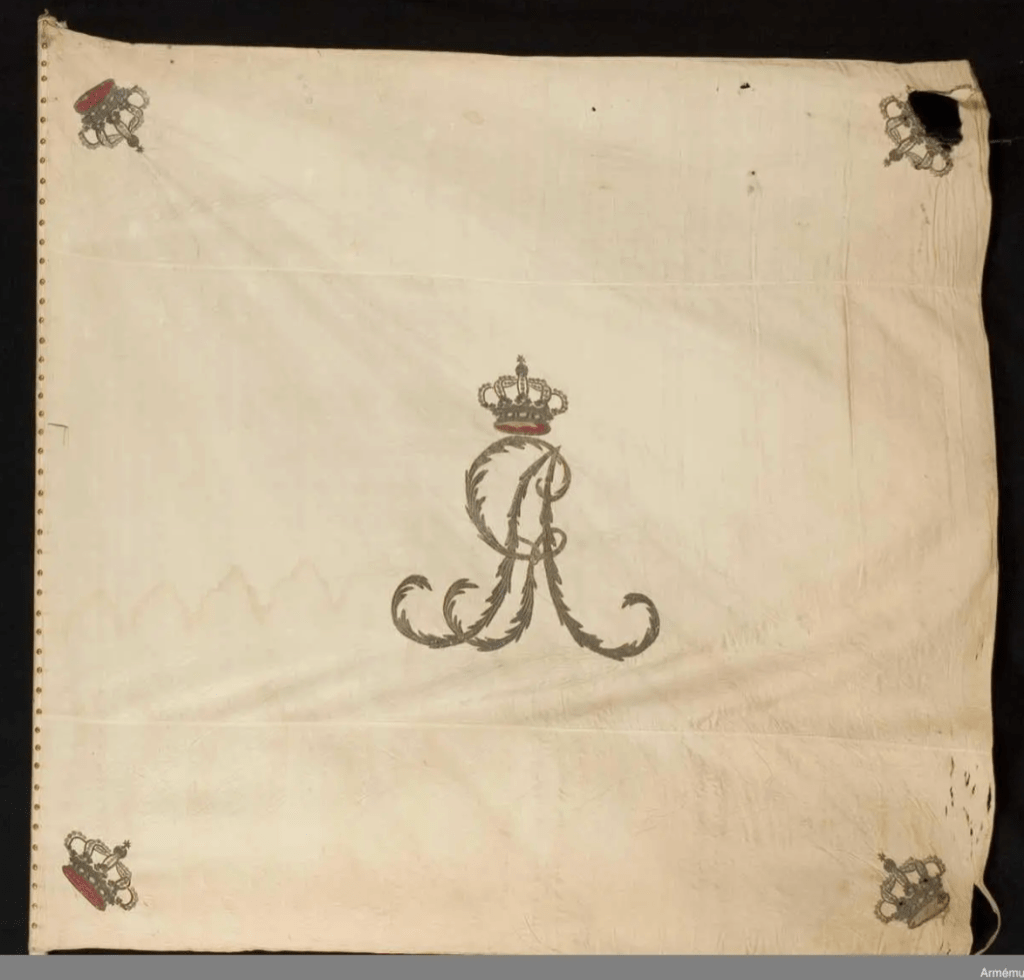

Illustration H: Company colors of a guards or grenadier regiment (left); king’s colors of a guards or grenadier regiment (right). (Digitalt museum/Armémuseum)
When the guards were demoted in late 1808, new flag designs were created (as the guards flags clearly marked their status) (Illustration I). Whether these new designs were ever used I do not know, but they are elegant. It seems unlikely that they would have been used at the battle of Sävar. By then (in August of 1809) the king had been deposed and his successor had already been crowned. The humiliating demotion of the guards was indeed a contributing factor, although probably a minor one, to the deposition of the king. It is therefore more likely that they carried the old flags, but modified so that the emblem of Gustav IV Adolf was replaced by that of Carl XIII. Such modifications seem to have been quite common and were probably relatively easy to make. This happened again, when Bernadotte (Carl XIV Johan) succeeded Charles as king in 1818 (Illustration J). The only reference I know of is Törnquist, who states that both guard regiments had relatively new flags at the time and that the old ones (with Gustav IV:s monogram) were only replaced in 1810. (Leif Törnquist, “Colours, Standards, Guidons and Uniforms, 1788–1815”, in Between the Imperial Eagles (Stockholm, 2000), p. 146).
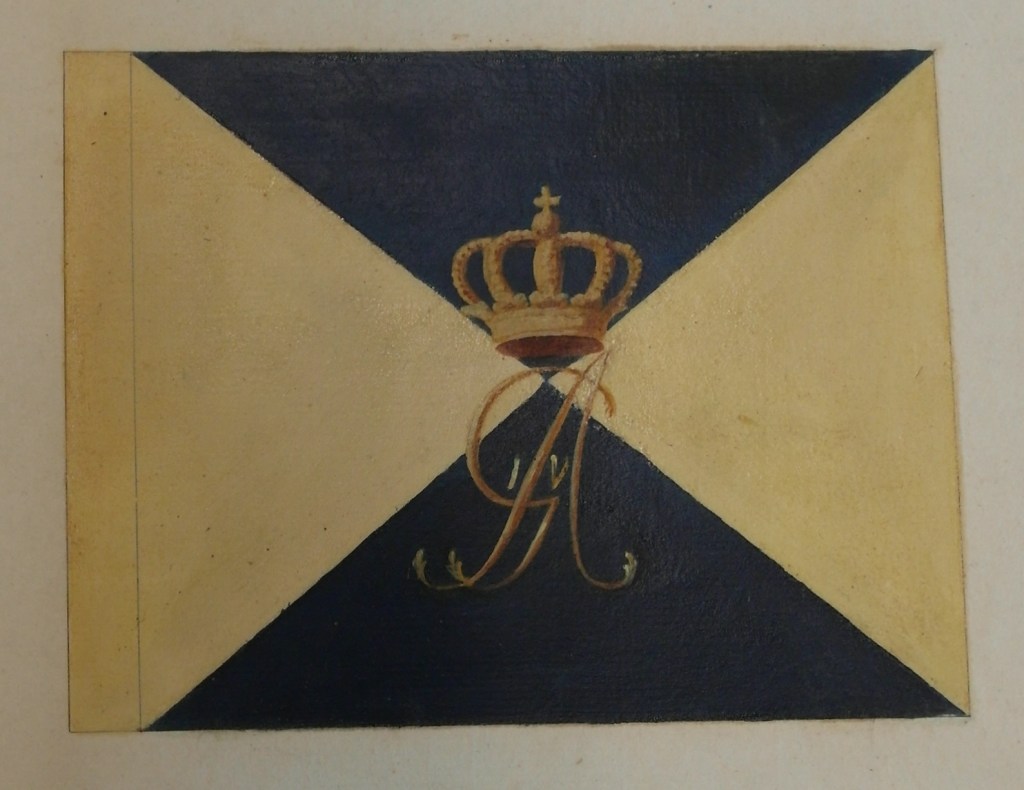

Illustration I: Proposed company colors of the Fleetwood and af Palén regiments (1808). (Riksarkivet/Krigsarkivet)
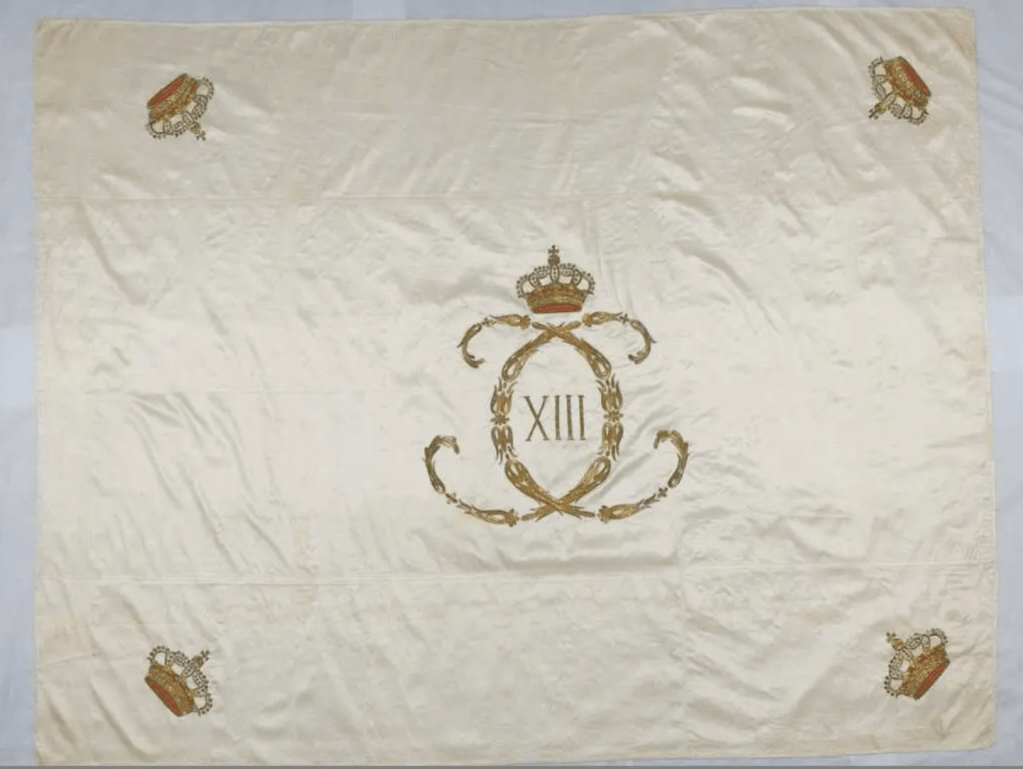
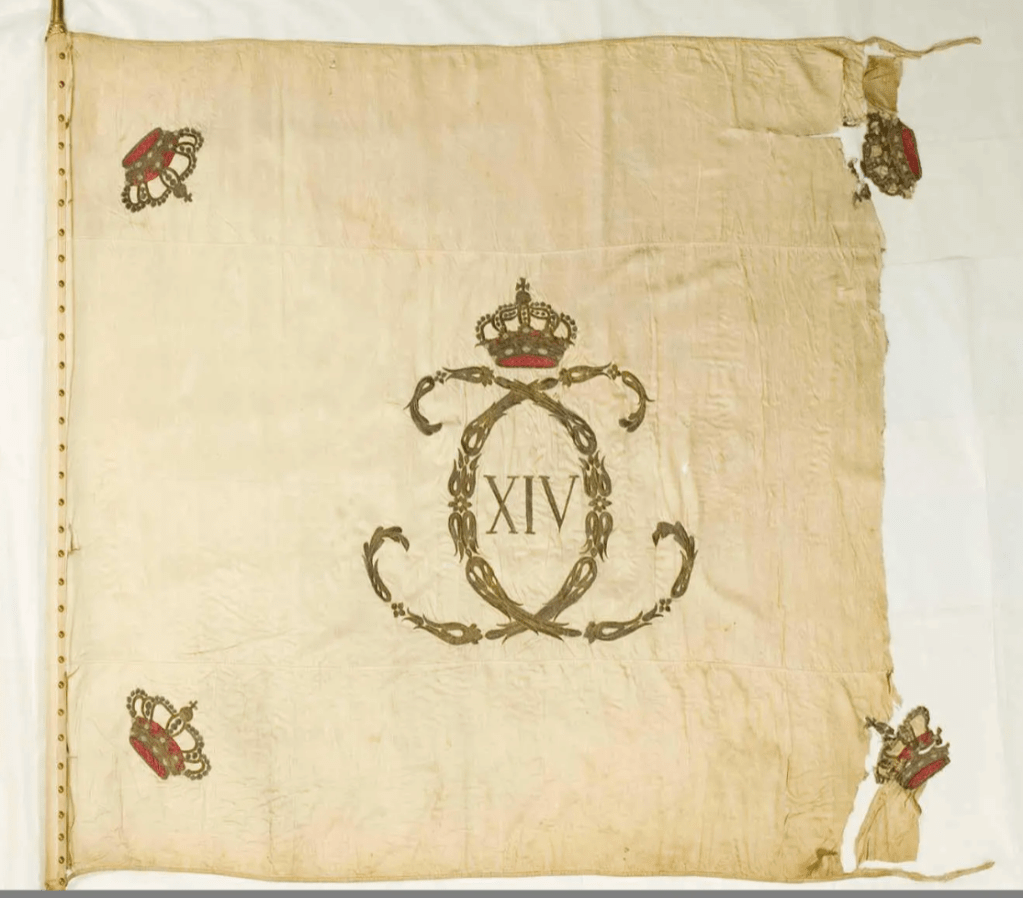
Illustration J: Company colors of guards regiments, 1809 and 1818 (Queen’s Life regiment and unknown guards regiment). (Digitalt museum/Armémuseum)
Figure availability and modelling ideas
Perry miniatures do not make any figures for Swedish guards at the moment. Lets hope that they decide to make them at some point in the future… But until then, one has to make do with some sort of conversion. My plan is to try to combine the heads of the Perrys’ Värmland jägers with bodies taken from their recent Spanish plastic infantry. The Värmland jägers have a hat which has the same shape as the guards’ hats, and should do nicely. The plastic Spaniards have most of the elements that I need for the rest of the uniform: plastron, gaiters, similar length of jacket (I think!?). I will need to add waist belts with greenstuff, but there shouldnt be that much else.
I should also mention that Eagle figures sell Swedish guard figures in 28mm. However, these are both quite dissimilar to the Perry figures in style, but more importantly, correspond more to 1813 and later periods. Elite miniatures and Steve Barber have ranges of Swedish napoleonics, but they are clearly for the later period and also have no infantry with guards or grenadier headgear. Connoiseur miniatures (sold by Bicorne) have Swedish grenadiers, but I do not know how these figures look and therefore not how they would work as guard figures. There is a website (digitalsculpt.se) which sells loose heads (resin) with the guard hat which could be an option for anyone who wants to kitbash together guards at a reasonable price.
There are likewise figures in smaller scales. There are 15mm figures by Naismith designs (not sure these are currently in production?), which look OK. There are also 15mm by Blue Moon; the figures labelled “grenadiers” could be used, although they have a single row of buttons on the jacket which is wrong, but perhaps not impossible to cut away with a knife. Blue Moon are otherwise good in that they wear clearly modelled gaiters. Old Glory 15:s look like they could also be an option. I dont paint 15mms and dont have these figures to hand and therefore cant really comment on the quality of the figures based merely on pictures.
 Pancratist