Anyone who has ever tried to understand Swedish army uniforms of the war in Finland of 1808–1809 knows that this is a very diffcult subject indeed. Shortly before the war, uniforms were changed several times in rapid succession. At the same time, old uniforms were still in use. It is therefore not easy to know how a particular unit would have been dressed at any given time.

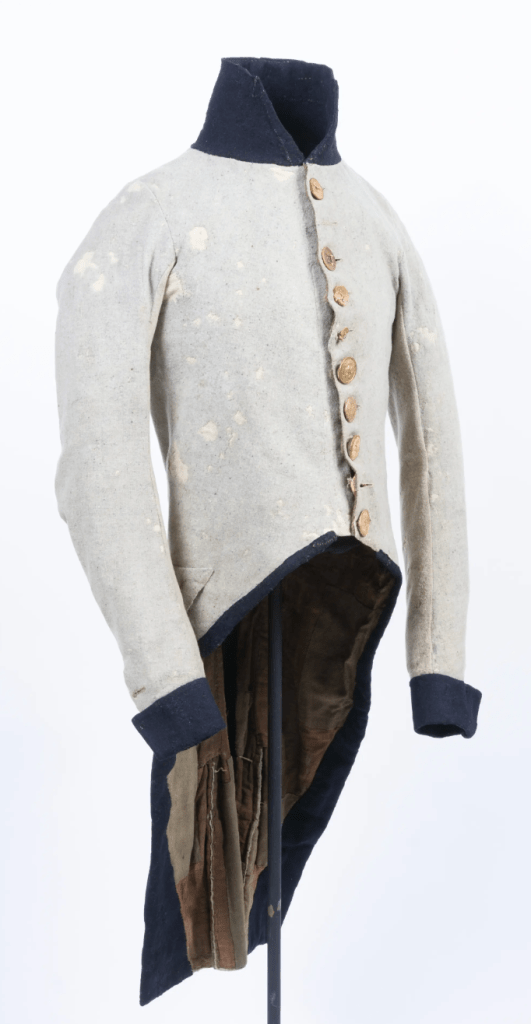

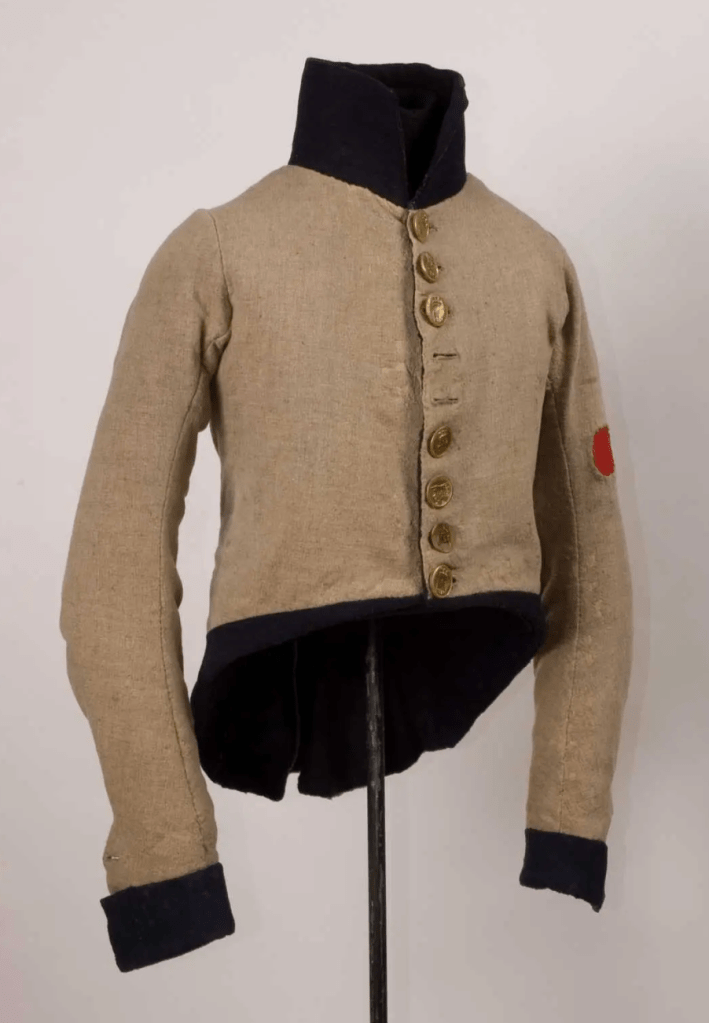

It used to be commonly assumed that the uniform of the 1802 model, which featured a plastron with two rows of buttons over the chest, was still used by many, of not most regiments in 1808. Indeed, there are a number of old illustrations of this uniform which give this rather misleading impression and they also circulate widely around the internet. The 1802 uniform jacket was blue with yellow, red and white facing colors, in different combinations for different regiments of the Swedish army. For example, the Hälsinge regiment had all white facings, while the Västerbotten had red collar with white turnbacks, plastron and cuffs. Södermanland had all yellow facings, while the Jönköping regiment had yellow turnbacks and plastron, but red collar and cuffs. The Finnish regiments wore grey uniform jackets, with different facing colors in parallel to the Swedish regiments, so that Björneborg had light blue turnbacks, cuffs, collar and plastron. Örjan Magnusson has provided a more than excellent overview of these uniforms here, including photos of the official model drawings for the uniforms (highly recommended): https://tacitus.nu/karoliner/kallor/1802.htm
However, when the war started in 1808, some things had obviously changed. The difficulty lies more in trying to establish which new regulations were carried out in practice, and when. In early 1806, it was ordered that the jackets should have just one row of buttons and the plastrons be completely removed. In late 1806 it was ordered that all jackets be grey (Swedish as well as Finnish), with different facings for different regiments, but in January 1807 this was again changed to grey with dark blue facings for all regiments. This latter, standard uniform model is called the m/1807.
In theory, all Swedish infantry (with the exception of the guard) should have worn the 1807 model uniform in 1808. However, as often happens, this was certainly not the case. It is sometimes said that m/1807 was an unpopular model among Swedish troops, because of its unglamourous grey color. Indeed, it was abolished soon after the revolution, in the summer of 1809. However, it seems that several regiments wore this uniform at the battle of Sävar in August of that year; we know for certain that the Västmanland regiment received it late in 1808 and there is a preserved example belonging to an officer of the Jönköping regiment, for example. The author and participant in the war Ljunggren describes how and when the new uniform arrived to his regiment (Västmanland). He seems to have appreciated it, if nothing else because it was sorely needed as a replacement for the sad remains of a uniform that his regiment had used for almost two decades by that time, repaired and re-sown several times. Apart from Västmanland however, it is not clear (as far as I know) that any other regiment wore the m/1807 in Finland in 1808. On the contrary, for most regiments there is clear evidence that they had not yet received it yet. In one sad case, the Södermanland regiment, we know that their old uniform was so worn out that it was unsuable. But because there were no new uniforms available, they seem to have had to fight wearing a simple fatigue uniform at the battle of Sävar in 1809.

In recent years, it has been clearly shown (by Martin Markelius at the Armemuseum in Stockholm, among others) that the most common pattern in 1808 was the m/1806, i. e. a uniform jacket with blue main color and the older variable facings, but without the plastron. Markelius studied the archival sources of the regiments of the Swedish division which arrived in Finland in August and subsequently participated at the battle of Oravais and other engagements. He found letters in which the removing of the plastrons from the old uniforms is explicitly mentioned for some units, and that it can be reasonably assumed that the same was done for the others. The color of the uniforms is confirmed by the eye witness (and keen uniform buff) Ljunggren. In other words, we are now largely agreed that most regiments wore the old uniform jackets, resown to the new standard (commonly called m/1806). This is also, thankfully, the model worn by the Perry miniatures Swedes, although at that scale, it is indistinguishable from the 1807, so that the figures can easily represent either variant.
Some uncertainty remains. I have only seen few references to the situation with the Finnish regiments. There is some conflicting evidence: there is a color drawing by another eye witness, Adelborg, who was himself an officer in the Nyland dragoons. He depicts one particular soldier who looks like he could belong to the Björneborg regiment (light blue facings), wearing a plastron on his jacket. However, it is not clear what the date is for this drawing. It may have been drawn from memory at a later date. It is not certain that this is a representation of a scene that he witnessed, it may rather be an idealized illustration of the magnanimity of the de facto commander of the Finnish troops, Adlercreutz. It may portray an event some years previously – I dont know.

This blog entry https://kaponieeri.blogspot.com/2018/11/suomen-sodan-sotilaspukuja.html gives an example of a preserved Åbo regiment uniform with plastron, which is in a Finnish museum. I dont read Finnish, but as far as I can tell by the efforts of Google translate, there is no exact date given. However, by biographical data I was able to surmise that the man who is supposed to have owned the jacket was discharged from the regiment as early as 1802. As a side note, I learned that automatic translations from Finnish leave much, indeed very much, to be desired, despite recent supposed advances in that field…
Being of a curious nature, I have been doing some digging after sources for Finnish uniforms myself. This will hardly be revolutionary, but I have looked at a source which is not so often mentioned in the literature, but is very interesting: portraits (mostly miniature portraits). There are a great number of miniature portraits from this period by great artists, such as Gillberg. They tend to depict officers, but sometimes of relatively modest ranks. This way they can tell us something of the uniforms as actually worn – and the artists often seem to have captured many fine details. On top of that, they are often dated by year, which is also very useful.
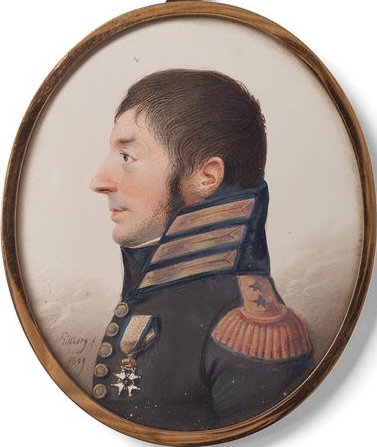
While searching various museum databases and auction catalogues, I have found that the model 1806 uniform is easily identifiable in many portraits from the years 1807 and 1808. I have not found a single example of the 1802. However, examples from the Finnish regiments are fewer (prestigious Swedish guard regiments are very much over-represented though). I did find one interesting example of such a portrait and it does confirm that at least the officers (some officers?) of the Björneborg regiment wore the m/1806 uniform in 1808. This particular portrait, of Henrik Gustaf von Qvanten, is perfectly detailed. I only wished I had access to a color image – as I understand it, the painting is in a private collection in Finland. Nonetheless, we can identify the uniform as m/1806: the color is lighter than the dark grey of the m/1807; we can count 10 buttons, where the 1807 had only 9 buttons. There are also preserved uniform jackets from both the Åbo and Nyland regiments, and both those examples have a single row of buttons. I have yet to see an example, either in a comtemporary image or a preserved jacket, of the Tavastehus, Savolax or Österbotten regiments. From the preserved examples, there seems to be little noticeable difference between the Nyland and Åbo regiments – in theory, Nyland would have had mid-blue facings, Åbo dark blue. Björneborg had a light blue facing color. Eben’s 1808 uniform plates show Åbo in the m/1806 and also Savolax jägers and Finnish artillery regiment wearing the same model (no plastrons). Indeed, from what evidence that exists, there is very a good case for Finnish uniforms being of the m/1806 without a plastron in 1808.
There are a couple of further things one could mention here. First, I would not rule out the possibility that plastrons and single button row coats could have been worn by members of the same unit. In particular, one could imagine that officers would have had acquired new uniforms sooner than the men. Markelius argues against this and he has a point: officers would probably try to see to it that the regiment was as uniformly dressed as possible. Furthermore, there is evidence (JEO Screen mentions this) that officers, especially in Finland, would make orders for new uniform cloth collectively, in order to get a better price. However, one can still imagine that officers and men had different model uniforms, indeed there is evidence of some complaints that officers, as it were, customized their kit quite liberally.
It shold be noted though, that miniatures wise, this does not matter all that much. On the Perry figures, much of the chest of the figures are covered in belts, so that a plastron can be imagined to be obscured. For some units, like Österbotten, the plastron was also in the same color as the jacket, which makes the plastron issue a minor thing, at least on the common soldier figures. As has been stated already, having officers in the 1806 model will hardly be wrong, even if you would believe that the men still wore a plastron.
Finally, it can be worth mentioning that there are a number of reenactor groups who have created their own uniforms, a couple in Sweden and at least one in Finland. The Finnish reenactors, of the Österbotten regiment, actually seem to be wearing a mix of uniform jackets, some with two, some with just one row of buttons. I dont know the reason for this, but one can assume that they have done their homework. The Swedish reenactors who wear the uniforms of the Uppland regiment include Martin Markelius himself, and consequently, they all wear one row of buttons on their jackets. The reenactors of the Västerbotten regiment do the same.
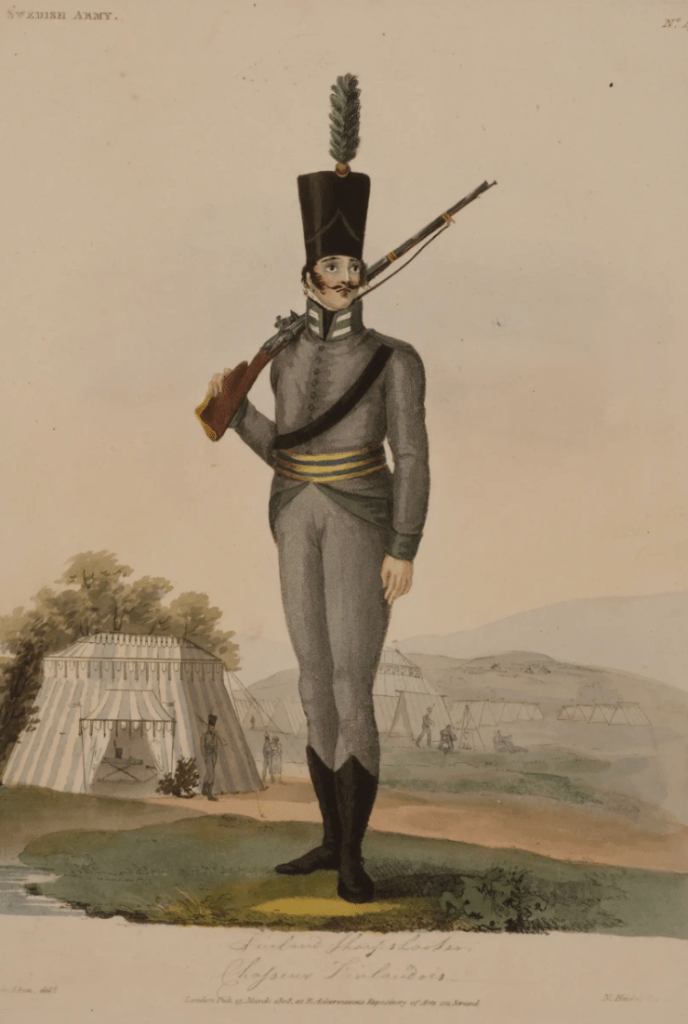


While I was searching, I also came across something I had never seen before – a portrait which seems to show an officer wearing the m/1807. The portrait is not surprisingly dated to 1809, which as I understand it was the only time when a relatively large part of the Swedish army was actually wearing the m/1807 in battle. Ironically, by the time of the last offensive in Västerbotten, when the new uniforms had actually reached the troops – who surely needed them – this model had already been abolished in favor of a new blue jacket model (subsequently called m/1810).
Rank insignia of officers
Collar distinctions
Captains and lieutenants wore stripes on the collar of their uniform jackets. A captain wore three stripes, a lieutenant two and a sub-lieutenant one stripe. As far as I can understand, these stripes were in the button color (which means that I have painted most of mine wrong).
Generals wore stripes of oak-leaf around the edges of their collars: a field-marshal (4 stripes), general (3), lieutenant-general (2) and major-general (1).
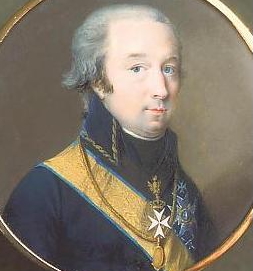
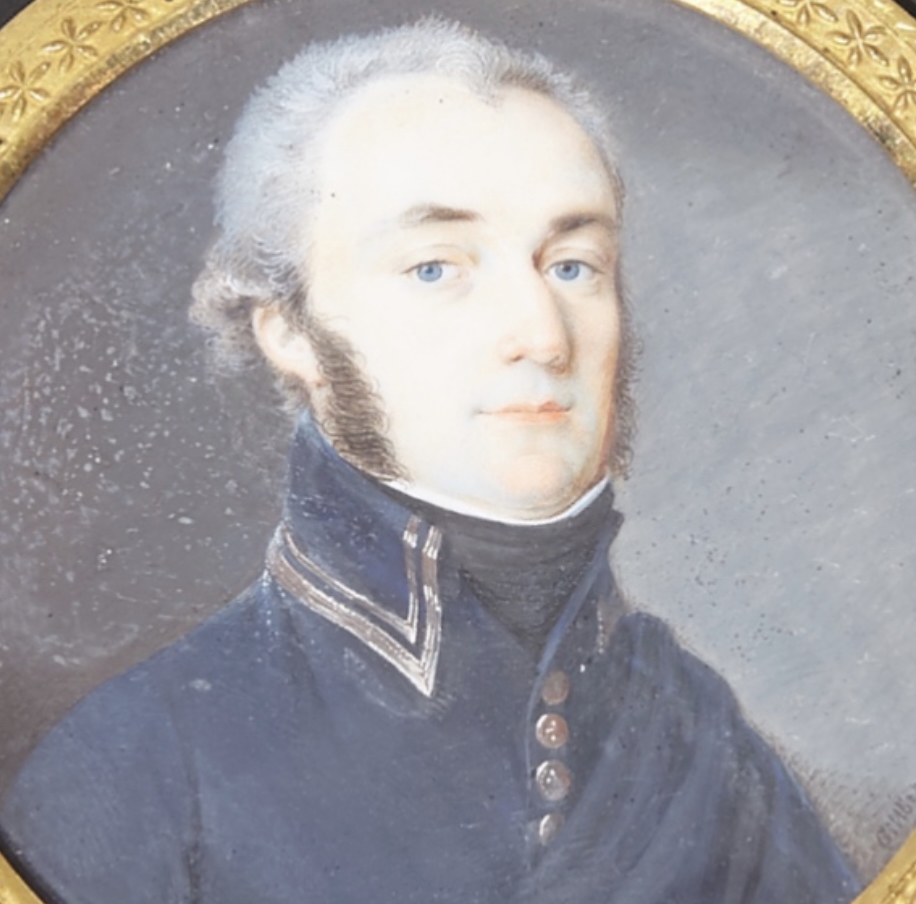
Adjutants, who wore the same uniform jacket as generals (m/1801), had straight lines instead of oak-leaves, otherwise in a similar way differentiating between ranks with varying numbers of lines.
Epaulettes
According to the regulations enacted in 1795, epaulettes for officers were distinguished by rank with a system of crowns and stars, and with different quality of the fringes. The color of the epaulettes was according to the button color of the uniform. In some portraits, it looks like silver fringes are worn with gold epaulettes. This doesnt seem to correspond to the regulations, maybe the thin fringes just looked lighter than the epaulette itself and therefore seem silver in comparison.
The lower officers (kompaniofficerare) wore epaulettes of silk, but they had no fringes. A captain wore two stars on the right shoulder, and one on the left. A lieutenant wore one star on each shoulder and a sub-lieutenant one on the right; an ensign wore no stars on his epaulettes.
Regimental officers (regementesofficerare) all wore fringed epaulettes, with fringes made out of silk. A colonel wore three stars on each shoulder, a lieutenant-colonel three on the right, two on the left. A major would wear two stars on each shoulder.
Generals wore crowns on their epaulettes instead of stars. Their fringes were made from metal. A field-marshal wore three small crowns with a large crown over them on each shoulder; a general three small crowns on each shoulder. A lieutenant-general wore three small crowns right and one large crown left. A major-general wore one large crown on each shoulder. Looking at the portraits above, it is easy to see that these guys wear fringes on their epaulettes together with stripes on the collar, which they really shouldnt have!
I have provided a pdf of this post below. The formatting did not come out very well in the conversion, but I hope it is at least readable.
 Pancratist
Great post! Can one get it as a PDF?
LikeLike
I would love to, but I dont think I know how to do that.
LikeLike
Hej, Jag har nu lagt upp en pdf. Den är inte vacker men den borde gå att ladda ned i alla fall. Har inte gjort detta tidigare så det var ju kul att testa hur man gör. Den ligger längst ned i posten.
LikeLike
Great! Thx for the PDF option!
LikeLike