As I am painting a lot of figures for the Finnish war, with the aim of recreating some of the battles of the summer of 1808, there are a few specific terrain items that I need. Recently, I did some typically Scandinavian fences (gärdesgårdar). I will need even more, as such fences were built around even the smallest patch of land in Finland in 1808 – there was some law or ordinance which made this practice favorable for the peasants (dont ask me how exactly!).
Two other typical terrain features were bogs (mossar, or myrar in Swedish) and förhuggningar. The first of these is a natural feature of the Finnish landscape, while the second was a common form of simple, improvised defensive work.
Bogs are characteristic of northern and central Finland. Unsurprisingly, the first man to scientifically categorize different types of bog was a Finn (Carelian parson Jacob Stenius, also known as “Bog-Jacob”). He even put his expertise in bog-science to work for the government and contributed to the improvement of border defenses in eastern Finland in the middle of the 18th century. This may sound like something out of Monty Python, but it is quite true!

Needless to say, bogs were important in the war of 1808. Wetlands were part of the battlefields of several of the most important and well-known battles, such as Oravais, Jutas, Rouna-Salmi and Karstula. The battles of Parjakanneva and Kokonsaari are named after the bogs on which these battles were fought. The battle of Kokonsaari in particular is worth mentioning. Here the Russians are reported to have waded through the wet ground with mud up to their knees. Despite this, the Russians defeated von Fieandt’s small detachment after a bloody battle (casualties were proportionally among the highest in the war).


The bogs were not particularly difficult to make. However, I did need very large bases for them, as these will often need to fill up a large part of the gaming board. I made the bases from masonite type board. It is very useful, but can be difficult to cut. After some testing with different tools, a metal saw turned out to be a reasonably effective method because of its fine teeth. I sanded down the edges, painted the pieces with textured paint (hobby paint+sand+water), but left large spots empty for the pools of water. I then highlighted the ground with brown and then buff (Vallejo Dark Sand), and the pools blue. I painted the edges a brown green and flocked the whole thing with various Woodland Scenics materials and grass tufts.
My original idea was to add Vallejos Still water product over the pools (and perhaps parts of the grass too), but I must have misplaced the bottles – I just couldnt find them, although I am sure I bought some a while back. So that will have to wait. I was reasonably happy with the result anyway, although maybe the pools are a little too blue for a swamp.
Many of the above mentioned battles also featured the second type of terrain piece, so-called “förhuggningar”, which is something similar to what is known in English as an abatis. These simple fortifications are mentioned many times in the sources, but they were probably variations on a theme. They seem to have served different functions. Sometimes, trees were felled in order to clear the line of sight for artillery; in other instances, felled trees were used to fortify defensive positions. Sometimes, perhaps, these two functions could be combined. The use of wood has of course been a feature of war since the earliest times. Finland is, and was, covered in forests to such an extent that this must have been a very expedient means of preparing defensive works. This was certainly the case in 1808.

These were made in a similar way to the bogs. The tree stumps are resin pieces I bought somewhere some years ago – the rocks are just, well, stones. I will add some natural twigs to look like felled trees over the bases. I also have some smaller resin log piles and log-and-earth fortifications made by Baueda. Together they will make up some nice förhuggningar for my Finnish campaign – or why not eastern front ww2 games.
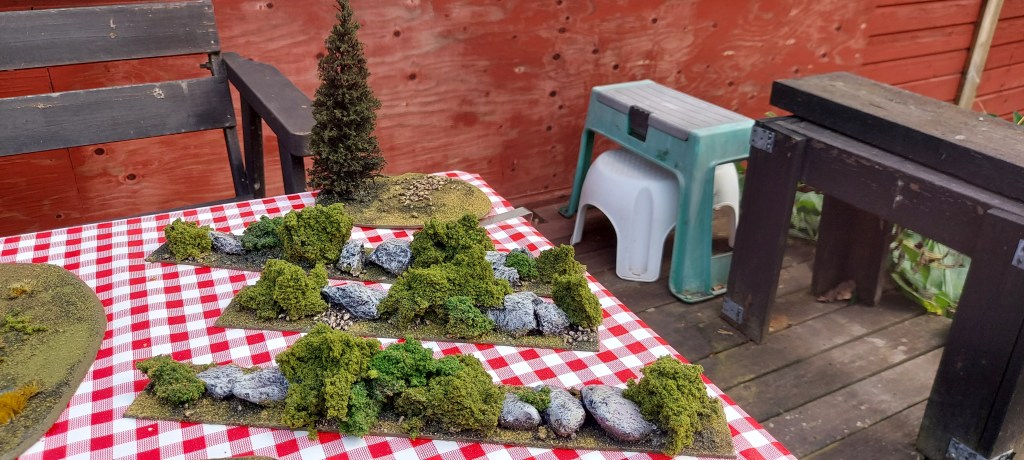
While I was at it, I also flocked my recently painted houses and did some other small pieces, such as the rock-and-bush sections, and some more bases for my trees.

 Pancratist
I am loving the terrain! My bogs pale in comparison. I did get some 15mm gärdesgårdar from Sabotage3d which looks great. Building the fences in 15mm was way too fiddly. May I ask what rules that you would use for the battle of Kokonsaari, Forsbyå and Artjärvi? I feel like most rule sets are designed for Division sized actions and Sharp Practice is too small scaled.
LikeLiked by 1 person
It will probably be Black Powder or Valour and Fortitude. Maybe with some adjustments, but they are so simple and adjustable it will probably work OK. Even though this was something like one brigade vs two brigades in size, there will still be around 8 vs 10 units on the table.
LikeLike
Sorry I meant Kuuskoski which was also fought in a Bog. I am still leaning, but your blog has been a huge help.
LikeLike
Ive focused on the relatively large battles, where there are at least a few battalions involved. In the BP Rebellion supplement, the author shows quite nicely how to scale down things, where he sometimes has small units representing companies rather than battalions. However, for very small skirmish games, another rules set would probably be called for. Ive heard that Rebels and Patriots is a good game, but I have never tried it. Sharp Practice is an option to, but Ive only read through the rules, never actually played them.
LikeLike