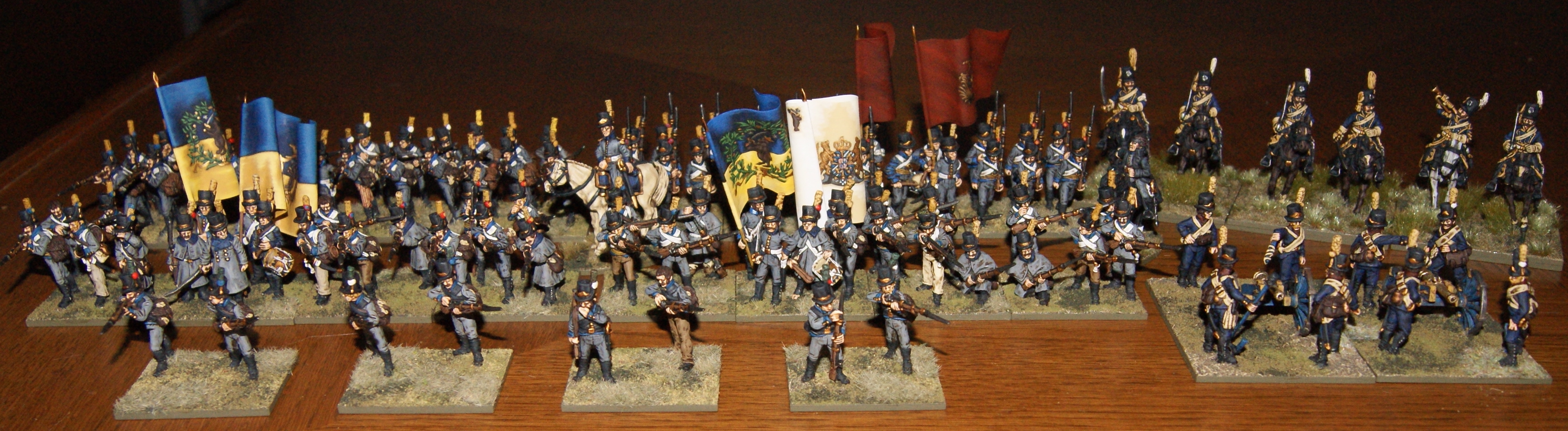
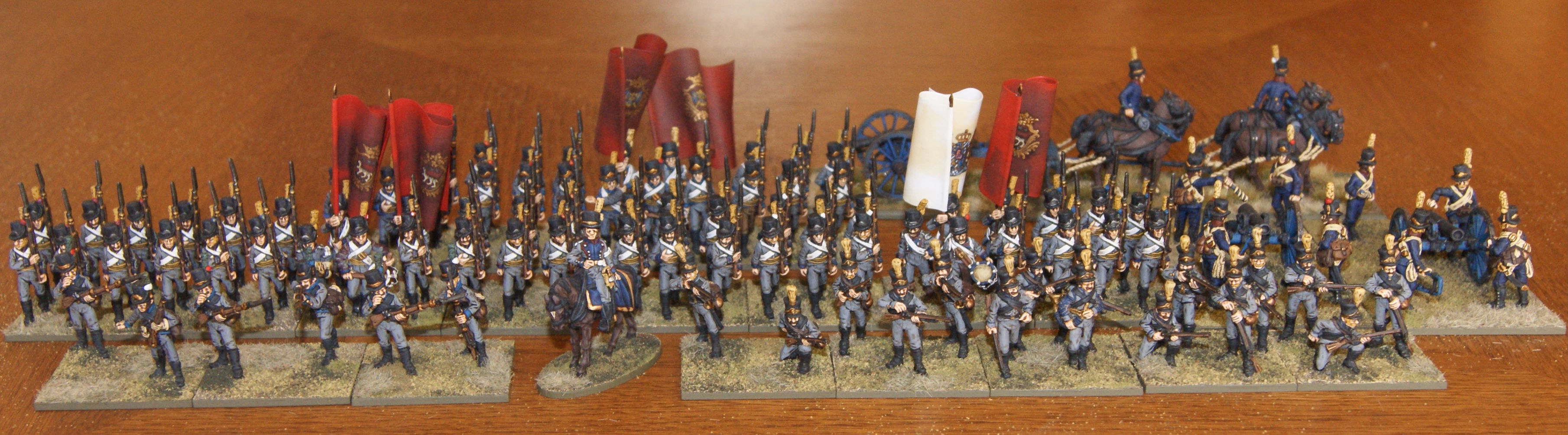
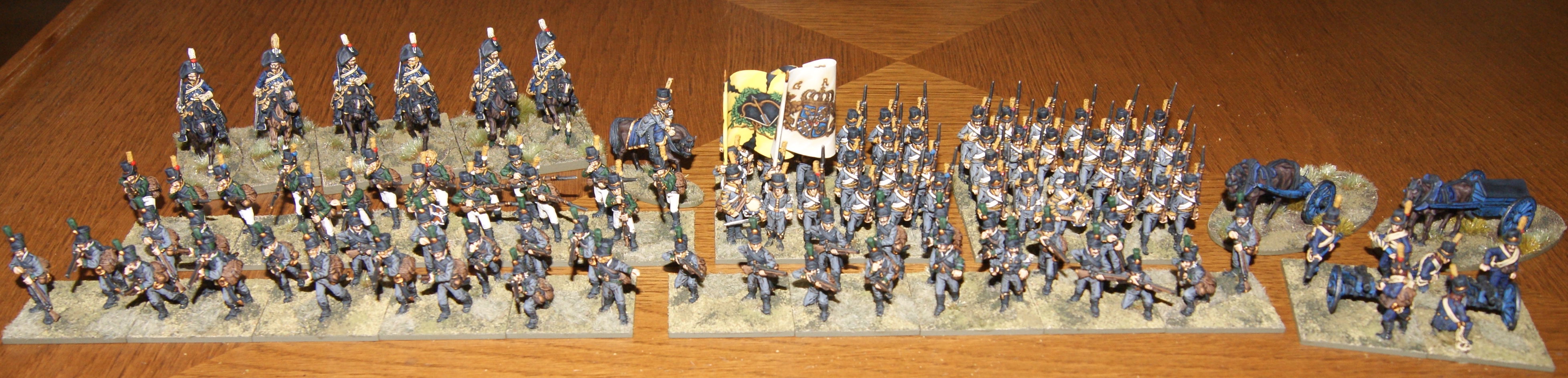
There it is. Pretty much the whole of the core, Finnish part of the Swedish 1808 army, the 2d-4th brigades (the understrength 1st brigade effectively being included in 2d brigade). Each brigade is around 100 miniatures strong. This roughly corresponds to at least a 20:1 ratio as compared to the historical forces.
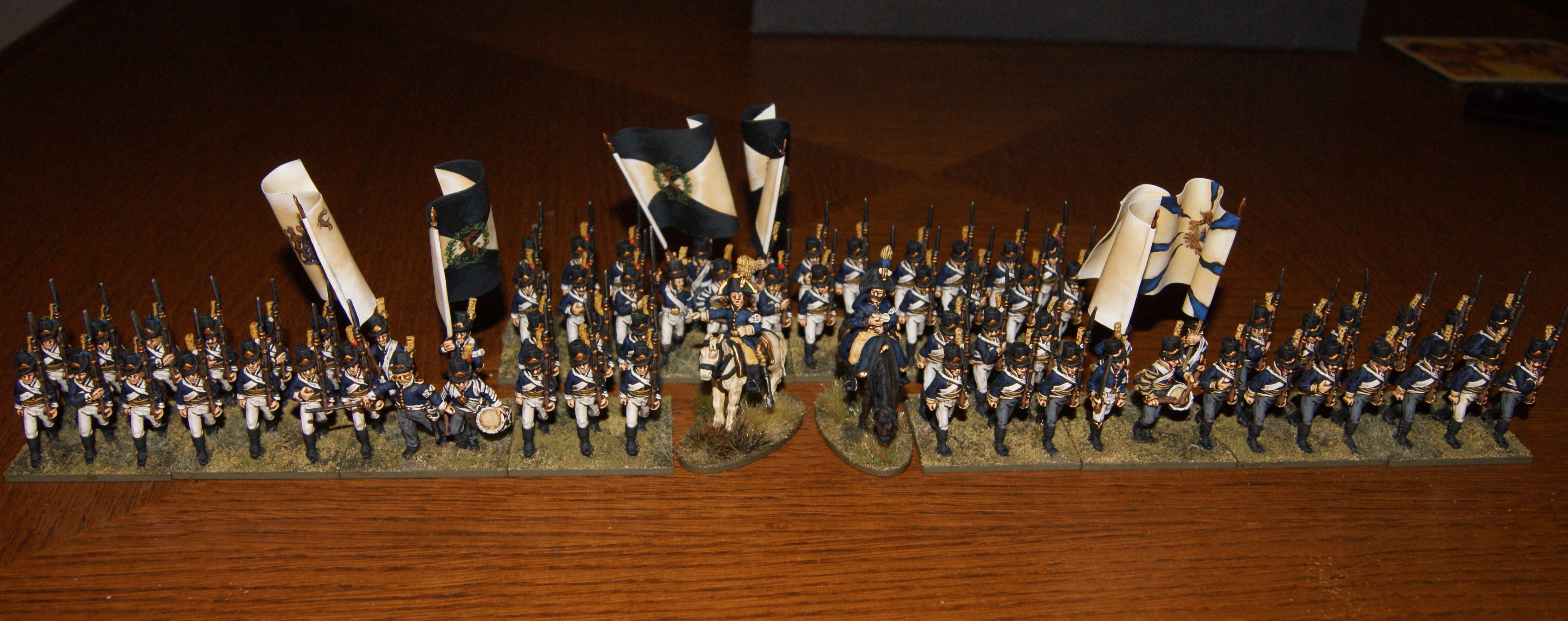
Below the three Finnish brigades, I have also taken a photo of the Swedish battalions I have done so far. These are most of 2d and part of 1st (Swedish) brigades.
Someone asked me how I decided on the size of the units. That is a good question and the answer is actually not very straightforward. A common ratio of miniatures to historical soldiers is 1:20. However, if one holds strictly to such a ratio, the numbers of figures will vary wildly and a basing system with 6 figures to a base will have to go out the window as soon as you start putting your force together. Ive seen people writing up historical scenarios detailing the exact number of figures per battalion, such as in The Last Summer and The Turning Tide scenario books for Finland 1808 by Sword and Sabre (publ. 2009). An example from those books looks like this:
(Russian vanguard under Kulnev, April 1808)
1 battalion 23rd jäger regiment, 16 figures
2 companies 26th jäger regiment, 14 figures
2 companies 24th jäger regiment, 9 figures
As you can see, none of these units can be represented with a basing solution using 6 figures per base. Only the first could be represented using bases of 4. So for practical purposes, there is no way that anyone would play according to a strict ratio like this. Instead, it is necessary to adopt standard unit sizes.
I started out planning to do standard infantry units of 16 figures. I based them on single bases which fit in movement trays. Originally I had thought that the figures might be used for a skirmish type game as well as a division sized pitched battle and tried to accommodate both. At that time (around 4-5 years ago), I regarded painting even a brigade of units of that size to be a mammoth task that I was unlikely to ever finish. Up to that point, I had painted mostly WW2 figures in platoons of maybe 30-40 figures, consisting of a few units of 8-10.
After a couple of years of painting the 1808 figures and playing a few games, I realized that the basing and unit sizes were not ideal, for several reasons. The skirmish type game never really happened. The basing system with movement trays was impractical and annoying, as the figures never really stuck to the trays well enough. I also realized that the standard for Napoleonic gaming is 24 figures per unit (minimum). And in this world, keeping to an established standard is key. Napoleonic wargaming is not huge in Sweden, and games have proven to be few and far between.
Anyway, I found that 24 men per battalion was a good standard, while aiming for a very approximate 20:1 ratio. I base the figures 6 men to a base, with a 15mm frontage per figure. This works very well for the marching pose, although I tend to put only two figures in the second rank of the command base, to leave some room for the somewhat over-sized flags!
However, many of my figures are in a firing line pose. With a 15mm front, such figures will fit on the same type of base, but I found that the bayonets tend to stick out from the base or in front of the face of the next figure. This looks ridiculous and can make it difficult to arrange the bases in practical formations, which is useless in a game. So for the firing line poses, I have fewer figures per base (4 or 5). For the jäger units (which were almost invariably smaller anyway), I have only 4 figures per base. I also have a few bases of three figures and many bases of 2 figures. These are of course meant to be used as skirmishers, but in combinations they can also represent smaller units. Many scenarios for 1808 include half battalions or smaller detachments of just a single company. I think that the basing I have done for the Finnish troops will be useful for many situations and rules sets. For the Russians, I still need to add some more skirmish bases (I am still in the process of re-basing and beefing up some of the old units).
Ive re-based everything except the cavalry. This is fine for the moment, as Finnish cavalry was so few in number that 6-man units is good enough in most cases. However, further on up the road, I will probably want to make them into 9-man units (maybe 12 for Nyland) and base them slightly closer together.
I am very happy with the way the basing looks. I think it looks better than before, even though I have now simplified the basing somewhat. I used to base the individual figures with gravel before I primed them; now I base the painted figures and then cover the bases with Vallejo’s earth texture product. When that is dry, I drybrush it slightly and then add the basing material. I used to put single tufts of slightly taller grass on the bases first, then the fine turf material of various types, and finally some static grass. For these, I just omitted the tufts, and it works just as well. This way, the ground looks very much like Nordic wood- or bogland of the meager sort you find in many places in Mid- to Northern Sweden and Finland. Ive been thinking of adding small branches and clump foliage to imitate spruce and pine scatter, but that will have to be done at a later date.
The guns of 2d brigade still lack a limber team. I have planned to do this, but it will require some slightly difficult conversion work. The Swedish 3-pounders had three-horse limbers of a type for which there are no good proxies available. But it should not be impossible.
The next step for this project is the Västerbotten and Österbotten regiments, which were partly outside the brigade structure, but were deployed together with the Finnish regiments. For my purposes I will only need one battalion each of these regiments, and I have in fact already painted about half of the 2d Västerbotten battalion.
After that come the two Swedish brigades, of which one is already pretty much done already. The Swedish brigades were slightly smaller than Finnish ones, so they dont require quite as much work. After that, Gyllenbögell’s corps (equivalent of a brigade) is an interesting project to try. What is slightly mind-boggling is the number of battalions this would amount to if all of it was indeed painted at some point in the future. The thought that I would have 25 fully painted battalions…
However, before I add more to this lot, Id better paint some more Russians for them to fight! I will never need quite as many Russian battalions in total, but they are seriously outnumbered at the moment. I also happen to have something completely different in the works… Stay tuned!
 Pancratist