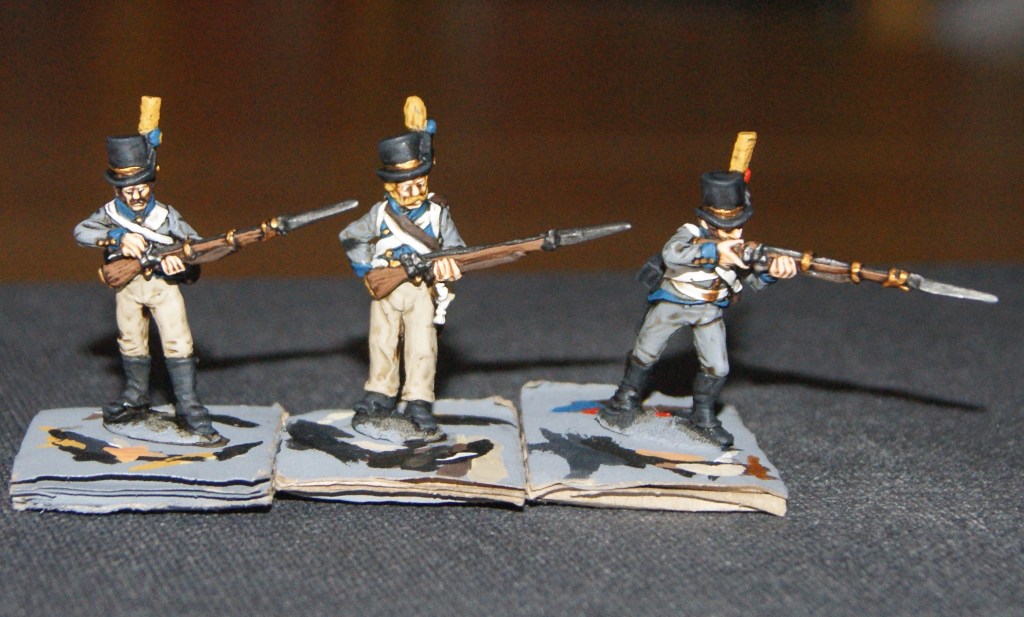
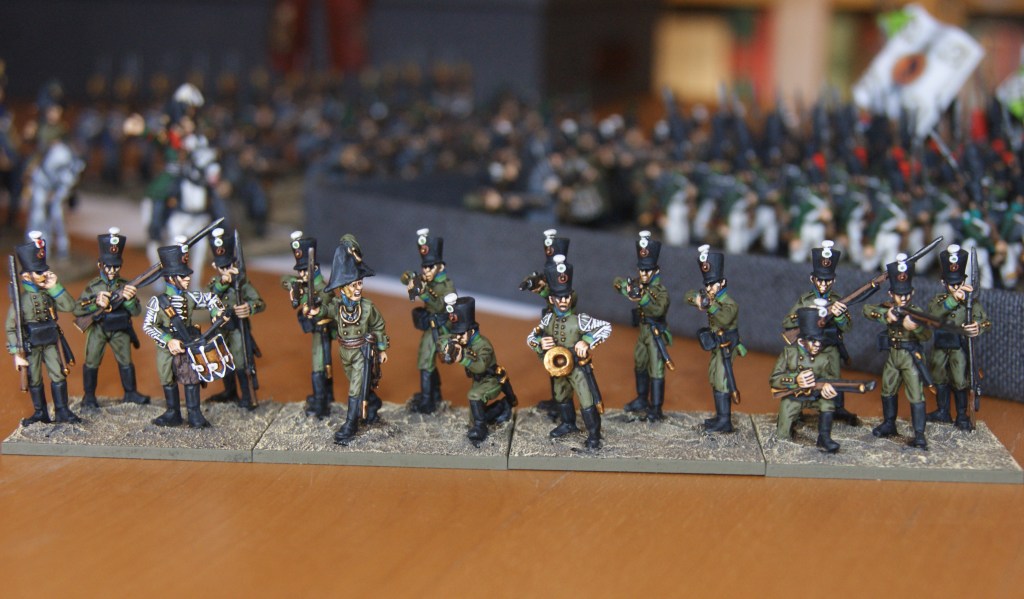
These are the Perry miniatures Nyland jäger figures. I really dont know how these should be painted. There are conflicting descriptions of their uniform in different sources. I decided to go for a practical option and paint them to look different from the Savolax jägers (who have green facings and a green plume). In this way at least they will be clearly distinguishable as different units when gaming. The figures are very nice, with the rifles being obviously modelled on the Helvig model 1804 rifle (in the Swedish army museum and digitaltmuseum.se). The level of detail on the rifle is an example of what makes the Perry figures so good.
At the moment, I am working hard to finish the Finnish (sic!) part of my Swedish force for 1808. The aim is three small brigades with 3-4 infantry units and one battery in each.
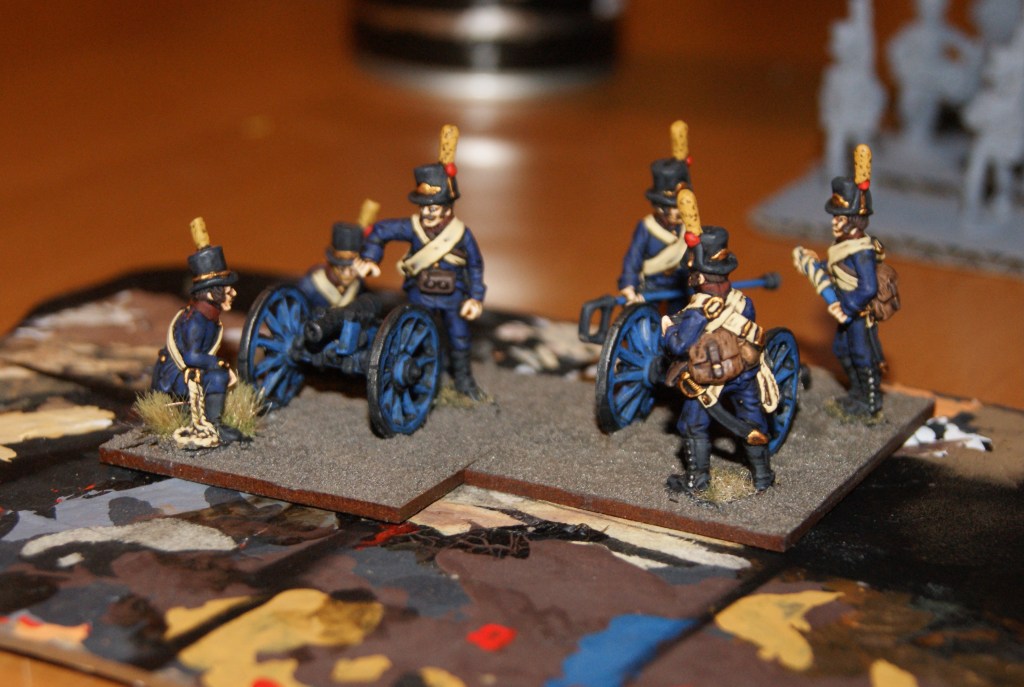
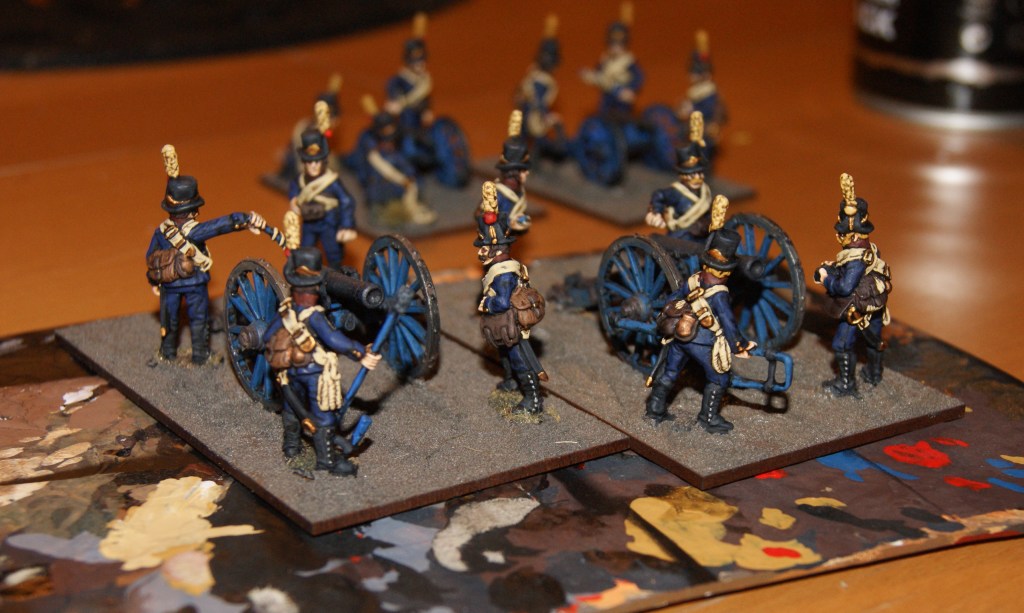
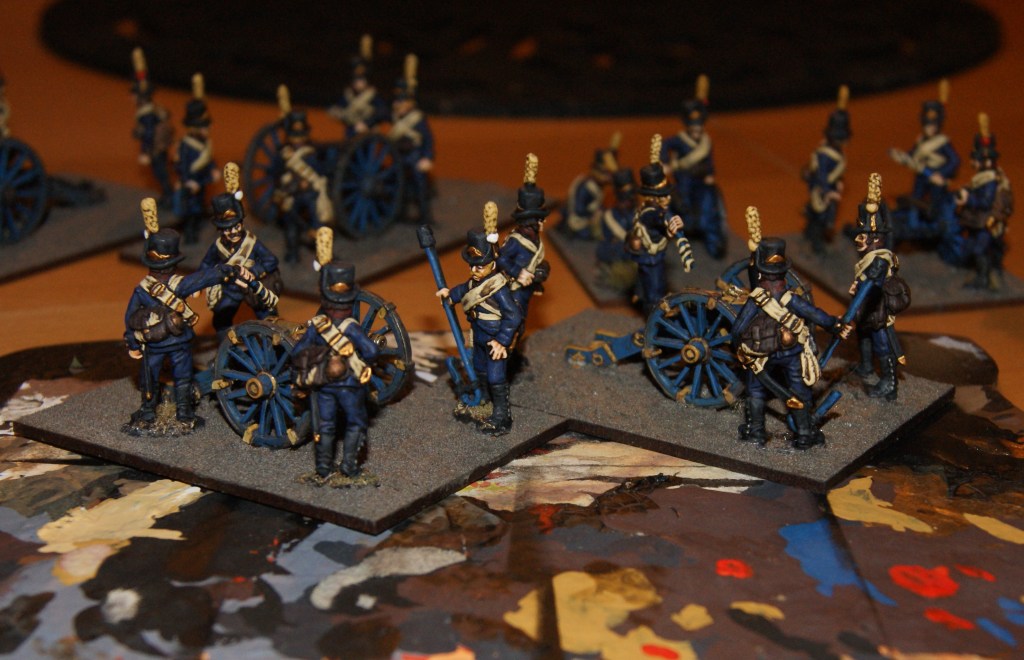
The artillery lacks a few figures, one cannon and one limber set, the aim being three two-gun batteries with limbers. The pieces are of three different types: a 6-pounder of the 1804 model (made by Perry miniatures); a 3-pounder field gun of an older type and finally a small battalion gun (referred to in Swedish sources as a “partikanon”, i e literally “raiding party gun”). The two latter types I made from a Perry AWI French 4-pounder and a Foundry AWI “grasshopper” (the smallest gun I could find). They are similar to preserved examples which can be seen on digitaltmuseum.se. Most artillery was painted blue and black at this time, but older holdovers from the 18th century would have retained the older blue and yellow scheme.
I used three different base sizes to correspond to three different types of gun, which I think was quite a good solution. Ill do the same for the Russians, although probably only use the larger two bases, as the smallest Russian gun is similar to the mid-sized Swedish one. The Russians also had 12-pounders of course, but I think they will fit nicely on the 6-pounder base – unless I want to differentiate them, by adding extra crew for example.
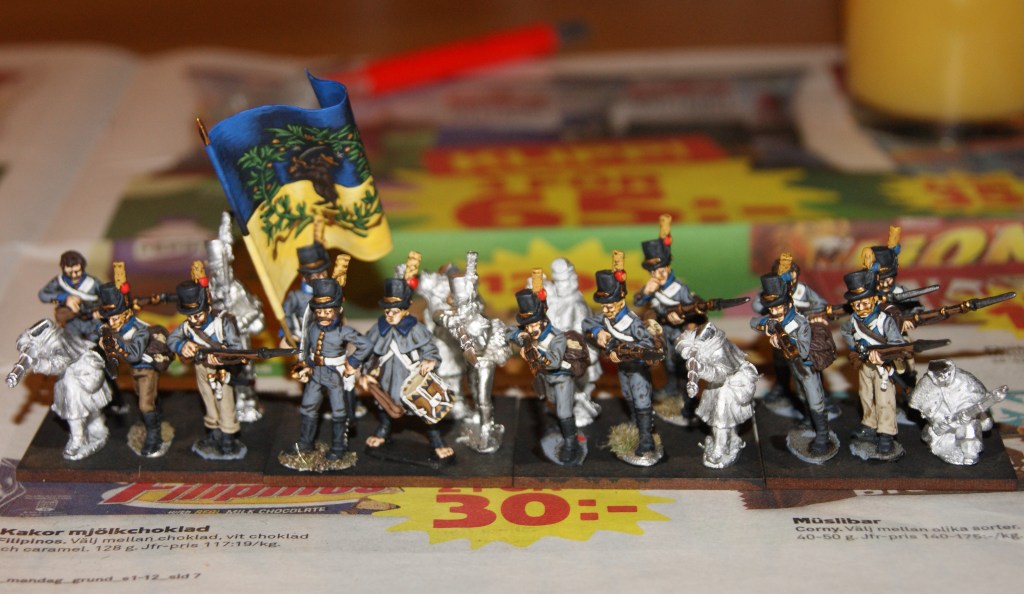
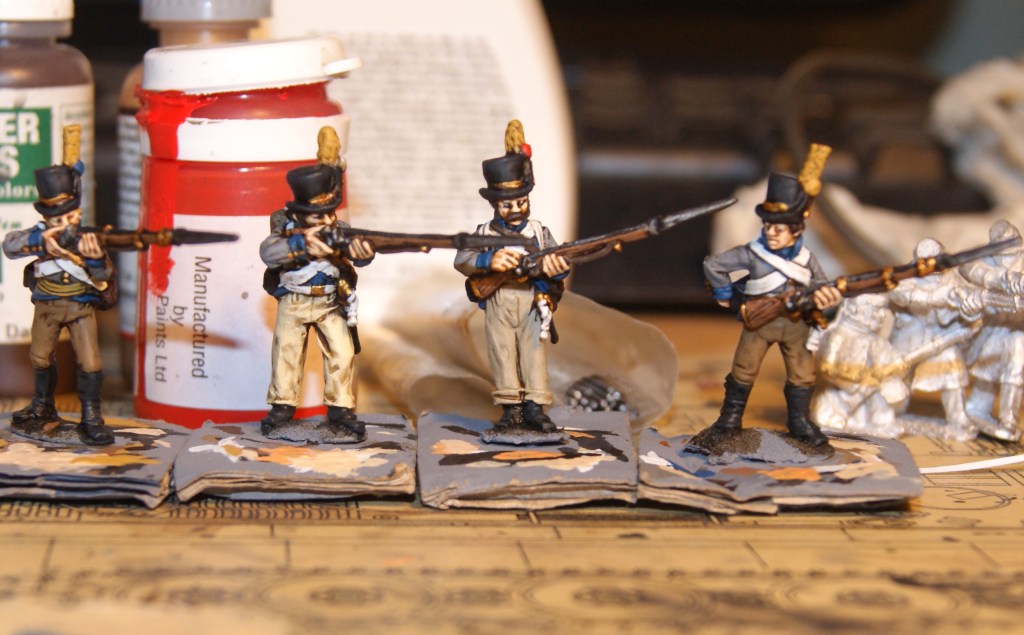
The firing line figures are tricky to base. I put the ones Id finished onto the bases to see how many more minis in what poses I need to add.
I am slowly working towards expanding my figures for the Björneborg regiment. I already had around 12 (now at 30!) painted figures, including one flag. As this is a regiment which featured in many important battles, both large and small, I will be needing many more, at least two battalions. For the additional figures, I am doing a few simple conversions and variations in the paint schemes to make the soldiers look more varied in appearance, and also appropriately worn and tattered.
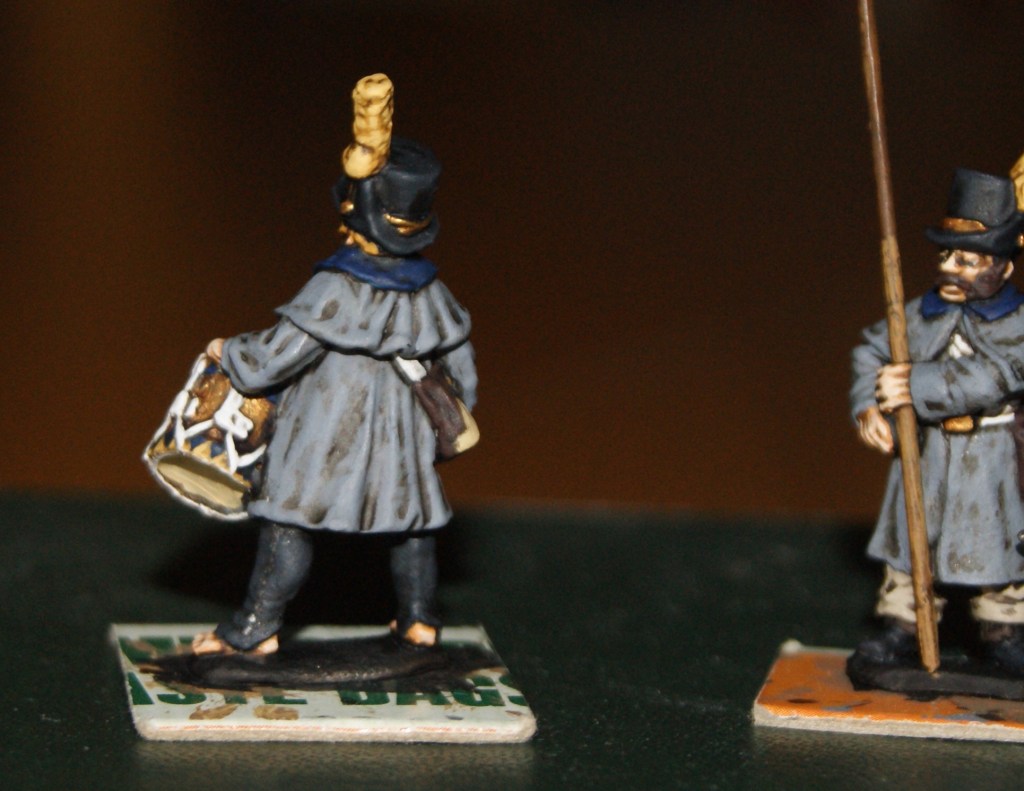
Some Swedes/Finns in overcoats. These figures could be almost any regiment, as the grey overcoat with blue collar was a universal model (matching the m/1807 uniform). The only thing giving away the Björneborg regt is the light blue collar underneath the officer’s coat. Officers and NCOs tended to use a surtout (which is what I tried to represent here), but they also used the overcoat as well. When wearing the surtout, the sword belt was generally worn over it, not underneath, as on this model. In fact, the surtout was (as I understand it) not worn over the uniform jacket, but instead of it – please correct me if I am wrong here anyone! The blue-and-yellow sash worn by other ranks was, on the other hand, as I understand it, worn underneath the overcoat. When not worn, it sometimes happened that coats were carried slung over the shoulder in the Prussian/Russian fashion. Coats were in high demand in Finland, understandably. However, only about half the soldiers had been issued an overcoat and many of those were of older, sleeveless types, which were much less practical. Historians tend to assume that various civilan coats were also used, but that is of course difficult to determine in detail. Especially officers used variant clothing; in Västerbotten in 1809, towards the very end of the Finnish war, this was especially evident. The multitude of variation does leave some room for artistic license when modelling these figures.The figures on the right and left were made from the bodies of Foundry ACW union infantry with heads from the Perry Swedes. On the figure on the left, I added gaiters with green stuff after carving away some of the lower trouser legs. Some minor details on the belts and water flask was also cut off with a knife. In addition, I added a bayonet to the musket, using that from the unfortunate dismembered Swedish figure who provided the head. The drummer comes from a pack of Perry miniatures “Ethiopians”, black slave soldiers in British service in the AWI. That figure lacked a collar, which was easily added using green stuff.
The officer seen above was made from the body from a Perry French guard grenadier pack. The head was swapped but little else was altered. With these figures, I am only trying out the feasibility of making Swedes in overcoats. Ill do 8-10 and mix them in with the Björneborg regiment. Later on Ill try doing a full unit entirely in overcoats, maybe even two.
Half of the above figures are made from Perry Spanish infantry, which wear jackets very similar to the Swedish uniforms in use in 1808. Even the hats are similar enough so that only very minor additions in green stuff was necessary. Some of the figures also wear backpacks, which is good as backpacks were used by the Finnish troops, although none of the Perry figures have them. To some of the soldiers I have also added short swords (leftovers from Warlord’s plastic Russians). The Swedish army abolished their short swords in the years before the war, but I imagine that some may have still been in use.
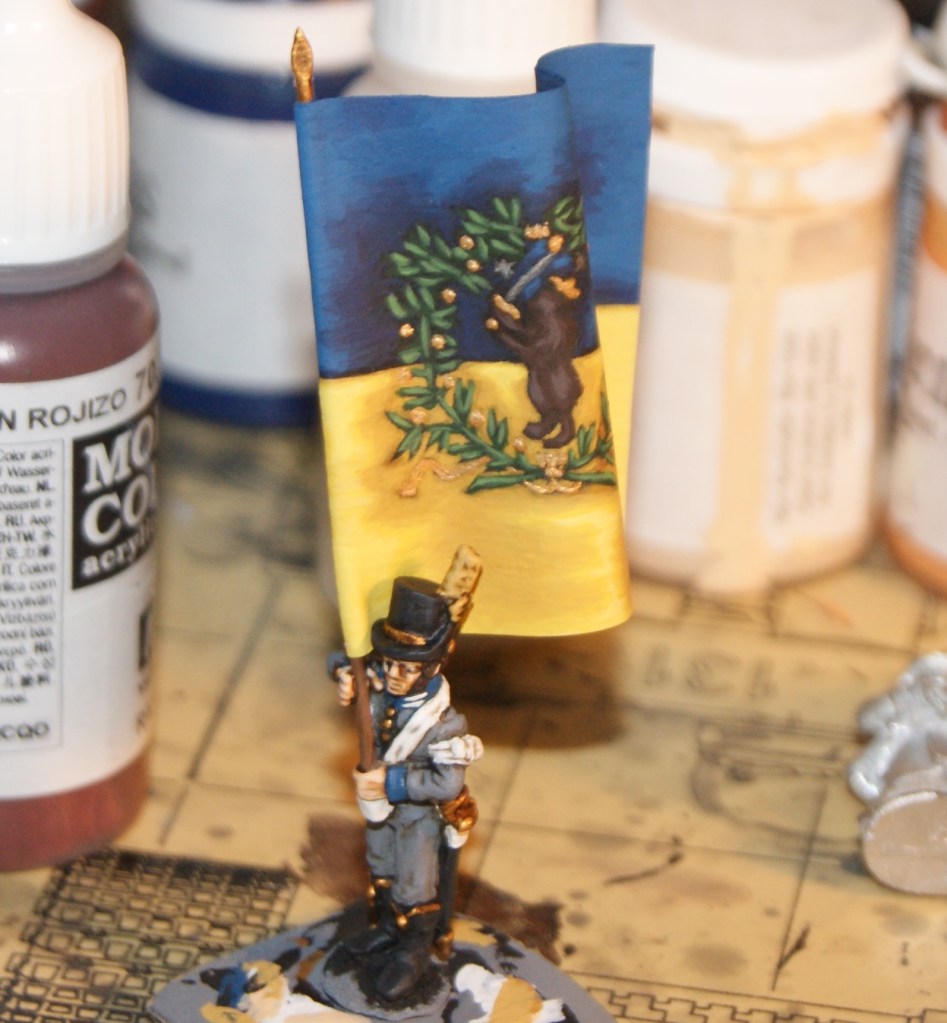
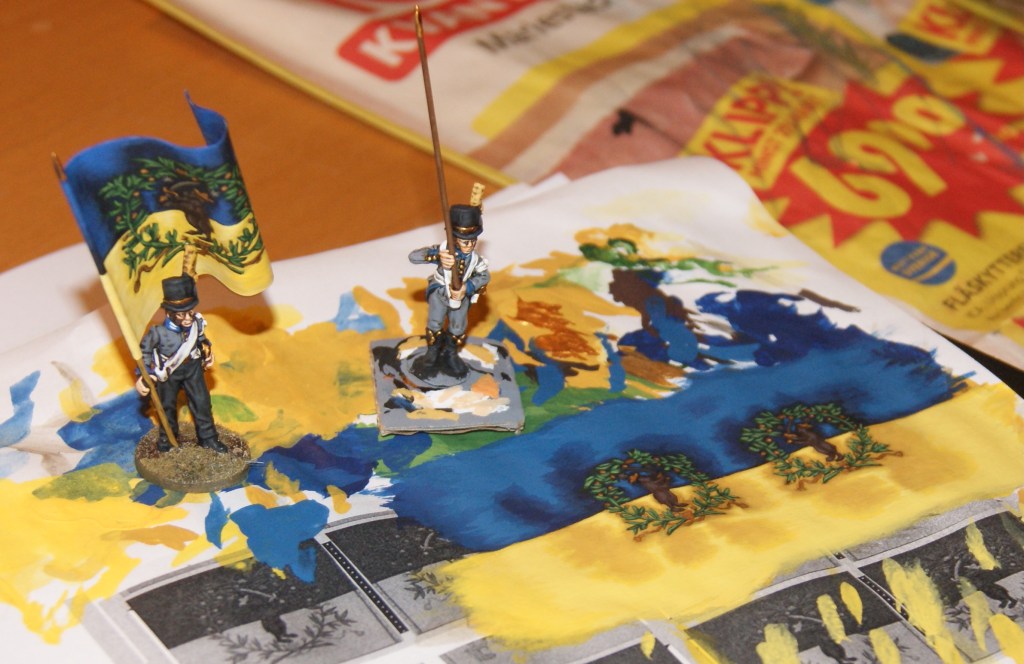
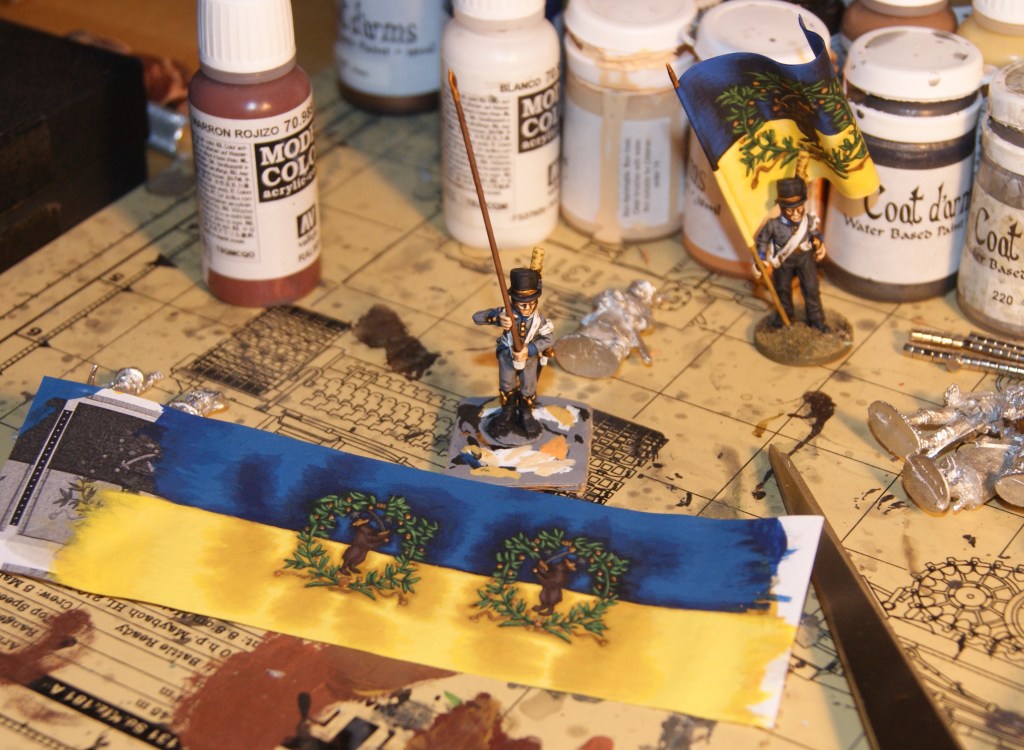
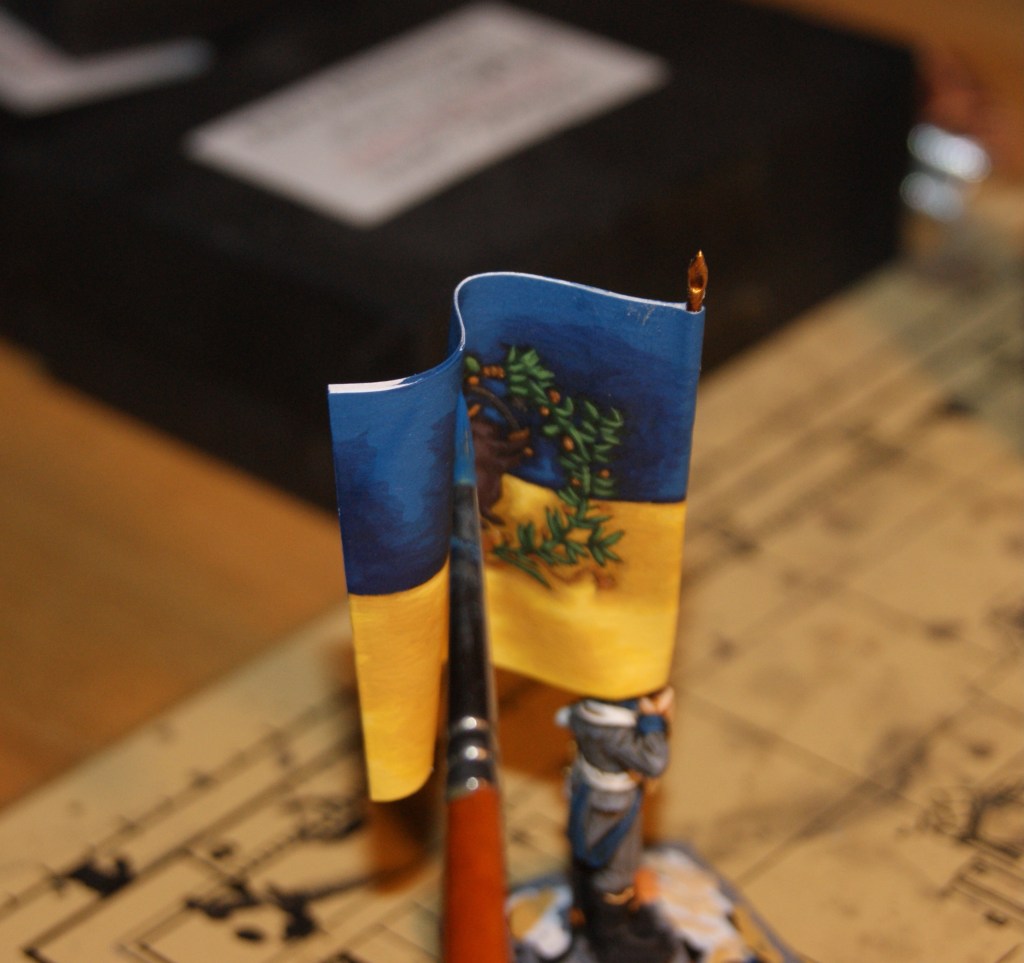
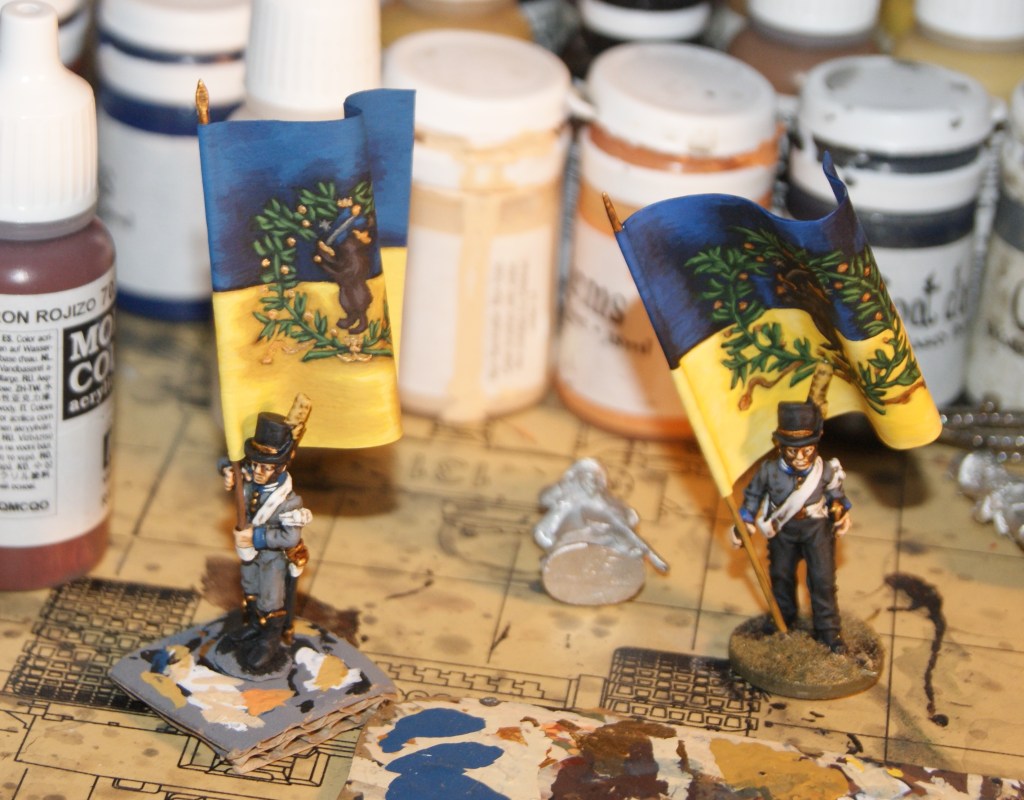
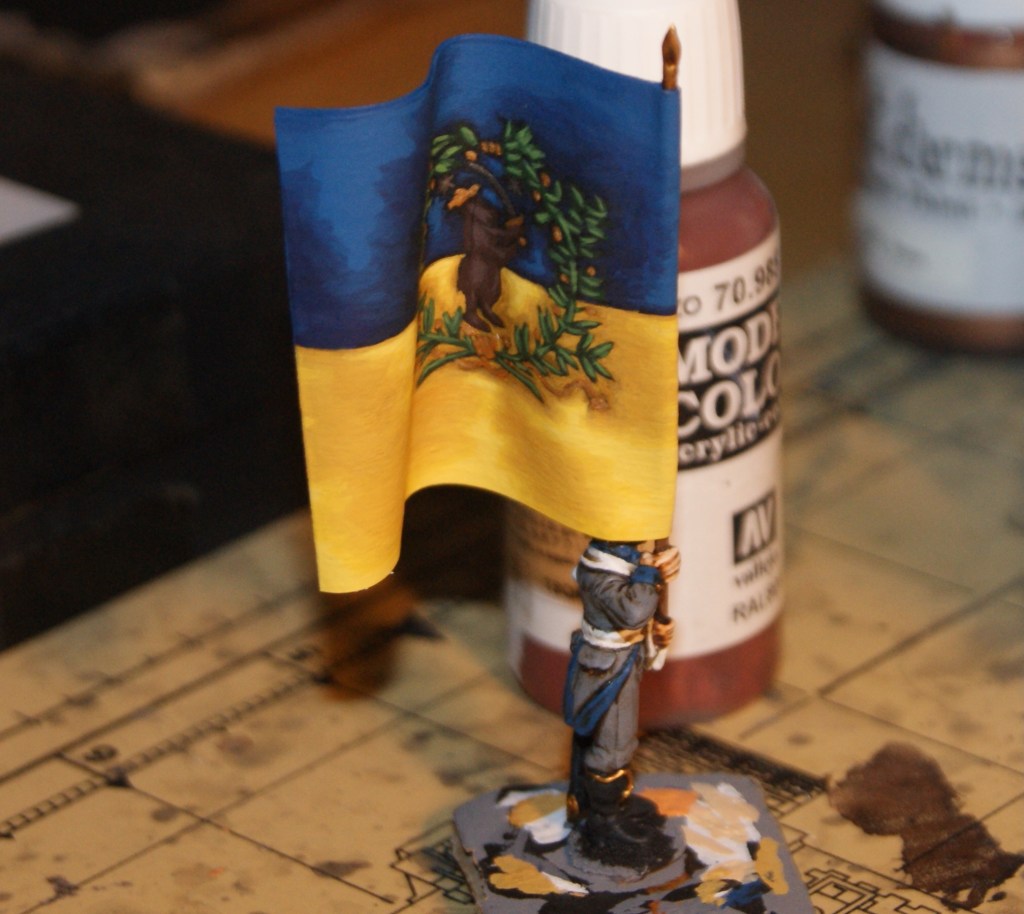
I have also painted a new flag for the Björneborgers. The old one I did a couple of years ago, so it was difficult to make the new one exactly the same. In this case, that is not a huge problem, as this particular regiment actually used flags of different models at the same time. They received one model 1766 flag in 1794, while the three remaining, including the king’s colors, were still of the old 1686 model. Even though the two flags shown below are a relatively good match, I may decide to put them in different battalions, pairing them with the king’s colors and the 1766 model respectively. A scan of the recently painted flag can be found in the flag post: https://pancratist.com/2024/09/14/swedish-infantry-flags-for-the-finnish-war-1808/
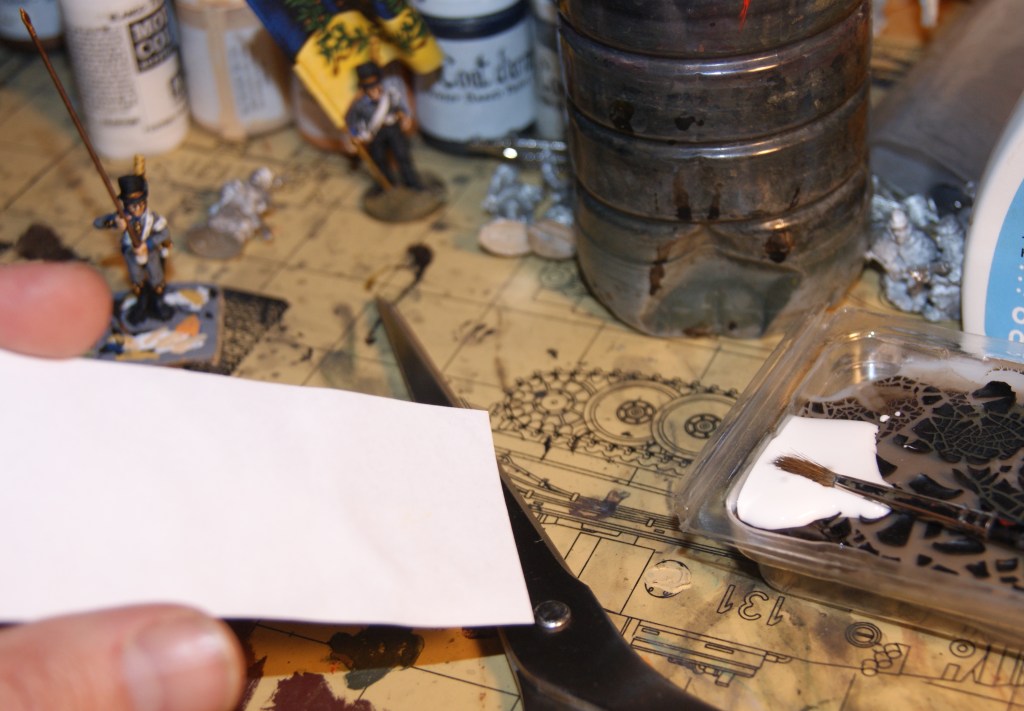
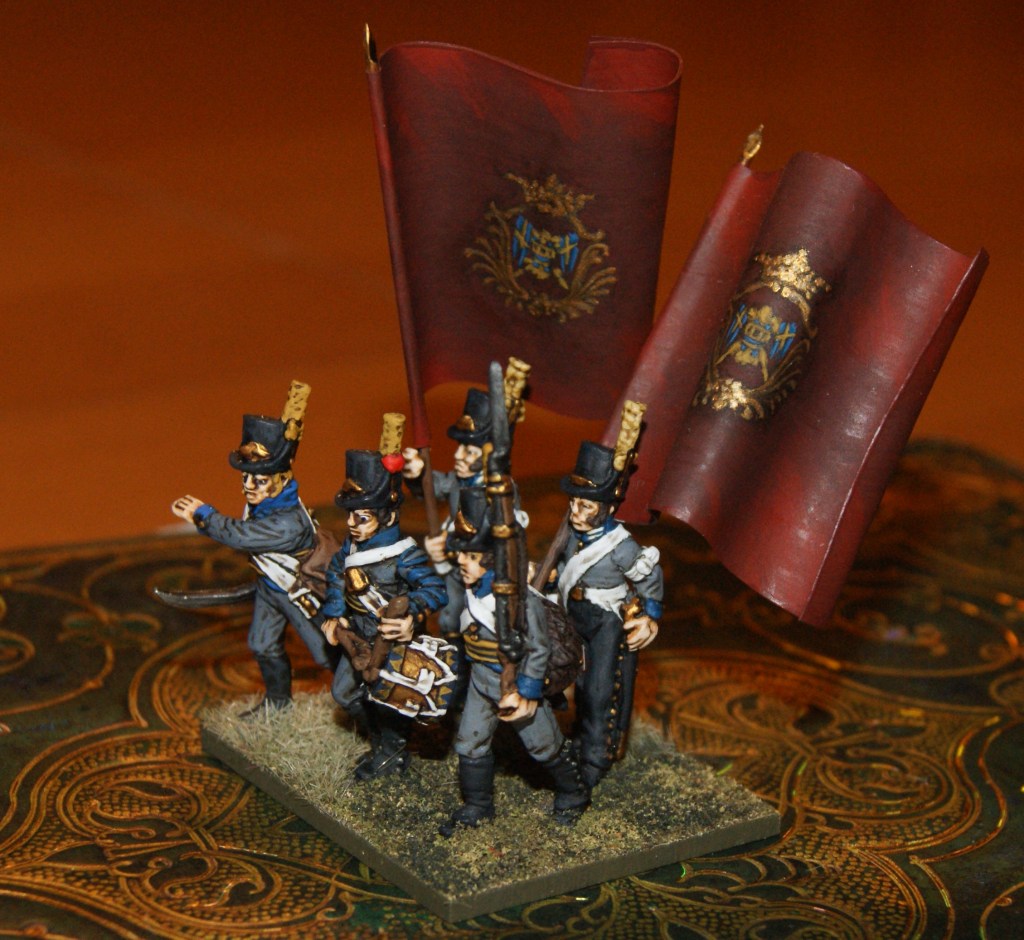
The pictures show something of the process involved in mounting the flag on the figure using PVA glue. In addition, you can see how it is a good idea to retouch the edges, as there will inevitably be some white showing from the back of the paper, when the two sides are glued together around the pole. In this case I also needed to cover a couple of spots where I had accidentally smudged the outside of the flag with glue.
As I have now painted at least one unit of most of the Finnish regiments that took part in the 1808 war, I thought I would sum up what I have learnt in the process, for others to use. Below is a table summarizing the uniform colors worn and the flags carried by the different regiments. Needless to say, some details are uncertain, but I have tried to explain the difficulties in the notes further down the page. I will try to update this page as I learn more, but the basics are there. In the future, I will be looking to doing the Swedish regiments as well, but that will perhaps have to be in a separate post. Similarly, officer’s uniforms would perhaps be best treated in a post of its own.
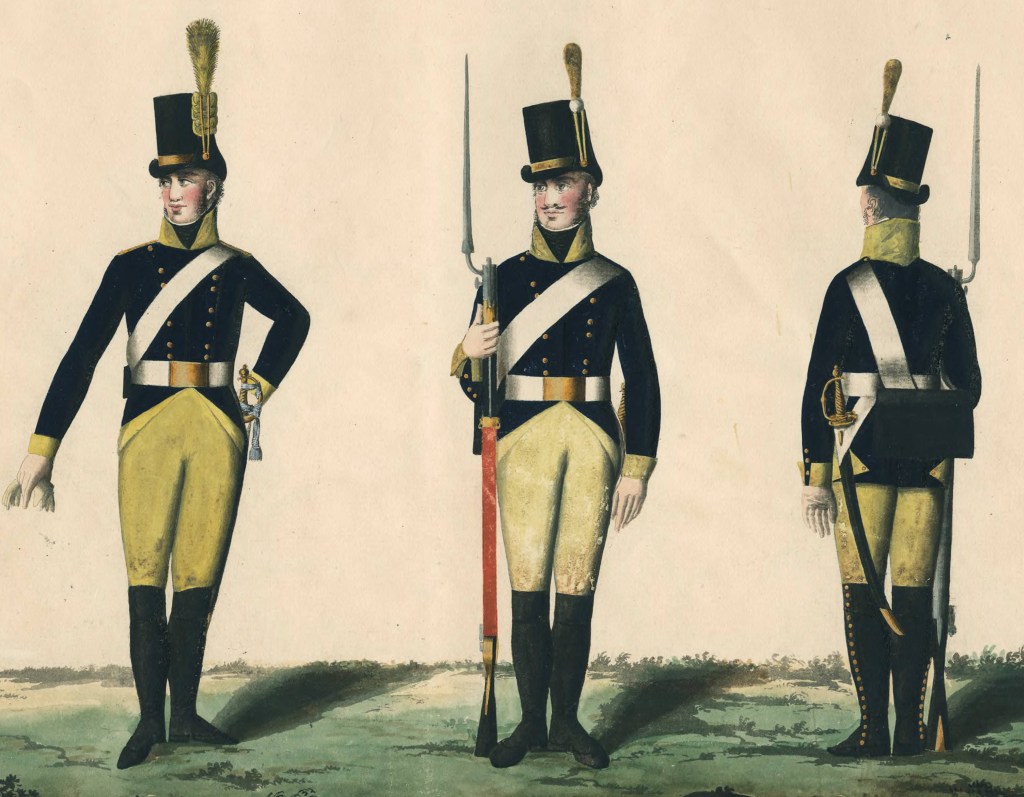
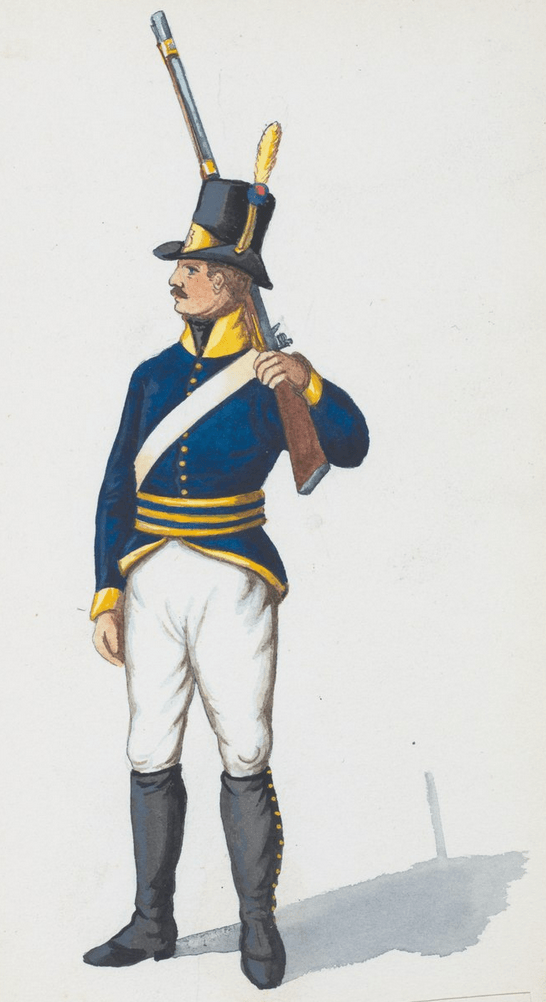
The uniforms of the Finnish army followed the models set for the Swedish army of which it was a part, but the Finnish regiments also followed a distinct line of their own. Swedish uniforms went through a quick succession of changes between 1792 and 1809, when the war against Russia was lost and all the Finnish regiments disbanded. The major uniform changes have been categorized as the 1792, 1802, 1806 and 1807 uniforms respectively. There is in fact a 1801 model as well, but that was used almost exclusively by senior officers, so we can leave that to one side for the moment. The 1792 was, especially for the Finnish regiments, quite different from the later models. Therefore, lets start with the m/1802.
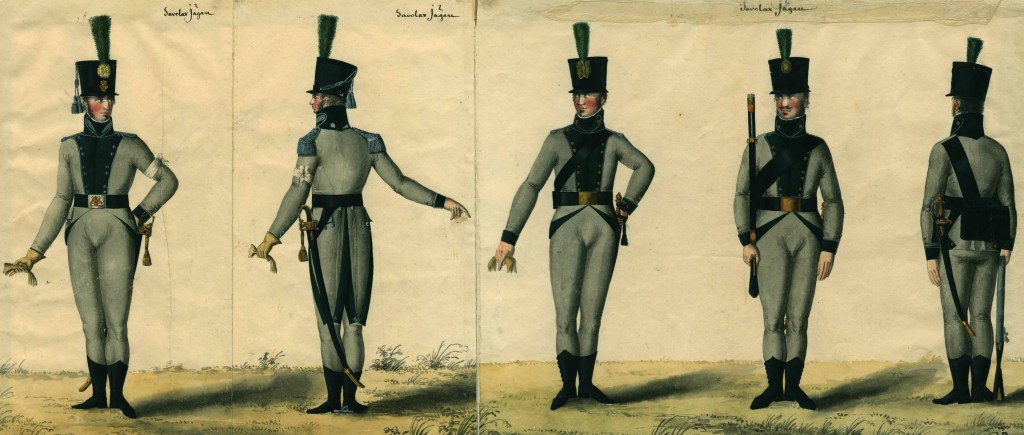
The 1802 uniform consisted of a double-breasted jacket with short trousers. Belts were white and a large brass belt-buckle was worn on the waist belt. Swedish regiments, and the Finnish Österbotten regiment, wore blue coats with different facing colors, distinguishing each regiment. The other Finnish regiments wore grey with various facings (mainly blues). The hat worn with this uniform, was the long-lived 1779 model. Among the Finnish regiments, there was one exception: the Savolax jägers wore a shako.
The colors were retained in the m/1806, in which the major changes was the single-breasted jacket and the blue-and-yellow sash which replaced the belt and buckle.
m/1802 (Hälsinge)m/1802 (Österbotten)m/1806(Södermanland)m/1807 (1806 in background!)m/1807
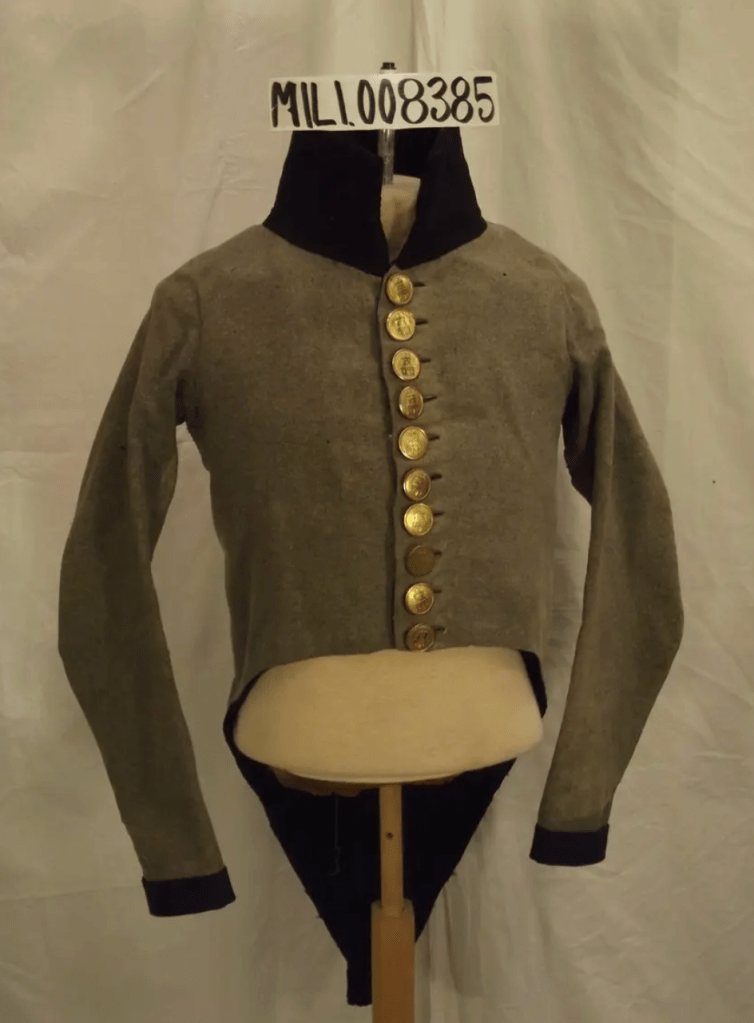
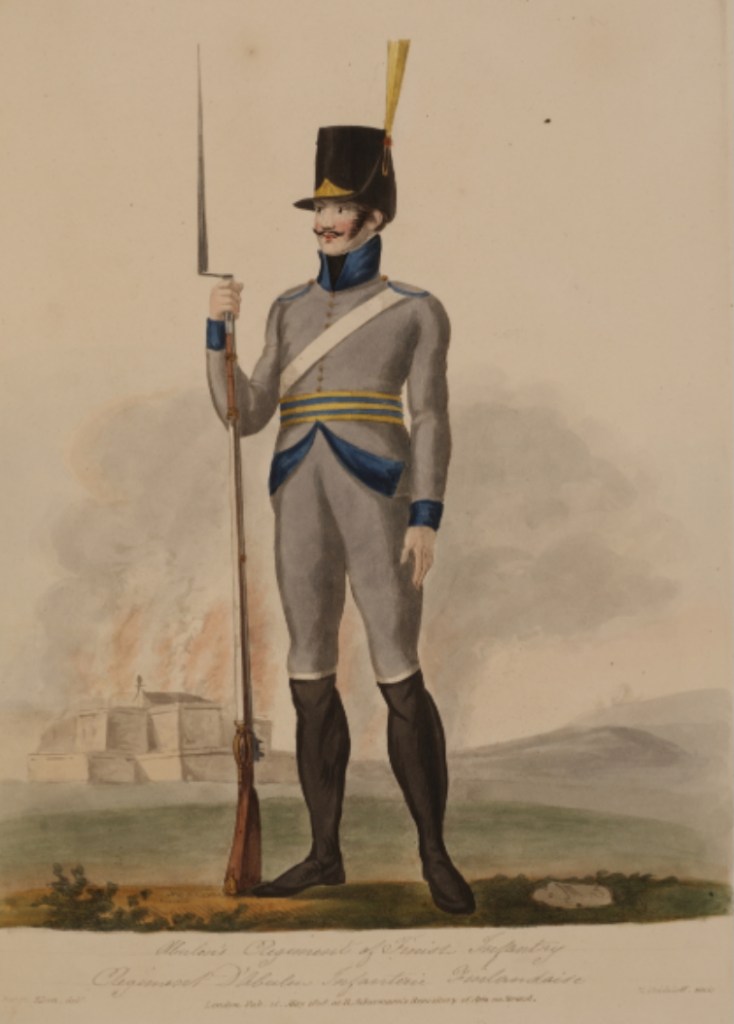
A major change was introduced with the m/1807. This uniform was meant to be universal (although guards units were excepted), with the same jacket and trousers for all regiments. It was grey with dark blue facings. Belts were black. Jägers were distinguished by a green hat plume instead of yellow. Regiments were distinguished by a regimental badge in the centre of the front of the hat.
The 1807 was unpopular. It also took time to adopt new uniforms, as old ones were to be replaced only when worn out. Therefore only a few regiments wore this uniform: the Nyland regt. seem to have done so in Finland. Some Swedish regiments did receive it, and at Sävar and Ratan, the last battles of the war (fought in northern Sweden) in 1809, this uniform was more widely worn (by Swedish regiments). But by then, it had already been decided that blue coats were to be re-introduced.
Savolax jäger regiment wearing the m/1802. Belts were black, as became common for jägers (but not the Karelian jägers!). Facings are green, but so dark as to look black in this illustration.Left: preserved officer’s jacket, model 1806, Åbo regt. (Nordiska museet/Armémuseum); Right: Private’s uniform model 1806 (from Eben, The Swedish Army (1808)).The table summarizes uniform details and flags of the Finnish regiments involved in the war with Russia, 1808–1809.
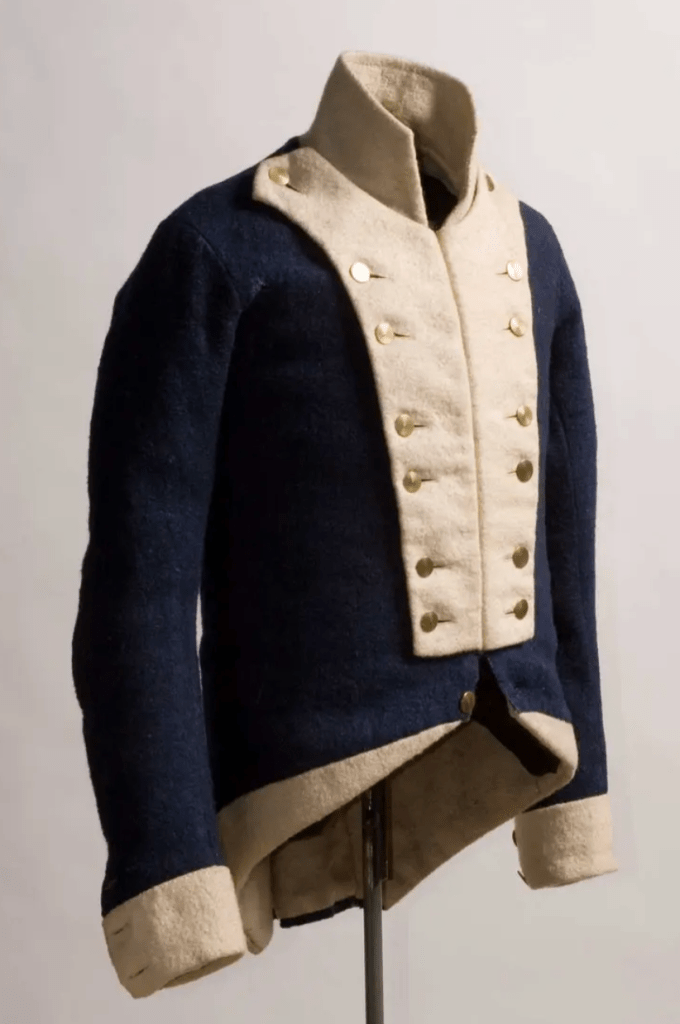
*To what extent plastrons were still worn on the uniforms in 1808 is difficult to determine in detail. The m/1806 and m/1807 uniforms had no plastron. However, many regiments still wore the old m/1802 or even m/1792 jackets. There was a general regulation stipulating that the plastrons should be removed from the old uniform jackets. This was a minor alteration to be done by the soldiers themselves. To what extent this was actually carried out is uncertain. There are few surviving examples of the uniforms in questions, and few depictions drawn from life by eye witnesses. Furthermore, the examples that do exist point in different directions. There are surviving examples of uniforms of the Åbo and Nyland regiments. The Åbo example (an officers jacket) is a m/1806 without the plastron. The Nyland (both officer and private’s uniforms) are of the m/1807. Interestingly, this means that the Åbo and Nyland regiments wore uniforms that looked pretty much exactly the same, as the m/1806 Åbo very closely resembles the 1807 uniform (which was the same for all regiments). The only significant difference was the number of buttons (10 vs 11 or something like that), which of course is so slight as to not be noticeable in miniature terms.
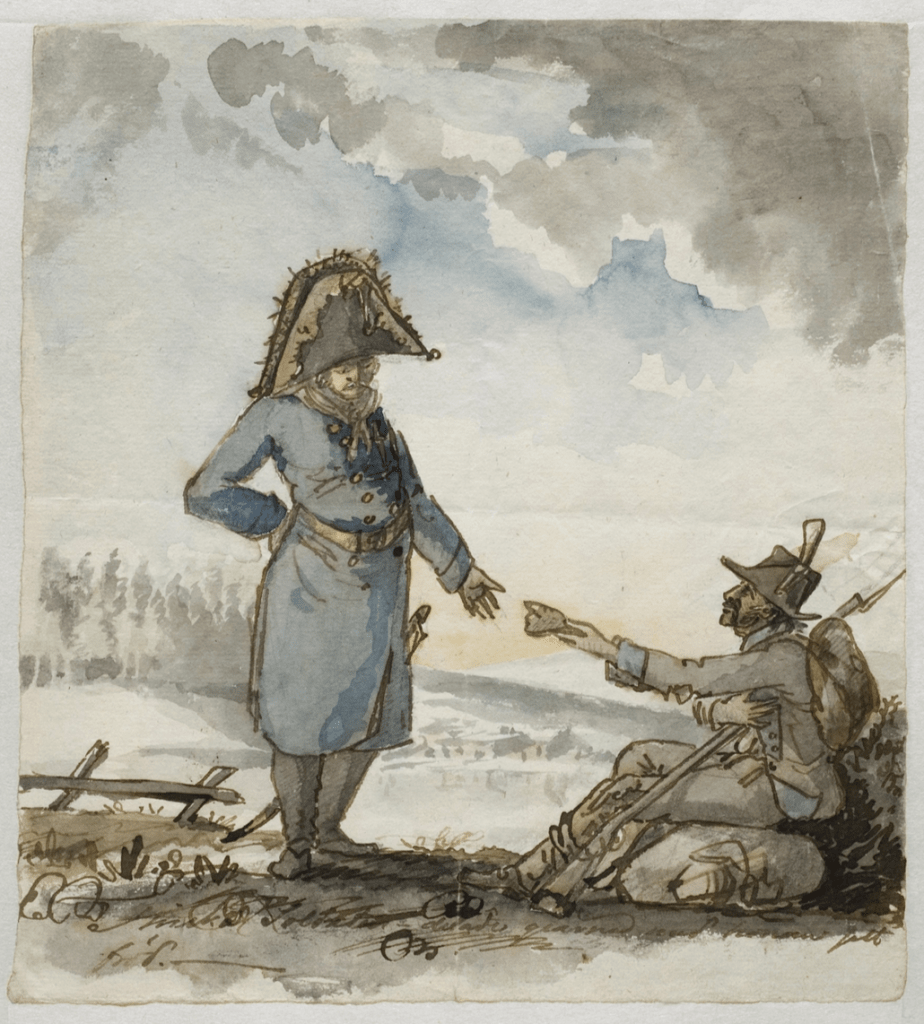
There is a water color by an artist (Per Otto Adelborg) who was an eye witness to the war. It shows general Adlercreutz being handed a piece of bread by a fatigued soldier. The soldier is clearly wearing a m/1802 uniform with the plastrons still there. (Incidentally, he also wears a backpack and not the regulation shoulder bag). As it seems from the examples mentioned above that the Nyland regiment was wearing the 1807, the soldier must belong to the Björneborg regiment. If all soldiers in his regiment wore the same style of dress, this would indicate that Björneborg wore the 1802 with the plastron. For the other regiments, I have yet to find clear examples either way. One could also say that there is a distinct possibility that the uniforms were altered in the early summer, when there was a pause in the fighting. It may be then, that the Adelborg drawing, and he made a series of them, although mostly in black and white, was made in the spring.
**Trousers were previously white in most regiments with a blue jacket, but after the campaign in Germany in 1806–1807, these proved to be impractical, as they were impossible to keep clean in the field. Therefore, all regiments were ordered to transition to grey trousers, as were already often used in practice (fatigue wear was grey). This means that most regiments with theoretically white trousers would probably have worn grey. This may well be true of the Österbotten regiment, who wore yellow trousers, as well.
***The Österbotten regiment was in a process of expansion at the time of the war. New Vasa and Uleåborg regiments were being formed. This was never fully realized, but parts of these new regiments were recruited and participated in the war. It seems that they wore the same uniform as the Österbotten regt.
Top left: 1766 livfana; top right: Björneborg 1686 company color; bottom left: Nyland 1766 company color; bottom right: Savolax 1686 livfana.
****The flags used by these regiments fall into two broad types: m/1766 and m/1686, with the number corresponding to the year of introduction of the respective types. Each regiment normally carried four flags, although some guards and enlisted regiments had more. One flags was a king’s color, a white flag with the emblem of the royal house in the center. The king’s colors of the 1686 pattern had a small regional emblem in the top left corner, but otherwise all king’s colors of this pattern were the same. In the m/1766 even this small distinction was removed, i. e. all king’s colors were exactly the same (for guards regiments there were also a crown in each corner). The three other flags were so-called company colors, which were of varying colors and had a regional emblem in the center. In the m/1686, the emblem was encircled by a laurel wreath; in the m/1766 the emblem was surrounded by a crowned golden leaf frame. The emblem was generally larger in the m/1686, although with time the emblems became smaller during the course of the 18th century, well before the introduction of the m/1766. Therefore, the difference between the two types was not as great in practice as they may seem on paper (i.e., if you compare a type drawing of the m/1686 and a m/1766). There were also slight variations within these patterns, intermediate versions etc., but these are too complicated to explain here. The Björneborg regiment carried one (company) flag of the m/1766 and the other three m/1686. The Adlercreutz regt. carried King’s colors of the m/1766 with newly designed (1805) company colors of a different design. The Kajana battalion had flags of an unknown design, made in 1799.
Left: preserved company color, Björneborg model 1686 (made in 1752); Right: preserved company color, Österbotten regt. model 1686 (made in 1744). Both were taken as trophies in 1808 and are now preserved in St. Petersburg.
†Adlercreutska regementet, Drottningens livregemente and Jägerhornska regementet only saw (limited) action during the siege of Sveaborg. However, some soldiers managed to escape after the surrender of the fortress and made their way into other units. Some of them may have served in their old uniforms in Gyllenbögel’s corps of volunteers.
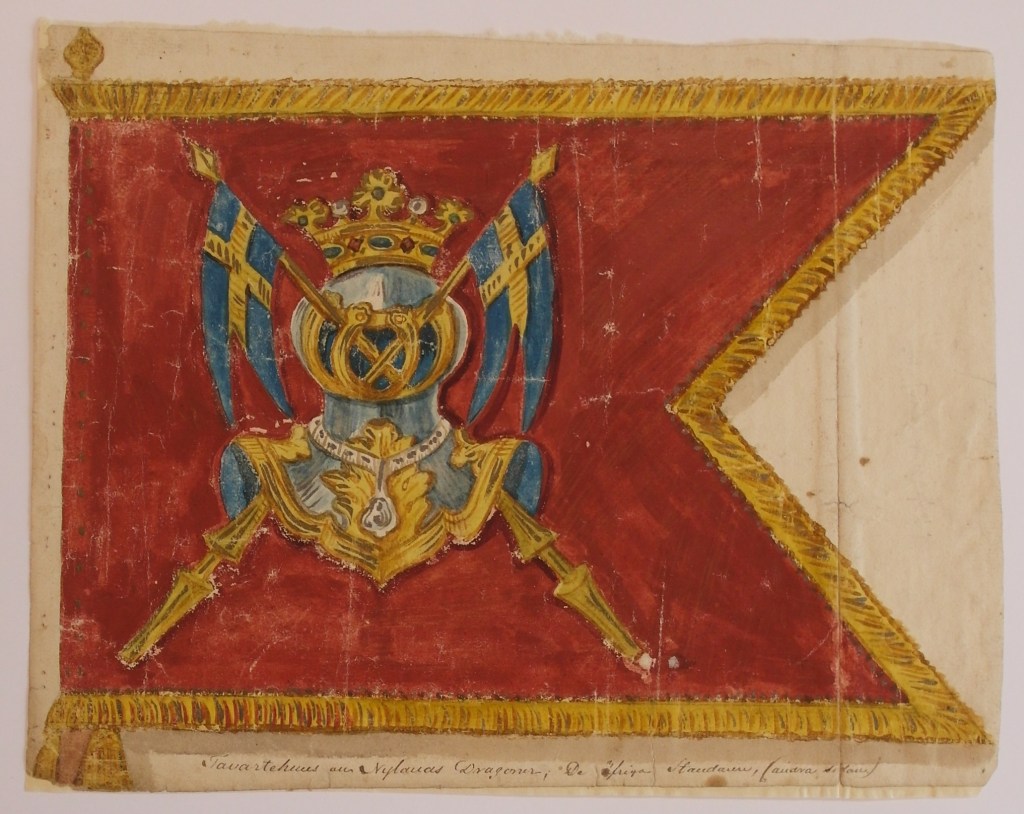
††It has recently come to my attention that the Finnish cavalry most likely did carry guidons, even though Törnquist claims that they did not. There is a very nice drawing by Adelborg, who himself led the first squadron of the Nyland dragoons at the beginning of the war. It shows a guidon being carried in 1804. I assume that the guidons for the Nyland dragoons would have been inherited from the 18th century.
Literature
Leif Törnquist, “Colours, standards, guidons and uniforms, 1788–1815”, in Between the Imperial Eagles, Meddelanden från Armémuseum, vol. 58–59 (Stockholm, 2000).
Martin Markelius, “Bestämmelser och verklighet: uniformeringen i von Vegesacks kår”, in Kronans kläder, Meddelanden från Armémuseum, vol. 69 (Stockholm, 2010).
Martin Markelius, Gustav III:s armé (Stockholm, 2020).
Erik Bellander, Dräkt och uniform: den svenska arméns beklädnad från 1500-talets början fram till våra dagar (Stockholm, 1973).
I finished the figures for this unit a few days ago, but have been working on the flags. I was very pleased with the king’s colors (livfana) I managed to paint. Unfortunately however, when finished it became clear that it was much larger than the company colors that I had done a long time ago. They just dont match, and the company colors were not very carefully done anyway. So, and this is a first, I do actually think that I have to scrap the old flag and make a new one. That hurts of course, because these flags do take some time and effort. Id say that painting two flags takes about the same amount of time as painting half the figures of a battalion (admittedly, these grey uniformed finnish infantry are quite quickly done).
The scan of the 1766 flag has been uploaded to the flags post I did a while back and this time the scan was actually relatively good.
I should add that the officer and drummer in this unit were made from a pack of Perrys’ Spanish infantry, with heads swapped for Swedish ones. They have plastrons on their uniform, as the Swedish m/1802 uniform had. Whether Tavastehus had retained the plastron or not, I dont know – but I do know that some soldiers in the Finnish army still wore jackets with plastrons in 1808, although most of them probably didnt. Some had (like the Nyland regt., apparently) received the new 1807 uniform, but most wore the m/1806, either newly made or re-sewn from old 1802 jackets.
For the first time in a long while Ive come back to the WW2 stuff. This time some Panzerfaust-armed Germans. Until now I have only had two such figures, and my focus was on the earlier stages of the war, before the PF was introduced. However, in order to be able to play the later period I needed at least a couple of these for each squad. The figures were assembled from leftovers from at least three WG plastic boxes. A tiny amount of Green stuff was used for the shoulder straps of the weapons on a couple of the minis. A few details still to do, but these are mostly done.
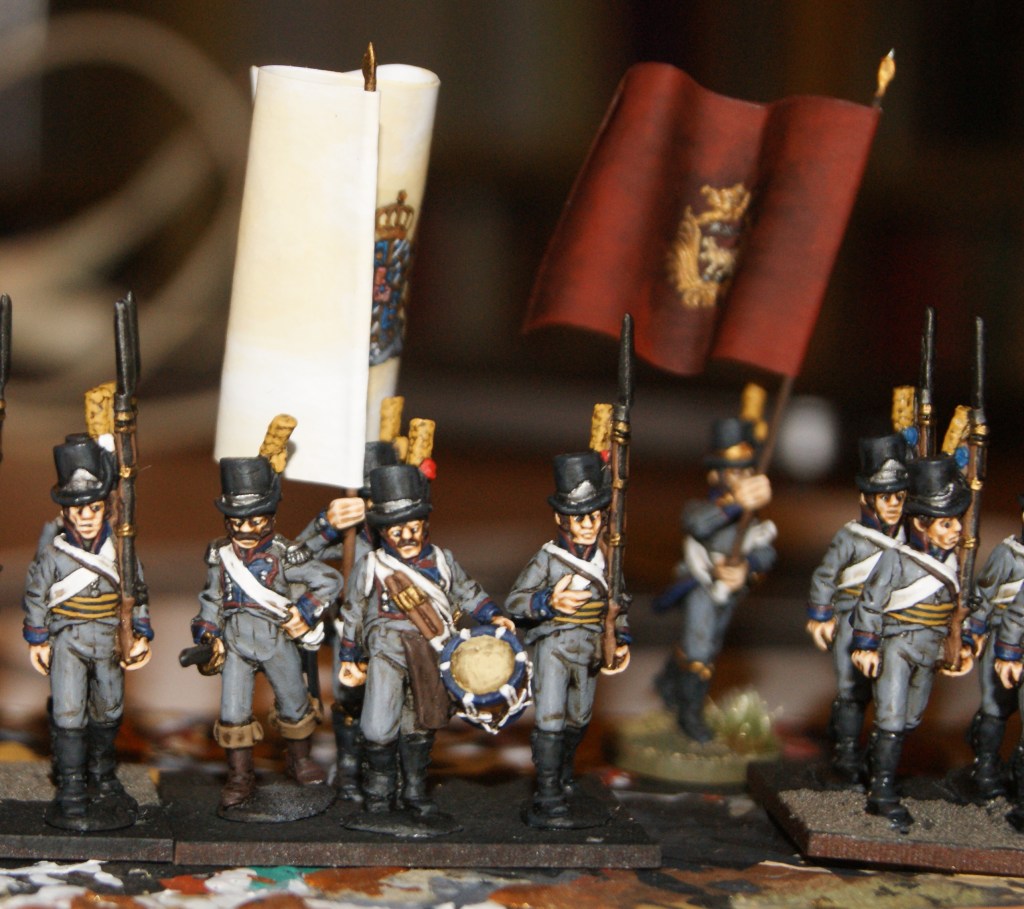
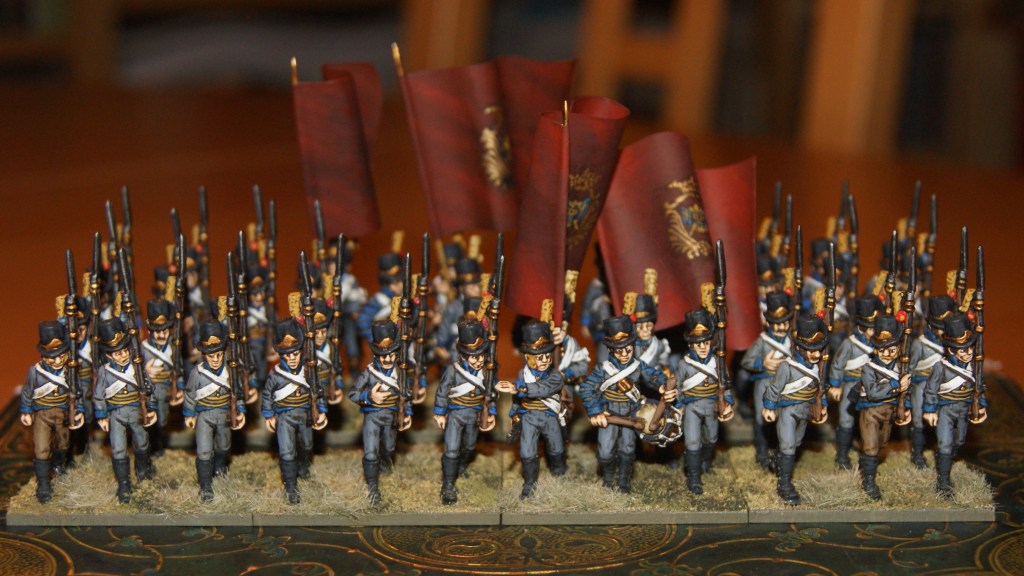
The latest addition is this 2d battalion of the Nyland regiment. In other words, the flags I recently painted have been mounted and Im surging ahead with the remodelling of the Finnish army into 24 man units. The figures are partly old ones rebased, and partly newly painted. Hopefully more to come soon.
It might be worth mentioning that the red on the flag has been painted from a Vallejo Hull Red base, with successive highlights of a mix of Hull Red and Coat d’arms Blood Red. I think this is a particularly good way to do red. The Hull Red base color covers very well, which is rare with red shades, and the end result is a nice deep red color which I use very often. As you can see, the same color was used for the Åbo regt. flag which is in the background.
The basing is done in a way similar to my Prussians, although with bases of six instead of eight. Unfortunately, in historical terms, these uniforms are out of date for the 1813 campaign. However, one does not always have to be so strict. Sometimes it is nice just to have fully painted units to put on the table, and historical correctness mustnt always be the priority….
I am doing my best to get back into painting my 1808 figures again. This time I am doing some Russian jägers, the 24th regiment to be precise. I will need to paint quite a few more Russian figures, around 150 or so, before I have everything I need for the 1808 summer campaign. That will take some time, but at least I have painted substantially more than half of the planned total already. It is quite insane really, doing one of the smallest possible campaigns of the Napoleonic period, and still I need ca 400-500 figures per side…
As I am painting a lot of figures for the Finnish war, with the aim of recreating some of the battles of the summer of 1808, there are a few specific terrain items that I need. Recently, I did some typically Scandinavian fences (gärdesgårdar). I will need even more, as such fences were built around even the smallest patch of land in Finland in 1808 – there was some law or ordinance which made this practice favorable for the peasants (dont ask me how exactly!).
Two other typical terrain features were bogs (mossar, or myrar in Swedish) and förhuggningar. The first of these is a natural feature of the Finnish landscape, while the second was a common form of simple, improvised defensive work.
Bogs are characteristic of northern and central Finland. Unsurprisingly, the first man to scientifically categorize different types of bog was a Finn (Carelian parson Jacob Stenius, also known as “Bog-Jacob”). He even put his expertise in bog-science to work for the government and contributed to the improvement of border defenses in eastern Finland in the middle of the 18th century. This may sound like something out of Monty Python, but it is quite true!
A bog, with PVA glue still not completely dry. French dragoons for scale purposes only!
Needless to say, bogs were important in the war of 1808. Wetlands were part of the battlefields of several of the most important and well-known battles, such as Oravais, Jutas, Rouna-Salmi and Karstula. The battles of Parjakanneva and Kokonsaari are named after the bogs on which these battles were fought. The battle of Kokonsaari in particular is worth mentioning. Here the Russians are reported to have waded through the wet ground with mud up to their knees. Despite this, the Russians defeated von Fieandt’s small detachment after a bloody battle (casualties were proportionally among the highest in the war).
The bogs were not particularly difficult to make. However, I did need very large bases for them, as these will often need to fill up a large part of the gaming board. I made the bases from masonite type board. It is very useful, but can be difficult to cut. After some testing with different tools, a metal saw turned out to be a reasonably effective method because of its fine teeth. I sanded down the edges, painted the pieces with textured paint (hobby paint+sand+water), but left large spots empty for the pools of water. I then highlighted the ground with brown and then buff (Vallejo Dark Sand), and the pools blue. I painted the edges a brown green and flocked the whole thing with various Woodland Scenics materials and grass tufts.
My original idea was to add Vallejos Still water product over the pools (and perhaps parts of the grass too), but I must have misplaced the bottles – I just couldnt find them, although I am sure I bought some a while back. So that will have to wait. I was reasonably happy with the result anyway, although maybe the pools are a little too blue for a swamp.
Many of the above mentioned battles also featured the second type of terrain piece, so-called “förhuggningar”, which is something similar to what is known in English as an abatis. These simple fortifications are mentioned many times in the sources, but they were probably variations on a theme. They seem to have served different functions. Sometimes, trees were felled in order to clear the line of sight for artillery; in other instances, felled trees were used to fortify defensive positions. Sometimes, perhaps, these two functions could be combined. The use of wood has of course been a feature of war since the earliest times. Finland is, and was, covered in forests to such an extent that this must have been a very expedient means of preparing defensive works. This was certainly the case in 1808.
These were made in a similar way to the bogs. The tree stumps are resin pieces I bought somewhere some years ago – the rocks are just, well, stones. I will add some natural twigs to look like felled trees over the bases. I also have some smaller resin log piles and log-and-earth fortifications made by Baueda. Together they will make up some nice förhuggningar for my Finnish campaign – or why not eastern front ww2 games.
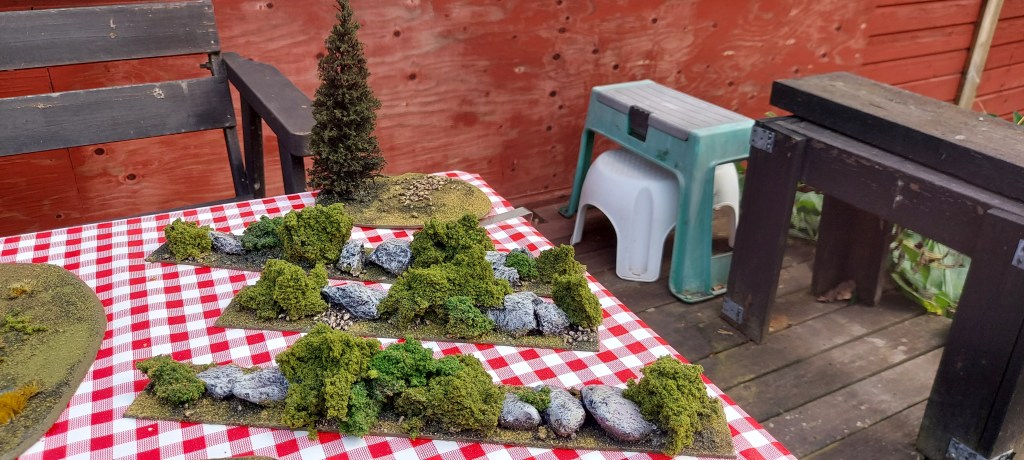
While I was at it, I also flocked my recently painted houses and did some other small pieces, such as the rock-and-bush sections, and some more bases for my trees.
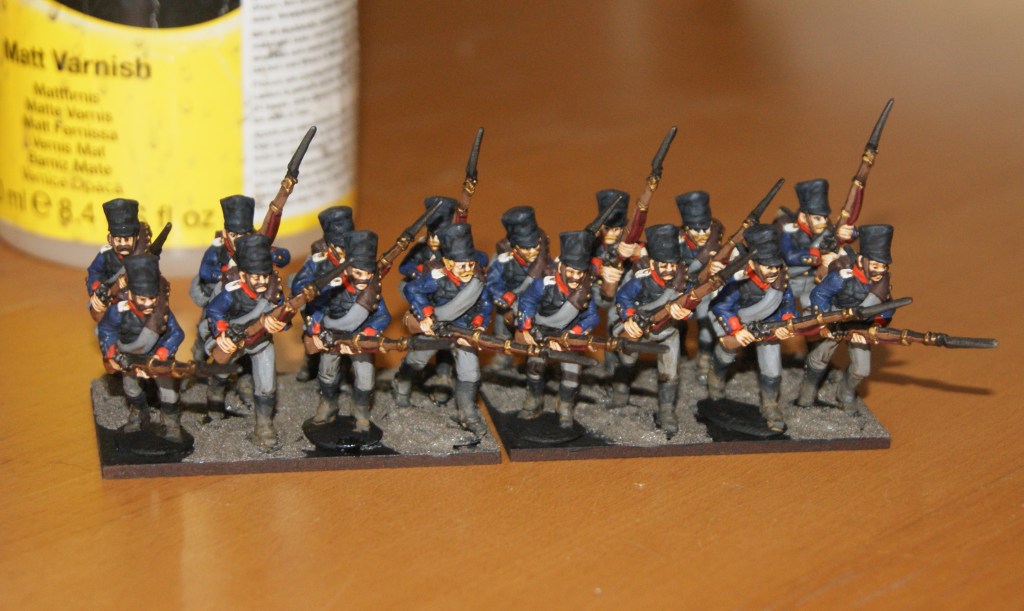
Im starting to come back to painting, but find myself doing multiple projects at the same time: 1813 Prussians, 1808 Swedes/Finns and Russians, a little bit of WW2 plus various terrain pieces. I havent really been able to finish a complete unit, but at least I did half a battalion’s worth of Prussian fusiliers. These are in charging poses, which was a bit of a challenge when basing them 8 figures to a 60×40 base. But it worked, and I am pleased that I stuck to this solution in the end. Next up, Ill try to do the second fusilier battalion with skirmishing figures. That is not quite looking as good! Such a type of figure doesnt seem to fit on these bases at all unfortunately… Ill have to think of something.































 Pancratist