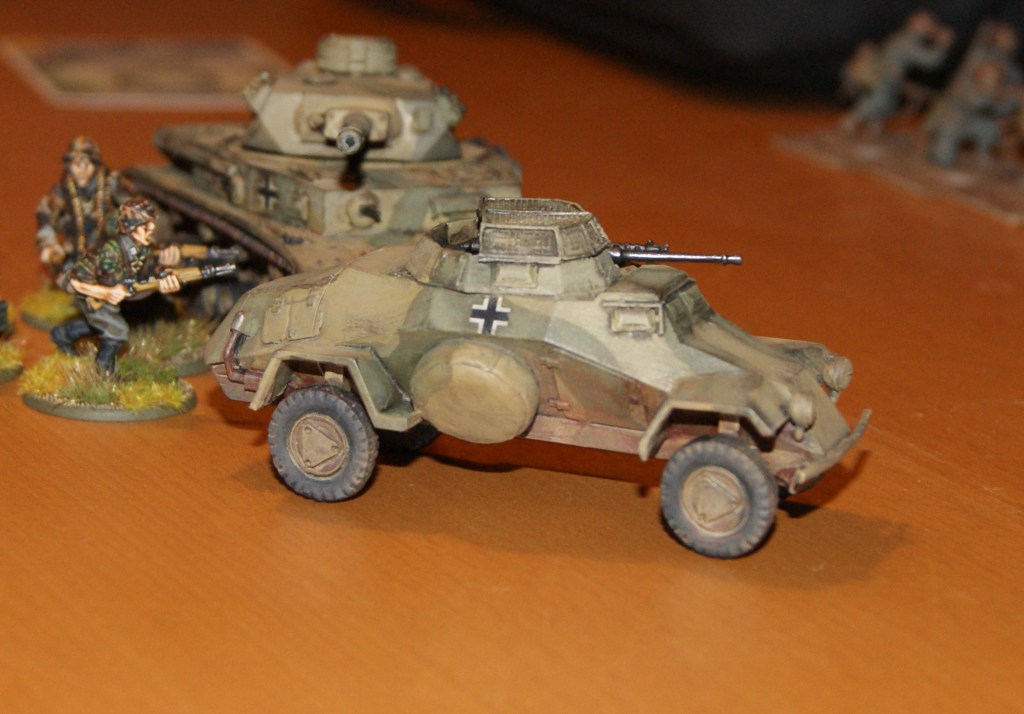
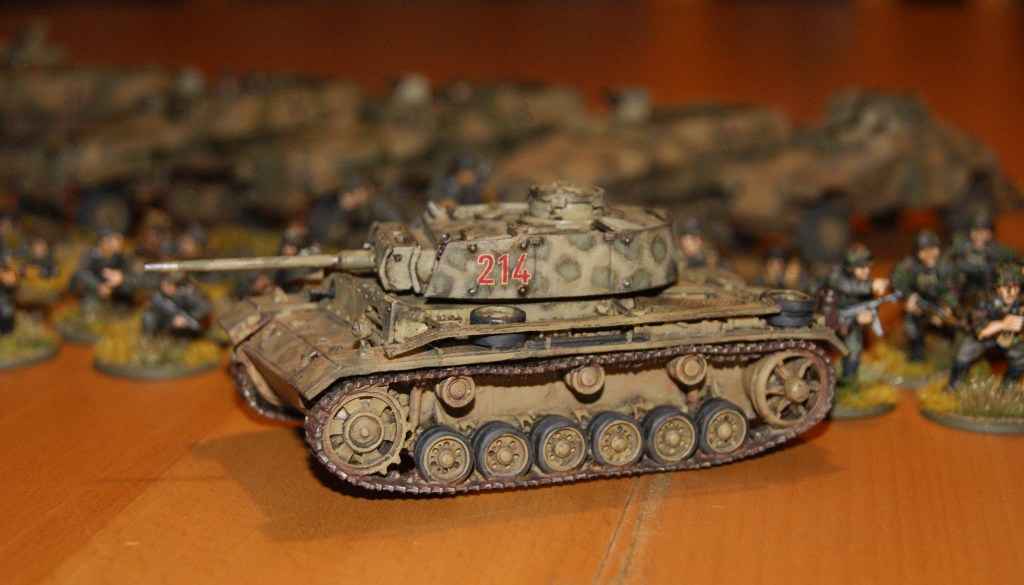
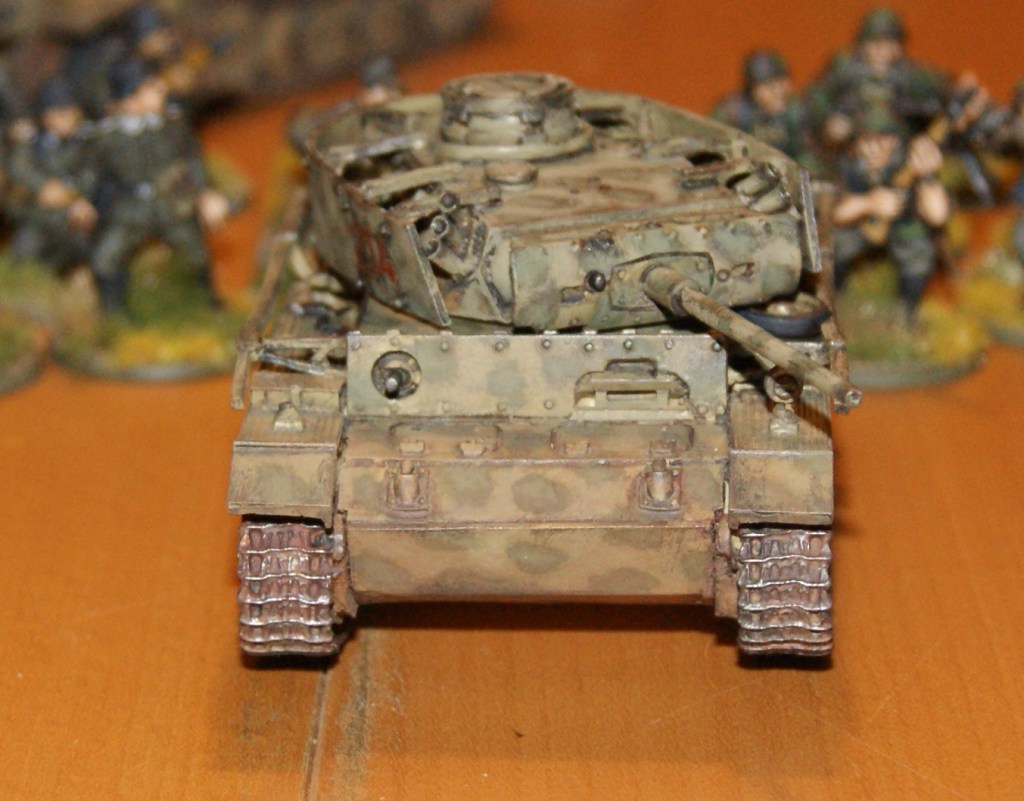
I finished a Panzer III Ausführung M and a sdkfz 222 leichter Panzerspåhwagen to add to my German armored collection. Pictures are not that great as I didnt have my usual camera to hand [I have replaced them with better pictures since I wrote this!]. The tank is a resin kit by die Waffenkammer and the armored car is a Warlord Games kit, also resin, but whereas the Waffenkammer kit has only resin parts, the WG model has details in metal, and there are quite a few of them as well. They are both very nice and with great detail and cast quality. But there are advantages with having the smaller parts in metal as the resin is brittle.
The Panzer III has armored side plates but I am not sure Ill be adding them. The tank looks OK without them and many lost them in the field. I think there may be a risk that they will just come off as the construction seems to be quite fragile. Also, a headlight came off from the tank when I was painting it and I couldnt find it again. Maybe Ill fix it with greenstuff, or maybe Ill just leave it. Im sure many came off IRL as well…
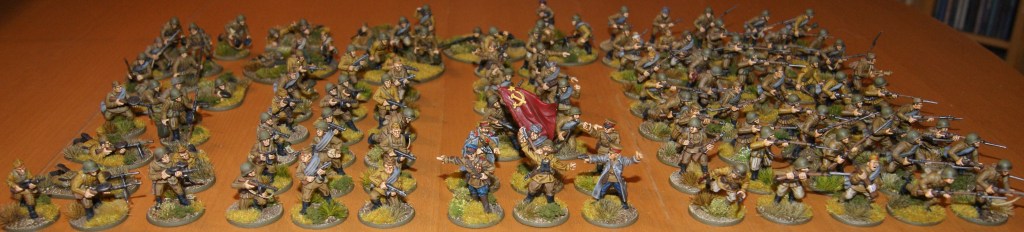
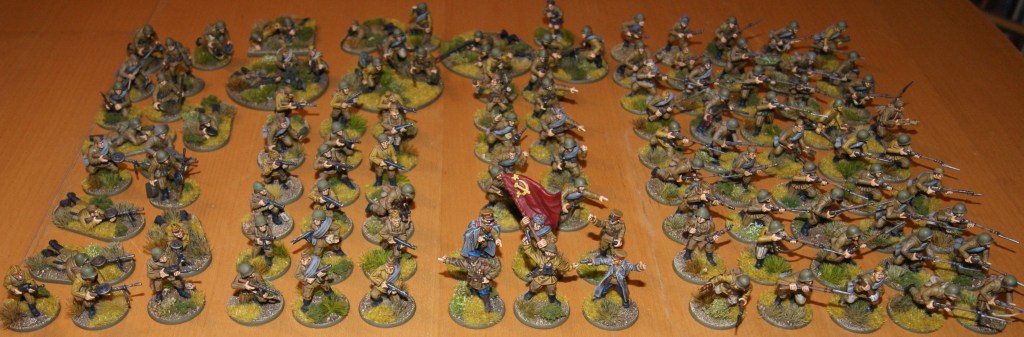
Going through my boxes of figures I realized something. While I may have a difficult time finishing projects, there is one project that I actually have finished – my ww2 Soviets. In fact, I have done many more figures than I ever planned. I counted them and apparently somewhere along the way I have managed to paint a whole company’s worth of red army soldiers. 9 squads of 10 men with officers and supports options: snipers, light mortars and Maxim guns were often integral parts of the rifle platoon. AT rifles were issued either at platoon or battalion level at various stages of the war. In real life, there would be an additional number of officers, medical personnel, etc., but I see no reason to represent all of these in a game. Using the army lists in the CoC rulebooks, I would have enough for two platoons of riflemen and one platoon of tank riders (SMGs), with a few figures to spare. The company HQ wouldnt be represented at all, although there is the option of adding a commissar.
I have a few spare minis that arent in the picture, but most of these wear fur caps and really look better in a winter themed force. I also have one more 50mm mortar team, which could be included too (in -43 each company included a mortar platoon with an NCO and two mortar squads, on paper). Spare figures could also be used as extra men to accompany the platoon commanders, representing sergeants and the like (in Bolt Action this is quite useful). Obviously, there are artillery, tanks and other vehicles to go with these as well, but painting the figures is the bit that takes time. And I could always do the tanks in a post of their own!
9×5 riflemen, 9×2 SMG-armed men, 9×2 LMG teams, 10 NCOs, 5 officers, 1 medic, 2 MMG teams, 2 AT rifle teams, 50mm mortar team, 1 sniper team. The standard bearer could be used to accompany the company commander, marking him out from the rest of the lot. In total: 111 men
The organizational structure of Soviet rifle and motorized rifle companies changed an inordinate number of times during the war. More importantly, paper strengths were of course seldom reached in practice. Originally, each platoon had four squads, but the fourth was, as I understand it, often dropped and after 42 this was reflected on paper as well. I dont have enough figures for 12 squads unless they are understrength, but with the extra figures I have I could probably just about manage 9×11 men (squads originally consisted of 11 men, but this also changed).
But how likely am I to actually field all these units in a game? Its a nice idea, but could make for a sluggish game. In Bolt Action terms, this lot would make about 20 units. For better gameplay you would probably want to drop some units, skipping snipers, mortars and MMGs perhaps, to get down to a more manageable number. A reduced company, as they were fielded in -43 after huge losses would often have looked just like that. Three platoons with a company commander but not support would be 13 units. Dropping the platoon commanders would make just 10 units; 9 squads led by the company commander. That seems like a more realistic army composition, while still fielding almost 100 figures.
The mix of SMGs and rifles could vary historically. With the figures I have, I could either do one platoon out of three fully equipped with SMGs. Alternatively, I might spread them out over the whole company (both seemed to have happened historically). Often there would have been some squads with two lmgs; unfortunately I only have enough for one for each squad.
The question is: why did I manage to finish these, as I cant seem to do the same with my other projects? I think the reason is that the Soviets wear simple uniforms that are easier than most other figures to paint. But they are also fun to do, with a lot of character. This is true of all of the figures; they are a mix of old Warlord Games metals and newer WG plastics, including the WG Siberian Veterans box, and Artizan. Because I knew that the Soviets were the kind of army where you need lots of infantry, I also deliberately chose a simple paint scheme, with less highlighting than I sometimes do. This worked well enough and made speed painting easy.
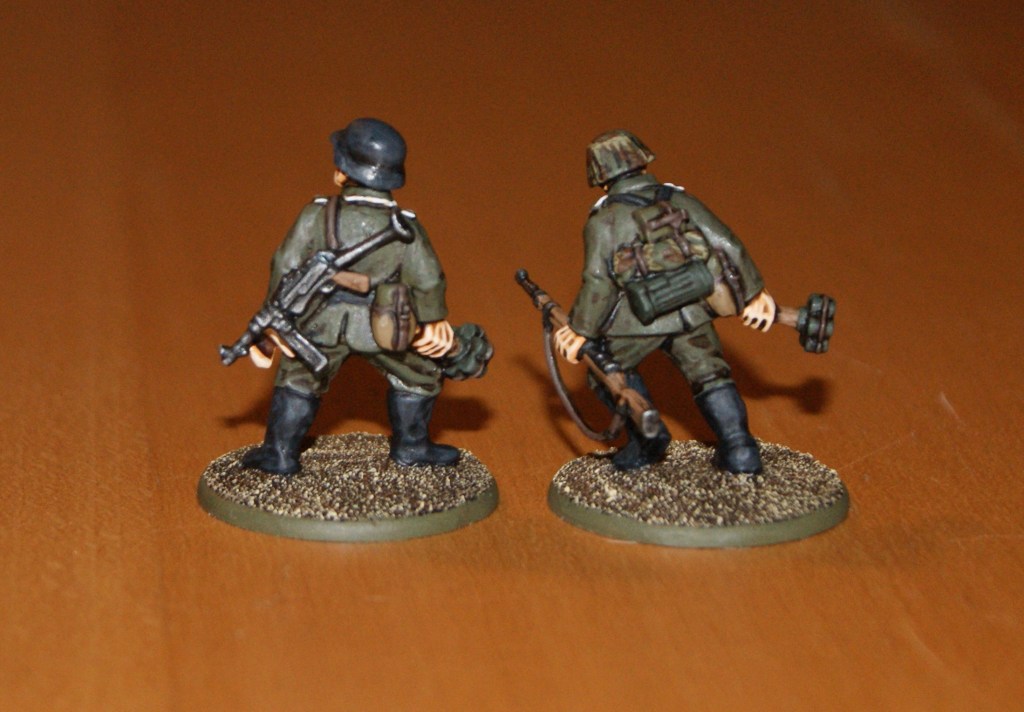
A couple of Germans with bundled charges for tank-hunting. Figures are by Crusader, but with added weapons from Warlord. The figure on the right also has a head from Warlord.
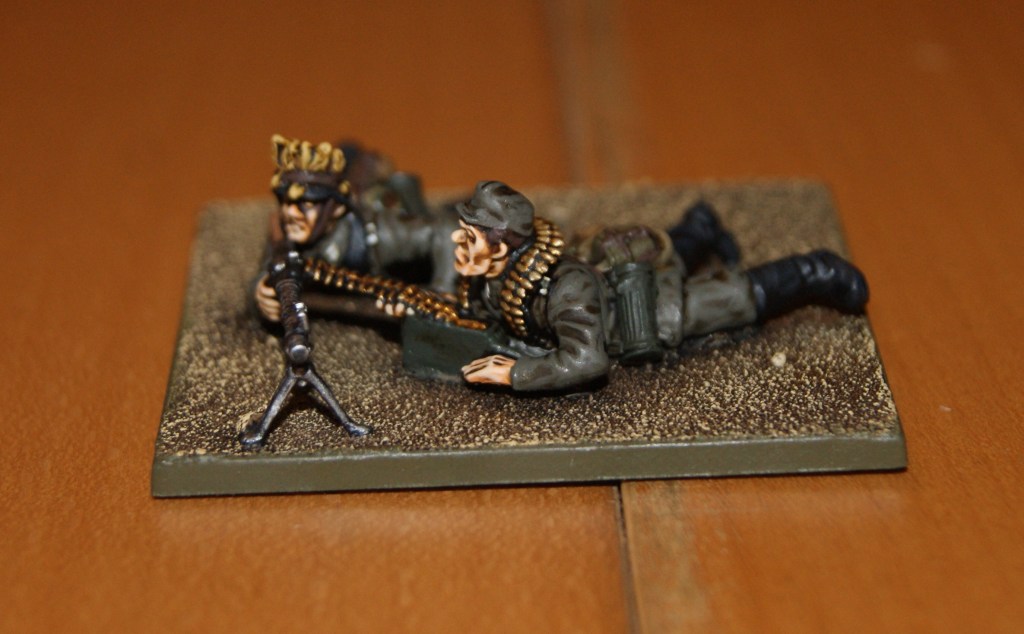
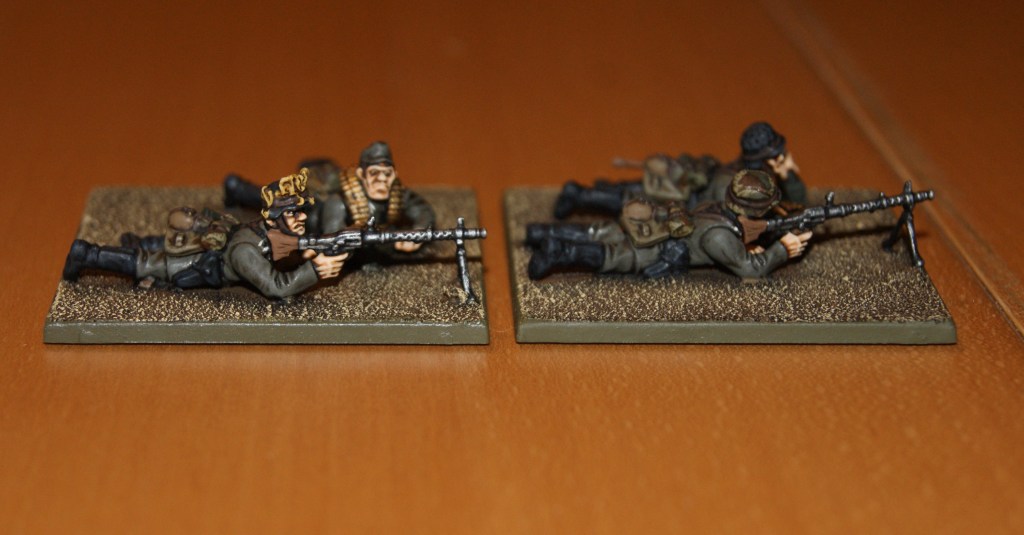
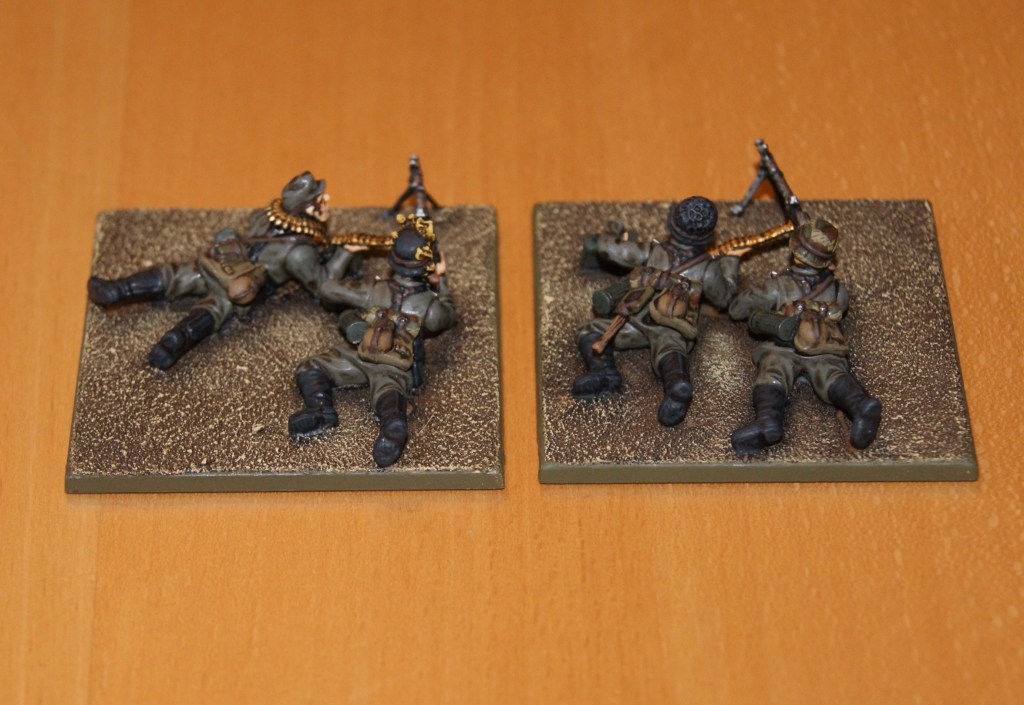
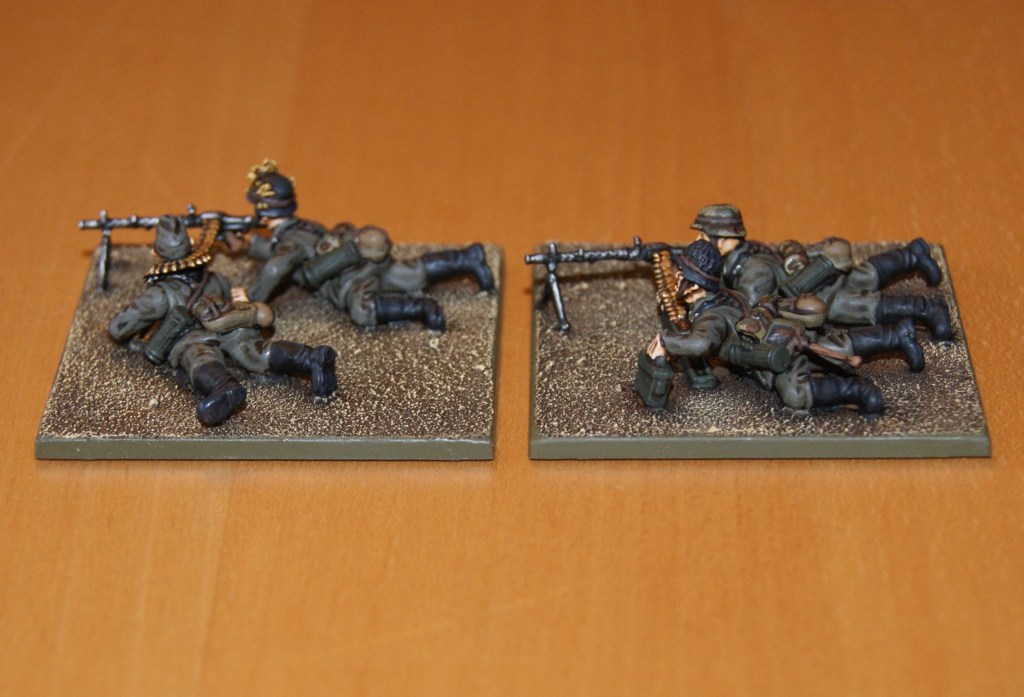
I finished a couple of German LMG teams (in ca 1943-44 style) during an otherwise slow hobby period. They are Warlord Games plastics with parts from several of their different kits, including some metal heads. With camo covers on the helmets and other bits they are a bit more varied and more interesting to paint than the regular Blitzkrieg Germans in the basic box (and I have quite a few of those painted up already anyway). I always prefer painting metal figures over plastics, but must admit that the end result often looks just as good. Some details are definitely better in plastic. In this case the weapons, the mg:s themselves. They cant really be sculpted as thinly in metal.
My 1808 Finnish war project has been slowing down somewhat recently. I did try out one idea which proved quite good. I have a small force of 1812 Russians already painted. Unfortunately almost none of those figures fit the 1808 setting, as the uniforms changed quite a bit. The artillerymen’s uniforms however, are wrong only when it comes to the shakos. And because the Warlord Games Russian artillery packs come with loose heads, swapping heads on the painted figures turned out to be a simple affair. I also had a few spare Brigade Games Russian infantry to provide the replacement heads with the old style shakos. The heads came off without ruining the paint job too much, and the collars were easily re-painted black with red piping once the new heads were attached. I found that the Brigade heads fit better on the WL bodies than I had expected. The repurposed 1808 style artillery can be seen on the left, the 1812 ones on the right.
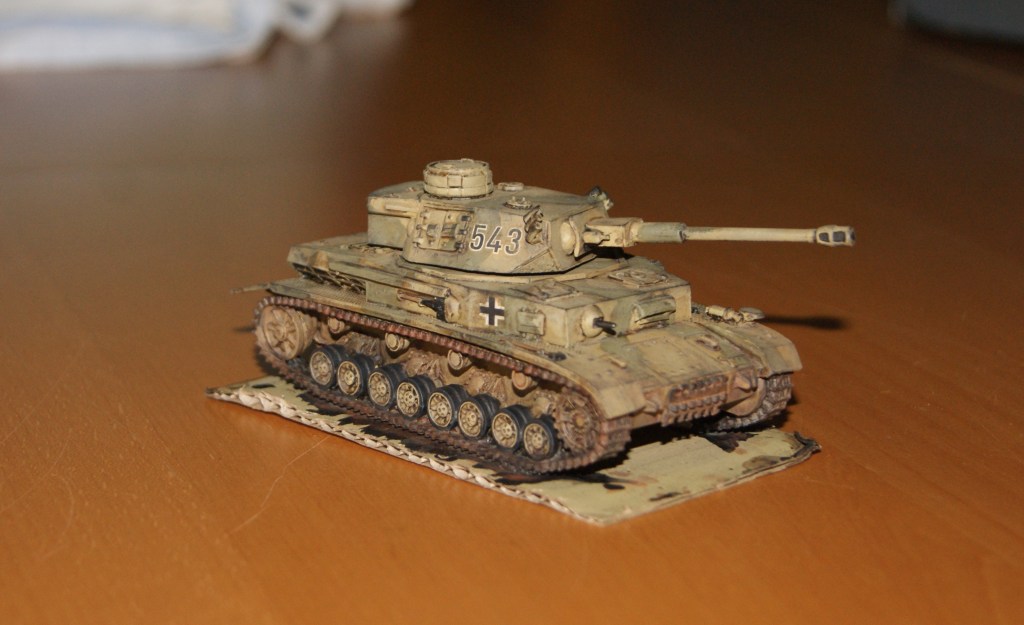
A hastily painted Pz IV. I have many more armored vehicles to paint, so I need to speed paint these. This is an old resin kit from Warlord Games which sadly is no longer available.
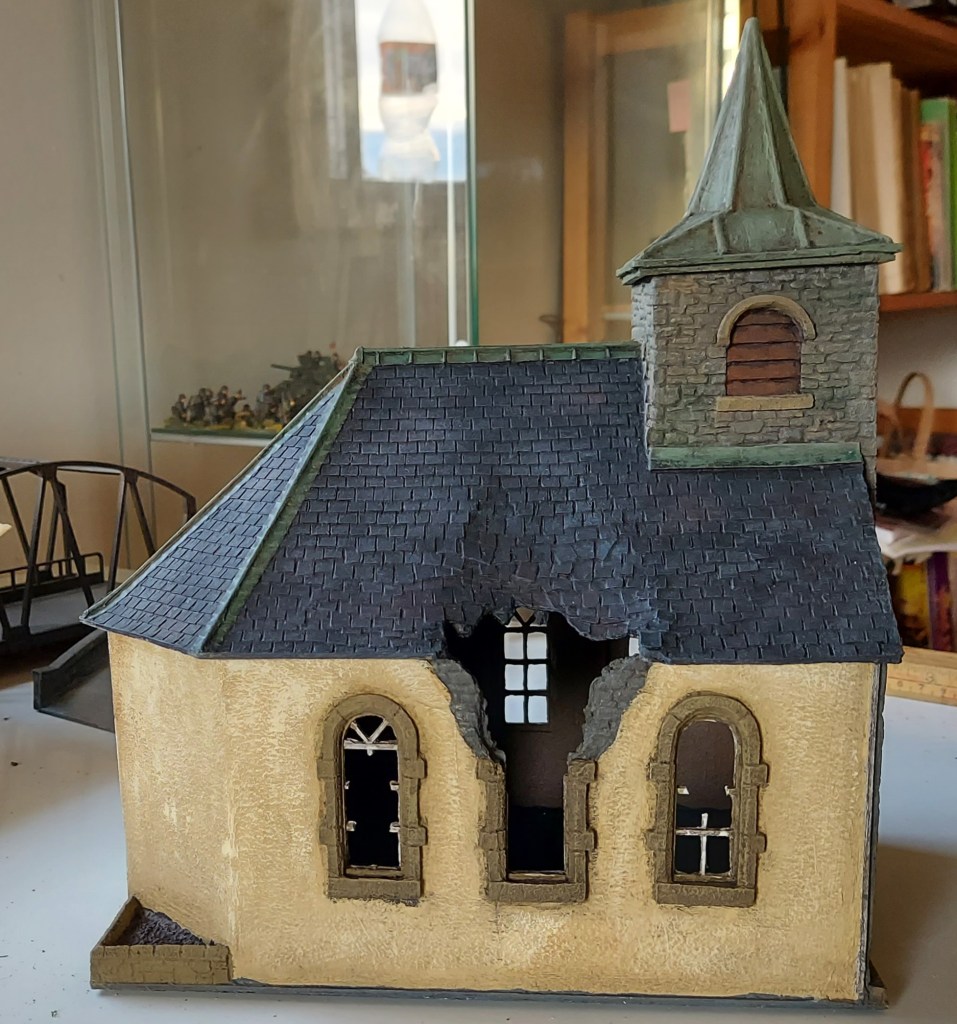
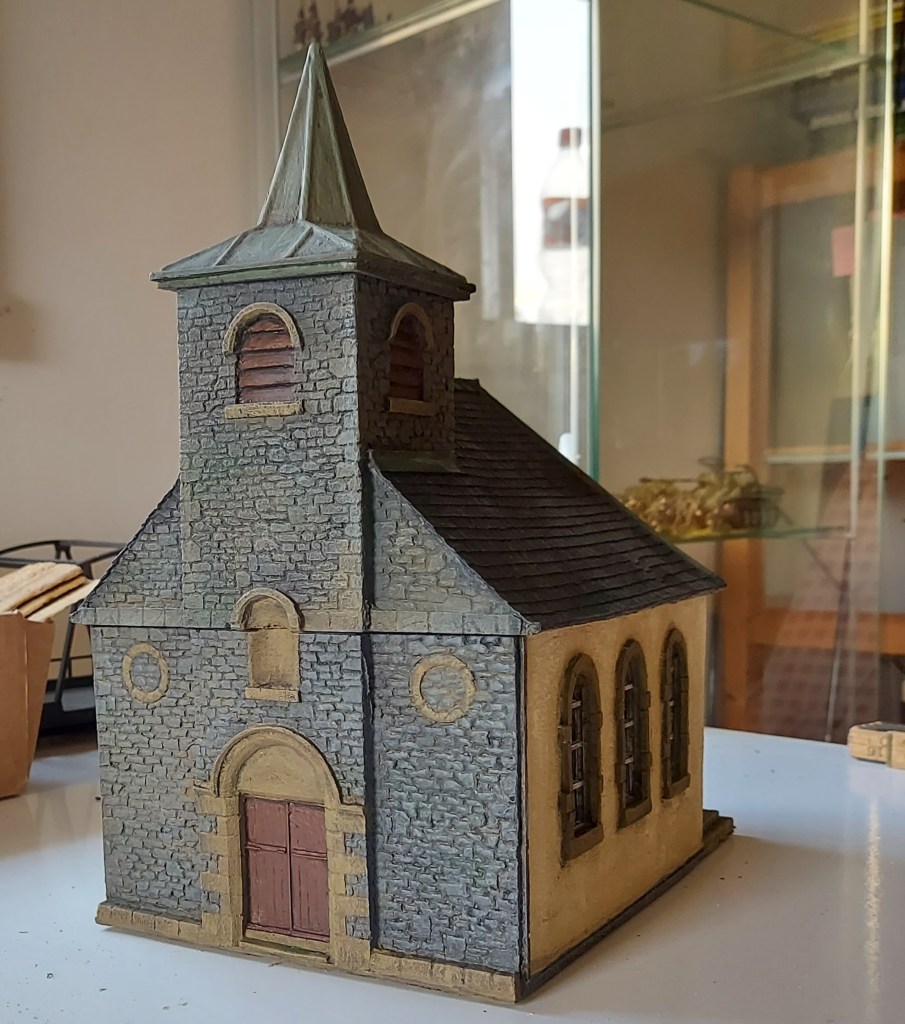
I painted up the church from Total Battle Miniatures. As you can see, there are still some areas that need touching-up, such as the underside of the roof where there is some naked resin showing through! I also havent painted the interior, although I dont know if I will ever feel that that is necessary. Anyway, the model is great, and the church is really big for a building in this scale! Obviously, it fits a late ww2 setting very well, but will work for Napoleonics as well. I have another of TBM:s resin buildings (a ruined one) and cant wait to get it painted up as well.
Here’s another figure for the Finland 1808 setting. This guy is a slightly converted Foundry Napoleonic Austrian. I only removed a few small details, such as medals, and added others, such as the armband.
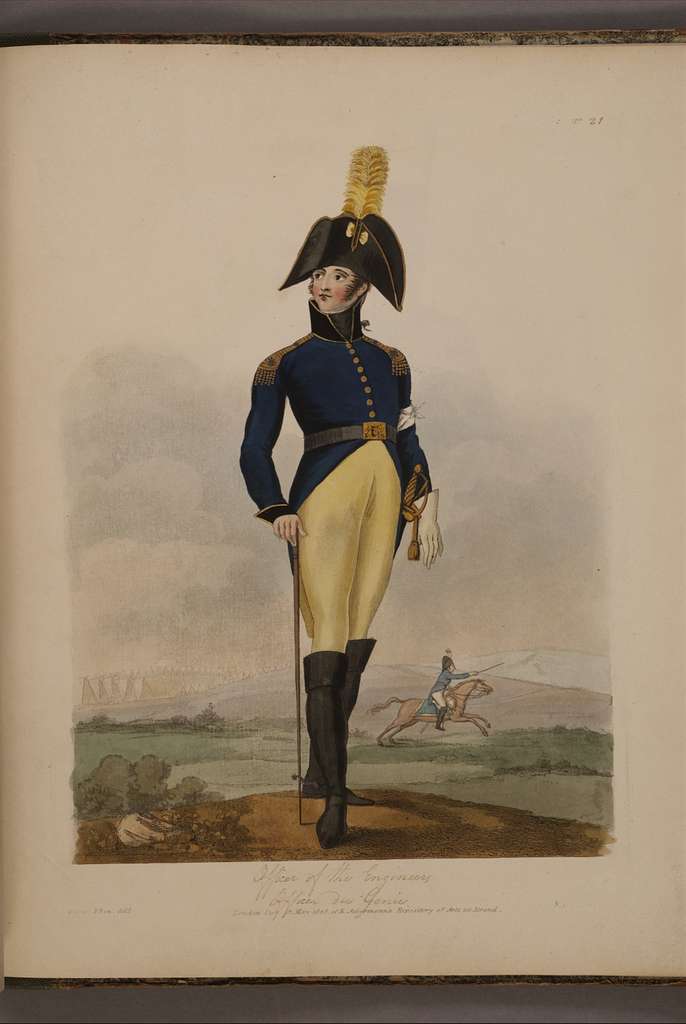
The miniature is supposed to look like a Swedish general who commanded the 4th brigade at Oravais in september 1808 (lt. col. Cedergren). He wears the uniform of the fortification (engineers) branch of the Swedish army, model 1802. I am not as pleased with this figure as I was with my other commanders, but I think that is down to the original figure. He and his horse are a bit too chubby. Also, the white on the horse looks a bit strange through the camera. Still, the blue and yellow colors work well, and as long as I dont look too closely, he will do just fine.
The model 1802 uniform as seen in the contemporary illustration by Eben.
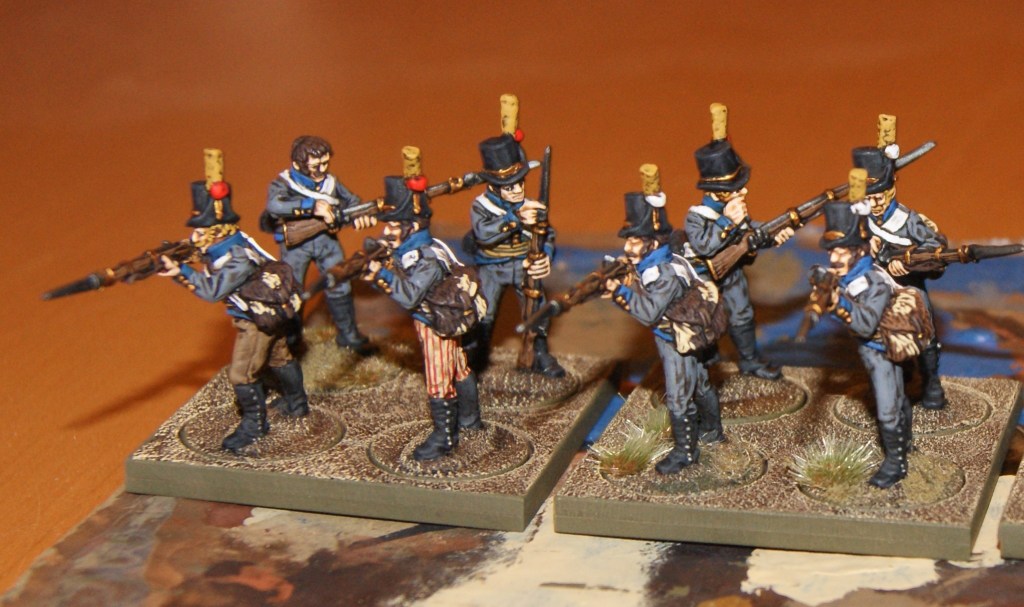
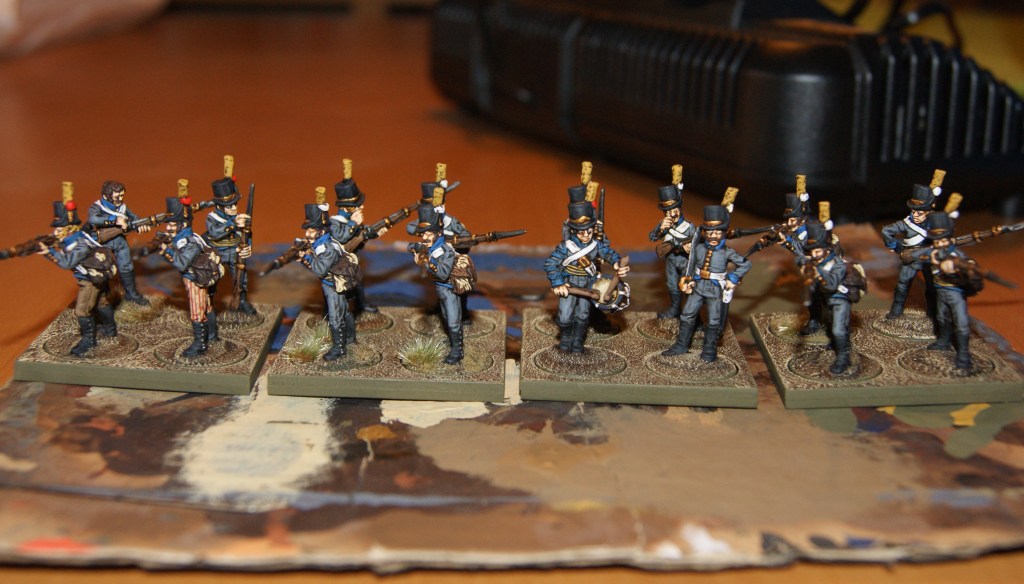
I havent done much painting lately, but I managed to finish one more Finnish battalion. This one does not have a flag, which was the case with the reserve (vargering) and so-called rusthållsbataljoner. The latter were formed in the 18th century, when a number of Finnish cavalry regiments were disbanded and converted into infantry. The former cavalry units were added to the existing infantry regiments, in which they formed extra battalions (normally, the regular regiments of the Swedish army consisted of two battalions).
The uniforms are the grey and blue worn by the Nyland and Björneborg regiments. The Åbo regiment wore a slightly darker blue facing color. I have painted them in a darker shade, but if I were to start over, I would do all three regiments in the same blue facing color, as the difference is hardly noticable on the tabletop. The grey-and-blue color scheme is also appropriate for the regiments which had received the new model 1807 uniform (with the same facing color for all regiments).
For these, I also varied the color of the trousers on a couple of figures. I will try and do this on more of my figures in the future, as I know that many regiments of the Swedish army in Finland had very well worn clothes by the summer of 1808.
We played scenario 4 (if I remember correctly) of the 29 let’s go campaign this evening. I played the German side. I used a motley selection of figures that I felt fit the Normandy setting relatively well. The game opened with me deploying a section in one of the central buildings. At first I thought this was a mistake, they were immediately pounded by a Sherman. But they survived. And this also lured my opponent into deploying his infantry in the bocage in front of the building. This led to them being caught in a crossfire out of which the Americans were not able to escape. One squad was wiped out entirely. In addition the Marder was able to engage and put some some shock on one of the tanks, while the leiG 18 and MMG hurt the American infantry even more. At that point my opponent threw in the towel.
The last game we played I felt that the Germans had no chance whatsoever of winning and was therefore surprised at the outcome this time around. The forces involved were pretty much the same. I think we both made mistakes, but I did roll better dice than I usually do.