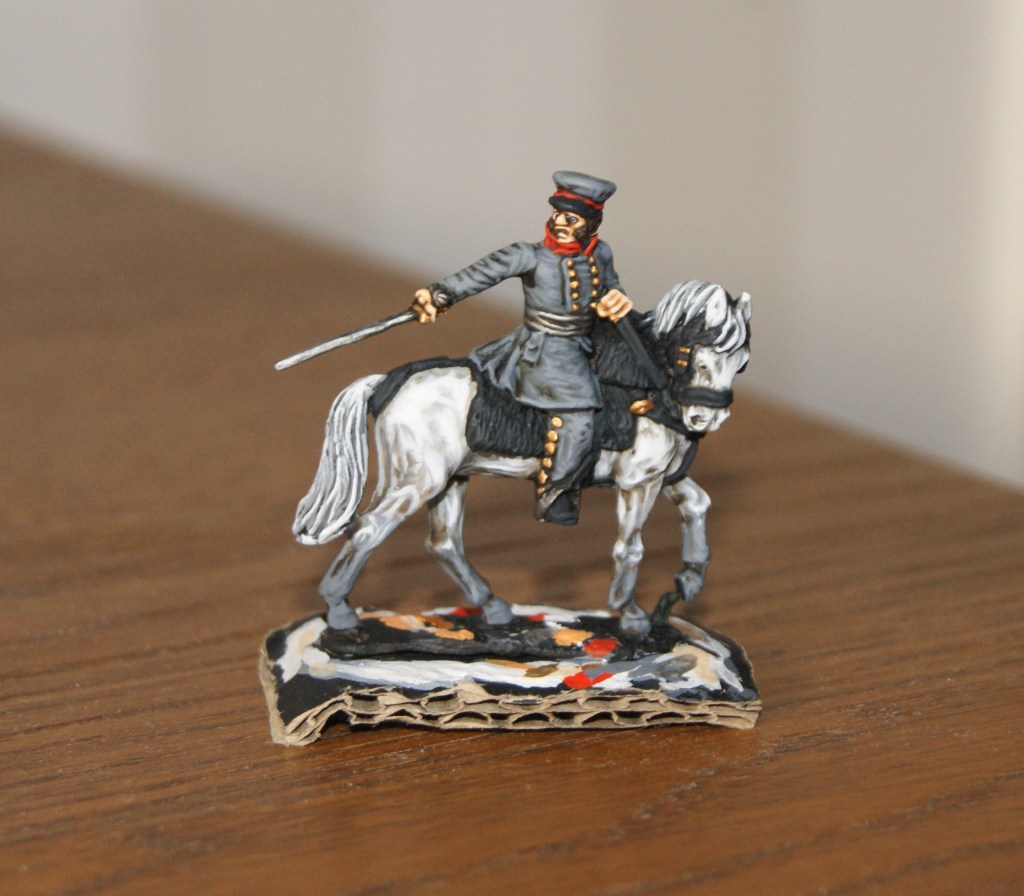
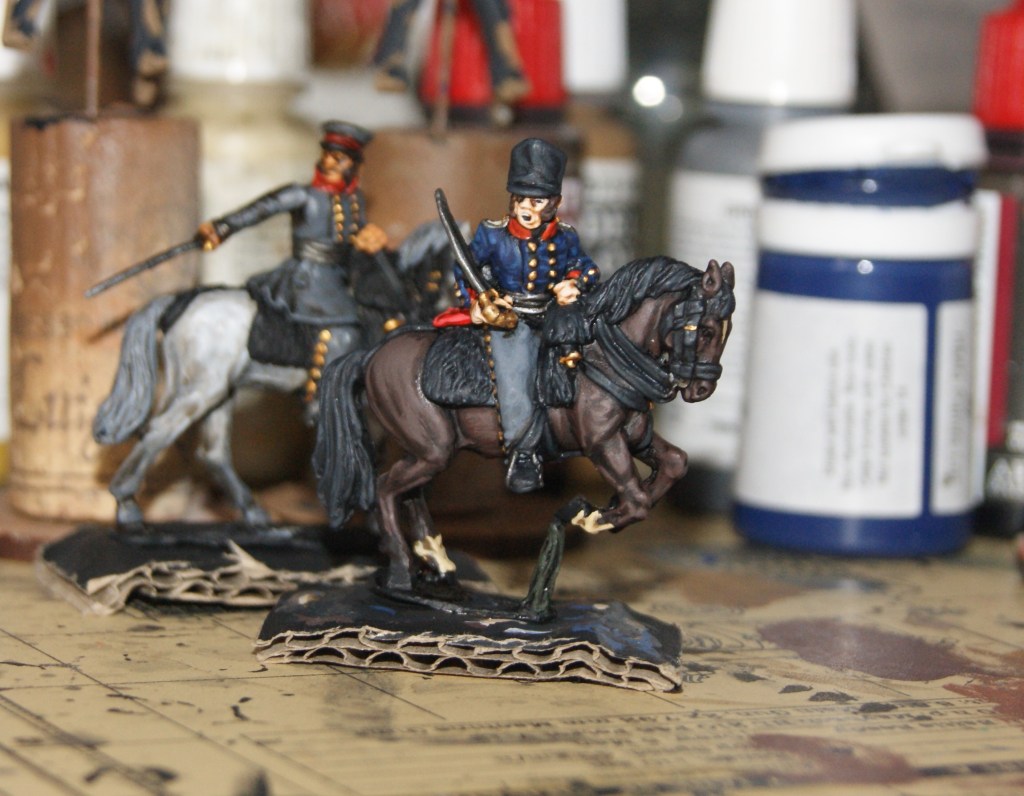
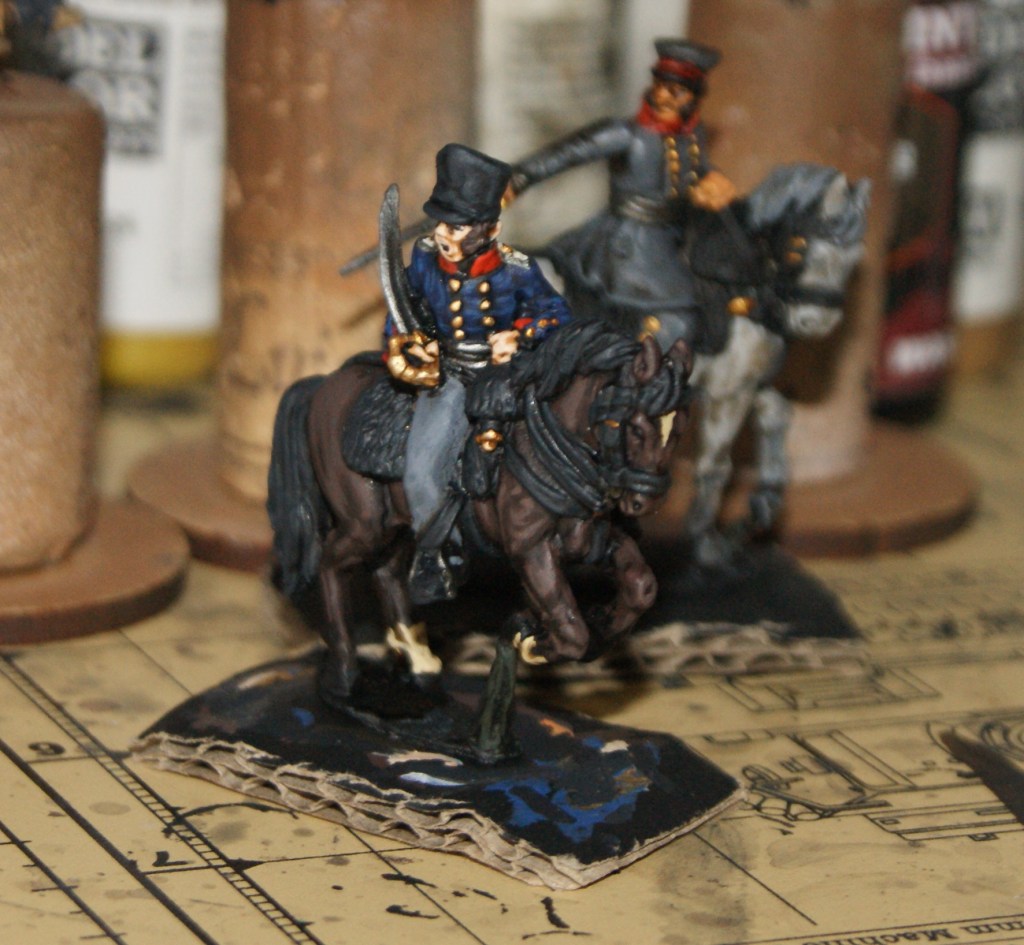
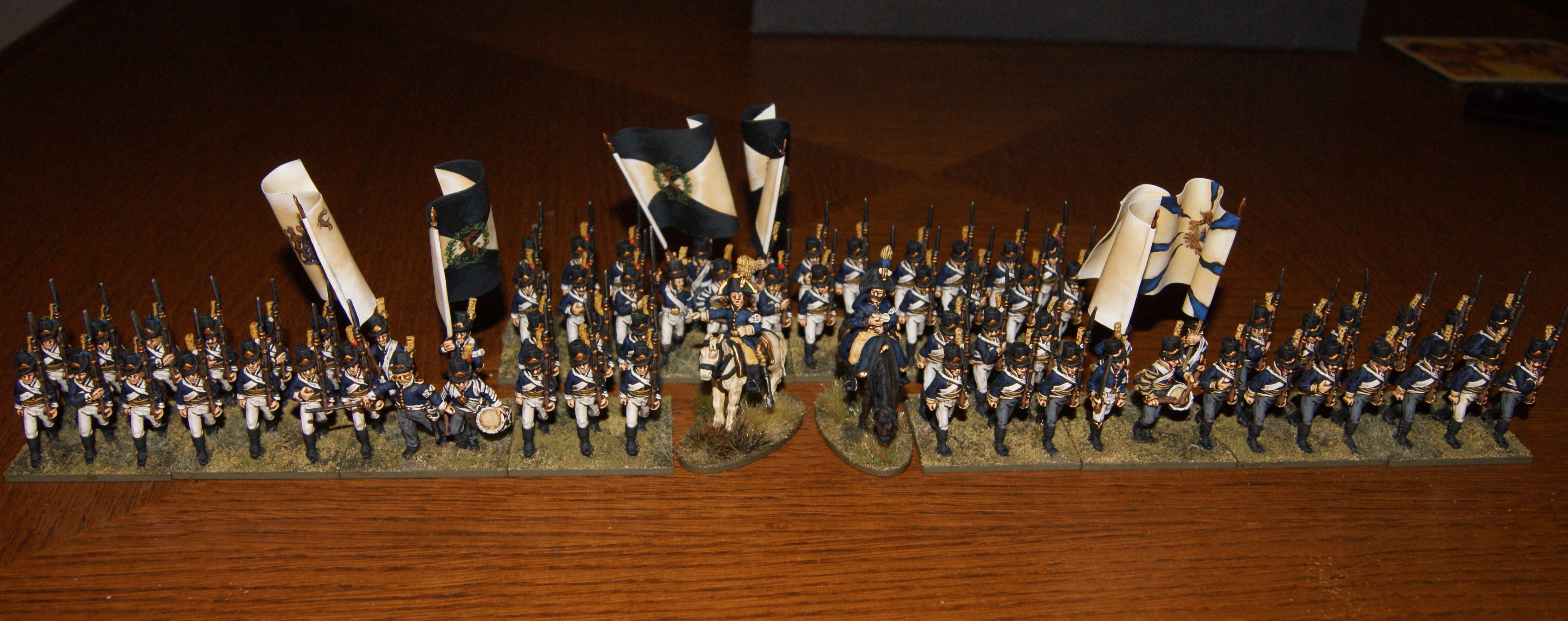
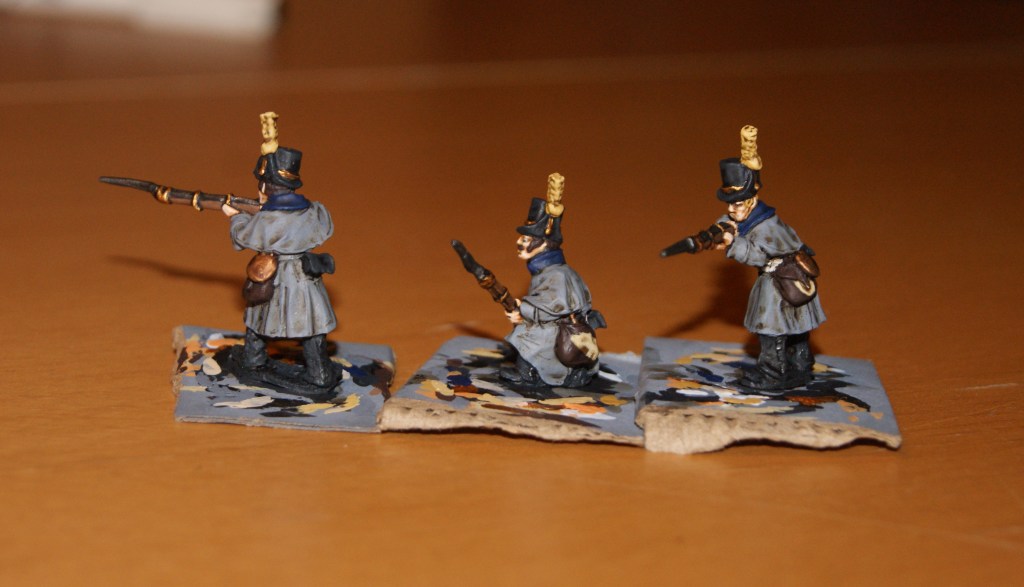
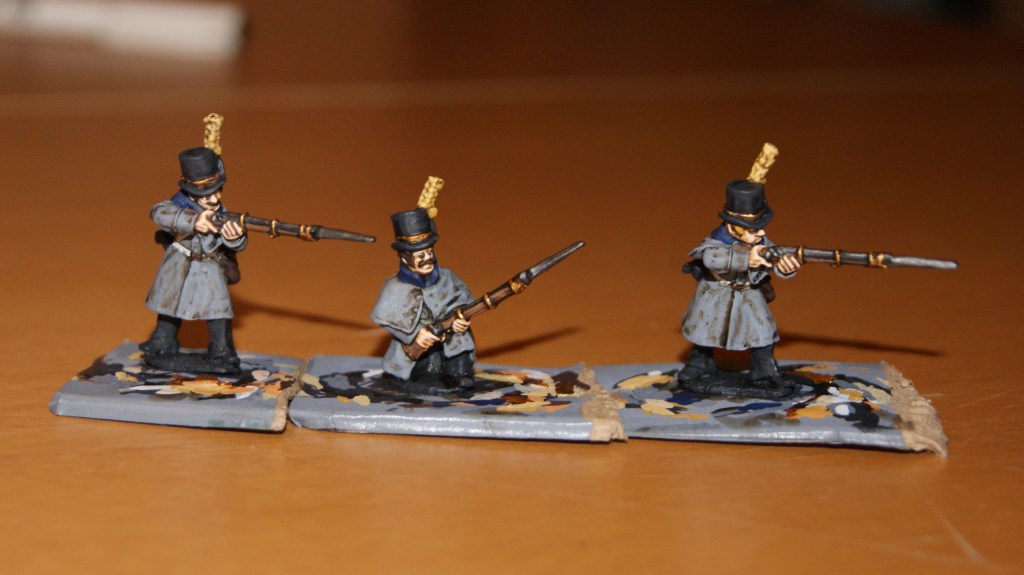
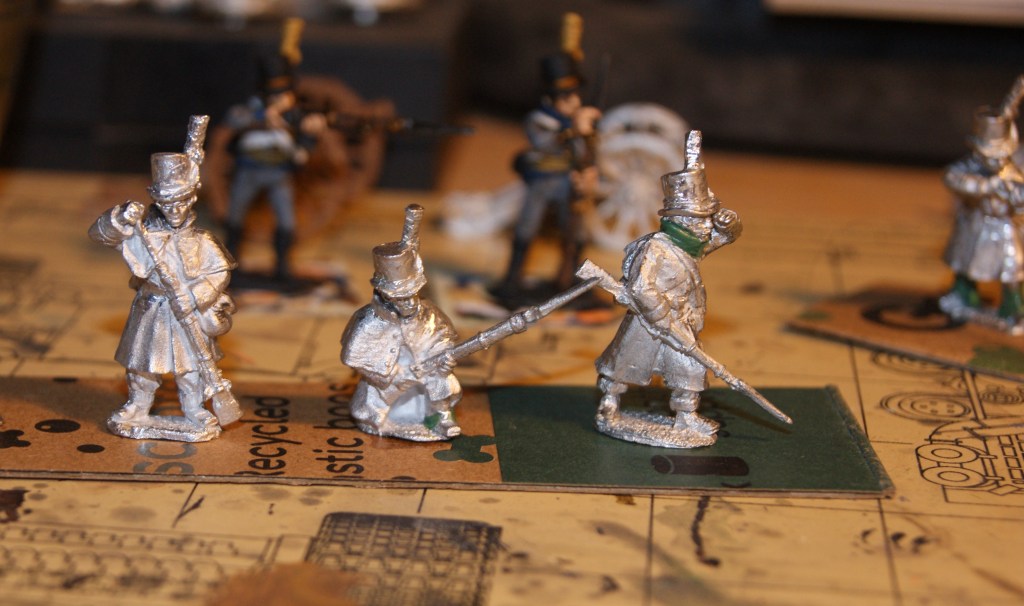
As I have been working on painting the Swedish and Finnish troops which took part in the war in Finland in the summer of 1808, I thought I might as well publish a short order of battle for this campaign. If nothing else, this will help myself keep track of what I am doing. If it can also serve as an aid to someone else, so much the better.
Introduction
What this army should actually be called could be made into a complicated question if one wanted to delve deeper. The terminology for and divisions of the armed forces used by the Swedes at this time is rather confusing. For my purposes it will suffice to say that there was, first of all, a main Finnish field army.
At the start of the war, some units were stationed in the fortress at Sveaborg. This was a large contingent which made up about a third of the army in Finland (around 6000 infantrymen). However, all of it was lost when the fortress was surrendered in early May. They therefore took no significant part in the war and I will leave them out. Some of these soldiers, who were allowed to return to their alloted homesteads, did end up as volunteers in the free corps.
The Finnish army
The remaining field army consisted on the one hand of the so-called alotted (indelta), semi-professional, regionally based standing regiments: the Åbo, Björneborg, Tavastehus, Nyland, Österbotten and Savolax infantry regiments. These regiments were all named after the province of Finland in which the soldiers and officers lived and worked the farms they had been alotted. Beside these alotted regiments were the enlisted (värvade), but equally semi-professional, jäger regiments: Savolax jägarregemente and Karelska jägarkåren; the Nyland jäger battalion was odd in that it was roughly half alotted and half enlisted. The enlisted soldiers often either worked in garrisons and as night watchmen in towns, or as artisans, to earn a living to complement their meager soldier’s pay. The Finnish artillery regiment was enlisted too, but the Finnish cavalry (Nyland and Karelian dragoons) was alotted.
Naturally, the main field army was made up of these regiments which were based in Finland. At the outbreak of war, a battalion of the Västerbotten regiment, based in the far North of Sweden (bordering Finland) was also present. It was brigaded separately in a weak 6th brigade, but as such still counted as part of the “Finnish” army.
The Swedish division
To the Finnish field army a Swedish division (fördelning) of two brigades was added in August, consisting of regiments based in central and Northern Sweden (Upplands, Västmanlands and Hälsinge regts.). These were part of the substantial force gathered by king Gustav IV Adolf in Åland. The original intention was to carry out landings in southern, Russian-held Finland. The attempts to land troops failed and were abandoned when the Russian archipelago fleet managed to gain the upper hand around the coast of southern Finland. After some delay, the majority of the Swedish division was transferred as reinforcements to the Finnish army on 27 August. They saw action at Lappfjärd two days later. The 1st battalion, Västmanlands regt. arrived the day after the battle, and the 2nd battalion of the same regt. arrived two weeks later. Unfortunately, the Swedish division was only 7 battalions out of around 30 that had at one time been concentrated in Åland, destined for Finland. In September, new attempts at landings were made, which again failed.
The Fieandt detachment
Besides this there was a detachment (commanded by major von Fieandt), a roughly brigade-sized unit which acted independently to guard an important road intersection, protecting the flank of the main army. The detachment consisted of elements from the field army, collected piecemeal from the main brigades (brigades 1-4).
Gyllenbögell’s free corps
There was also a free corps (under captain Gyllenbögell), also brigade-sized, consisting of volunteer and militia. The free corps brought together volunteers, former soldiers and peasant farmers who joined the army as lantvärn, a rudimentary militia organization. To this was added officers and NCO:s from the regular regiments, some of them from the regiments which had surrendered at Sveaborg.
The lantvärn was similar in concept to the Prussian Landwehr, although the Swedish and Finnish system was never as well organized. The lantvärn troops are generally considered to have been a failure, although Gyllenbögell’s corps itself was relatively successful. The common folk of Finland seem to have been somewhat eager to join, at least in the early part of the war. The officers on the other hand, tended to view the lantvärn with suspicion, partly for military and perhaps partly for political reasons. There was also a definite shortage of weapons and equipment, which limited the numbers that could be fielded effectively with short notice (the war in Finland only lasted less than 10 months). Despite this, the free corps arrived in mainland Finland in early August and saw action almost immediately.
The Savolax brigade
The above mentioned elements are the units I will concentrate on for the moment. There were also other contingents to the Swedish army of 1808-1809. There was a 5th Finnish brigade which operated in the eastern part of Finland: this unit was independent of the main field army and participated in a different style of fighting. The 5th brigade was mostly made up of battalions from the same regiments as the main field army. As they operated separately, they could be represented (by the wargamer) using the same figures, as long as you are prepared to let a first battalion play the role of a second battalion, and make other similar minor adjustments. In other words: if you have painted enough figures to represent the main field army, you will have what you need to also represent the smaller actions of the 5th brigade. This is how I have reasoned anyhow!
According to a long standing plan for the defense of Finland, the units that were meant to serve the role of a separate force defending the sparsely populated eastern areas facing the long Russian border, in the provinces of Savolax and Carelia, had been organized into a permanent brigade (the Savolax brigade). This was made up of the regiments based in the area, i. e. the Savolax infantry regiment, Savolax and Karelian jägers, the Karelian dragoons and the Savolax artillery company. These units were organized as battalions of half the strength of normal battalions (one battalion of two companies instead of four). This was intended as an adaptation to the smaller scale fighting expected and the difficult terrain of the area. This was clearly a clever concept and it also turned out that the eastern area of operations was the only part of the war in which the defense was truly successful. Here, lakes and rough terrain made it possible for a small force to tie up a much larger Russian army. However, the odd thing is that the Savolax brigade which was destined for this role was only partly used there. Instead, much of it was soon transferred to the main field army (as the 4th brigade), while other units were stationed in the east. I am not entirely sure of the reasons for this, but I suspect that it may have to do with the fact that the best troops were needed elsewhere, where the fighting was going less well.
The rest of the Swedish army?
As has already been mentioned, significant forces were being gathered on the island of Åland in the summer of 1808, for use in landings behind the Russian lines. Some of them were in fact used at the failed landings at Lemo (19 June) and Helsinge (26 September). There is also the Swedish regiments that took part in the fighting in Västerbotten (on the Swedish side) in 1809, and of course the rest of the Swedish army which was being held back for the defense of Sweden proper. Indeed, one of the main reasons for the Swedish strategic defeat in the war was the fact that it was threatened from all sides: not only the Russians in the East, but a Danish-French invasion from the South, or a Danish attack from Norway had to be taken into account.
The battle of Sävar in Västerbotten (August 1809) in particular is an interesting case: this was one of the largest of the war and also one of the bloodiest with high casualites on both sides. A large number of Swedish regiments, including guard and grenadier regiments, took part – but none of the Finnish troops, most of which had surrendered, disbanded or perished by then. Therefore, it would make a significant project in itself, and would need an entirely separate order of battle. Consequently, these will not be included here, as my focus is the campaign during the summer, in western Finland, in 1808.
The orders of battle
I have written up two orders, for July and September. As you can see, the exact composition of the brigades varied over time, and therefore these two versions together will give a good overview of the 1808 Swedish army in Finland. The main difference, however, is that the latter order includes the newly arrived reinforcements of the Swedish division and the freshly organized free corps. The orders are both based on the information in the old standard history of the war, Sveriges krig åren 1808 och 1809, volumes 3 and 5.
All in all, this amounts to less than 30 battalions of infantry in the later order, including the reinforcements and free corps. The Finnish field army on its own is just under 15 battalions, and that is also roughly the maximum number of battalions fielded by the Swedes in any one single engagement in Finland (Lappo, Oravais, Ruona-Salmi). In terms of collecting and painting figures, you will probably not need more than 25 battalions for the whole thing, and could certainly represent many battles with only half of that. If you are only starting out, the Fieandt detachment might be a good place to begin, as the units included are a good core that can then be expanded into the regular brigades later on.
Note on artillery
The guns listed are 3-pounders of various models, unless otherwise indicated. The 6-pounders are the modern (model 1804) iron guns. The 4-pounder howitzers are captured Russian unicorns. All artillery was at this time organized as “åkande”, i. e. a form of foot artillery where all crew travelled on the horses or gun carriages to make it more mobile (halfway towards horse artillery). The Swedish army did also have proper horse artillery batteries, as did the Russians, but none of these were ever used in anger in Finland as far as I know.
Note on cavalry
It should be noted that the squadrons of the Finnish cavalry were small: the Nyland light dragoon regiment consisted of 8 squadrons each of just short of 70 men (at full strength); the Karelian dragoons consisted of 2 squadrons of 100 men each. Both these units were light dragoons, as were the Horse Life guards (previously known under various names such as the “Finnish light dragoons”, even the “Life Hussars” etc). The Horse Life guards started out as an enlisted Finnish regiment, but at the time of the war it had been relocated to the area around Stockholm.
All cavalry was used almost exclusively in light roles: reconnaisance, guard duty and as mounted jägers (skirmishing on horseback). Reading descriptions of the proper set-piece battles, it is clear that there was never any real “battle cavalry” on the Swedish side during the Finnish war, and certainly no heavy cavalry to fulfil that role.
The strength in effective combatants (officers and other ranks) on the given date of each respective unit is given in italics within parentheses (400). This gives a good indication that the battalions in the Finnish army were never close to their paper strength of (in most cases) 600 men. Instead, battalions were typically 400-450. Half-battalions and detachments of one or two companies were also very common, which adds to the overall impression of a large number of small units.
One exception is the three half-battalions of the Savolax infantry regiment. These seem to have numbers exceeding their paper strength! This can only be explained by the addition of reserves (vargering). These were initially organized in a reserve battalion, but presumably later integrated into the existing half-battalions.
Order of battle, Army of Finland
10 July, 1808
Commander: Major general Carl Johan Adlercreutz
1st brigade (col. August Fredrik Palmfelt, Åbo regt.) (840)
2nd (381) and ½ (235) of 3rd battalion, Åbo regiment.
2 squadrons of the Nyland dragoons (106).
Finnish artillery regiment, 8 guns (2 6-pounders) (118).
2nd brigade (col. Georg Carl von Döbeln, Nyland regt.) (2365)
1st (452), 2nd (444) and 3rd (466) battalions, Björneborg regiment.
1st battalion, Österbotten regiment (including one company of 2nd battalion) (725).
3 squadrons of the Nyland dragoons (176).
Finnish artillery regiment, 6 guns (4 6-pounders) (102).
3rd brigade (col. Hans Henrik Gripenberg, Tavastehus regt.) (1992)
1st (471) and 3rd (391) battalions, Tavastehus regiment and ½ (279) of 2nd battalion.
2nd battalion, Nyland regiment (373).
½ battalion, Nyland jägers (186).
3 squadrons of the Nyland dragoons (201).
Finnish artillery regiment, 6 guns (4 6-pounders) (91).
4th brigade (col. Johan Adam Cronstedt, Savolax regt.) (2162)
1st, 2nd and 3rd half-battalions, Savolax regiment (878).
1st and 2nd half-battalions, Savolax jäger regiment (462).
1st and 2nd half-battalions, Karelian jäger corps (553).
1 squadron of the Karelian dragoons (83).
Finnish artillery regiment, 6 guns (4 6-pounders; 2 4-pounder howitzers) (97).
Savolax brigade artillery company, 2 3-pounders (87).
6th brigade (col. Otto Reinhold von Essen, Tavastehus regiment) (1082)
2nd battalion, Västerbotten regiment (480).
Field battalion (Västerb. regt., with recruits (vargering) of the Jämtland regt.) (526).
¼ squadron, Jämtland Horse jägers (28).
Swedish artillery regiment, 3 3-pounders (49).
Detachment von Fieandt (maj. Otto Henrik von Fieandt, Tavastehus regiment) (1315)
4th half-battalion, Savolax regiment (199).
½ of 2nd battalion, Tavastehus regiment (135).
1st battalion, Nyland regiment (389).
3rd half-battalion, Savolax jäger regiment (138).
1st battalion, Åbo regiment (364).
1/3 squadron (Nyland and Karelian dragoons) (34).
Finnish artillery regiment, 2 6-pounders (22).
Savolax brigade artillery company, 2 3-pounders (34).
Order of battle, Army of Finland
1 September, 1808
Commander: Major general Carl Johan Adlercreutz
1st brigade (lieut. col. Heribert (sic!) Conrad Reuterskiöld, Åbo regt.)
2nd and 3rd battalions, Åbo regiment (395; 379).
1 squadron of the Nyland dragoons (?).
Finnish artillery regiment, 2 3-pounders (37?).
2nd brigade (col. August Fredrik Palmfelt*, Åbo regt.) (2523)
1st, 2nd and 3rd battalions, Björneborg regiment (1580).
1st battalion, Österbotten regiment (including one company of 2nd battalion) (742).
3 squadrons of the Nyland dragoons (138).
Finnish artillery regiment, 11 guns (4 6-pounders) (63).
* Palmfelt was only temporarily in charge of the brigade during von Döbeln’s absence due to illness. Döbeln returned on the eve of the battle of Jutas, 13 September.
3rd brigade (maj. gen. Hans Henrik Gripenberg*, Tavastehus regt.)
1st and 3rd battalions, Tavastehus regiment and ½ of 2nd battalion (1508).
2nd battalion, Nyland regiment (449).
¾ battalion, Nyland jägers (275).
2 squadrons of the Nyland dragoons (?).
Finnish artillery regiment, 6 guns (4 6-pounders) (?).
* Gripenberg was promoted to major general on 31 July.
4th brigade (col. Nils Cedergren, engineer corps)
1st, 2nd and 3rd half-battalions, Savolax regiment (200; 179; 316).
1st and 2nd half-battalions, Savolax jäger regiment (374).
1st and 2nd half-battalions, Karelian jäger corps (416).
1 squadron of the Karelian dragoons (67).
Finnish artillery regiment, 6 guns (4 6-pounders; 2 4-pounder howitzers) (88).
Savolax brigade artillery company, 2 3-pounders (90).
6th brigade (col. Otto Reinhold von Essen, Tavastehus regiment)
2nd battalion, Västerbotten regiment (incl. jäger company) (465).
Field battalion (Västerb. regt., with recruits of the Jämtland regt.) (387).
Nyland dragoons (98?).
Jämtland horse jägers (15).
Svea artillery regiment, 5 3-pounders (69).
Detachment von Fieandt (major Otto Henrik von Fieandt, Tavastehus regiment) (1818)
4th half-battalion, Savolax regiment (273).
2nd battalion, Tavastehus regiment (493).
1st battalion, Nyland regiment (326).
3rd half-battalion, Savolax jäger regiment (231).
1st battalion, Åbo regiment (327).
1 squadron of the Nyland dragoons (58), with 13 men of the Karelian dragoons.
Finnish artillery regiment, 2 6-pounders (62).
Savolax brigade artillery company, 2 3-pounders (35).
Gyllenbögell free corps (capt. Anders Gyllenbögell)
Free battalion (volunteers)
Sharpshooter battalion (former soldiers)
Malax lantvärn battalion
Närpes lantvärn battalion
Recruits of the Västerbotten and Jämtland regiments
Swedish division (maj. gen. Eberhard Ernst von Vegesack)
1st brigade (adj. gen. Adolf Ludvig von Schwerin)
1st and 2nd battalions, Uppland regiment.
1st battalion, Västmanland regiment.
Jäger battalion (Uppland and Västmanland regts.).
Svea artillery regiment, 6 6-pounders.
2nd brigade (col. Fredrik Christian von Platen)
1st, 2nd and 3rd battalions, Hälsinge regiment.
Svea artillery regiment, 2 3-pounders.
Unbrigaded (Swedish) units
2 field-squadrons, Horse life guards
Engineers













 Pancratist