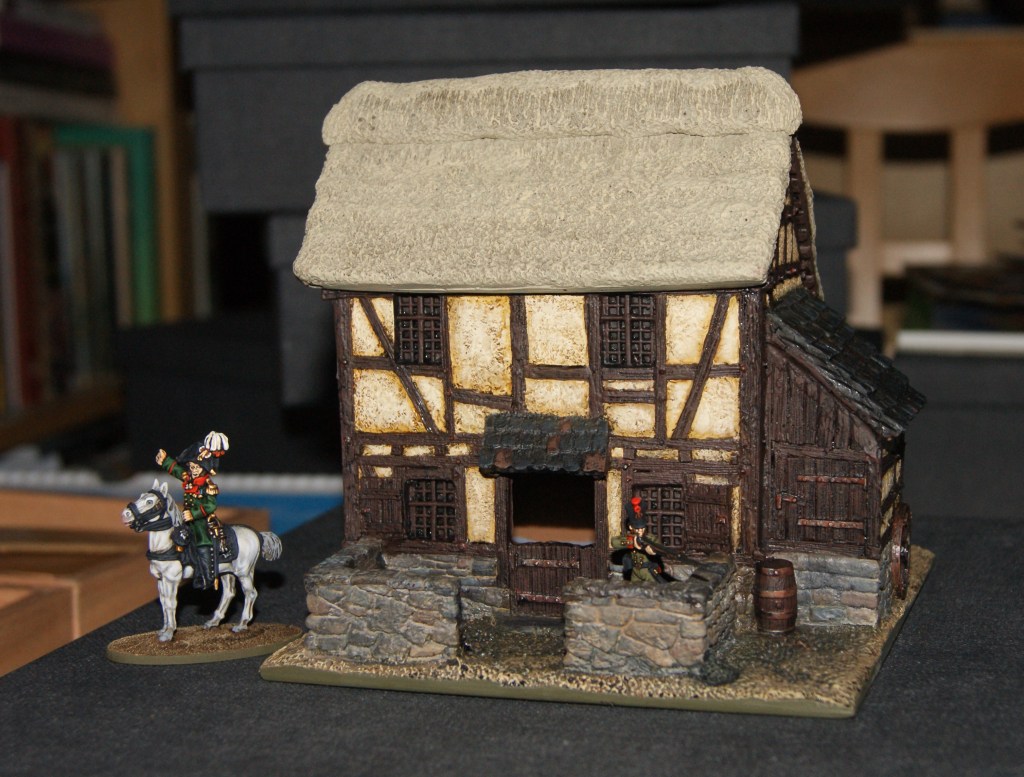
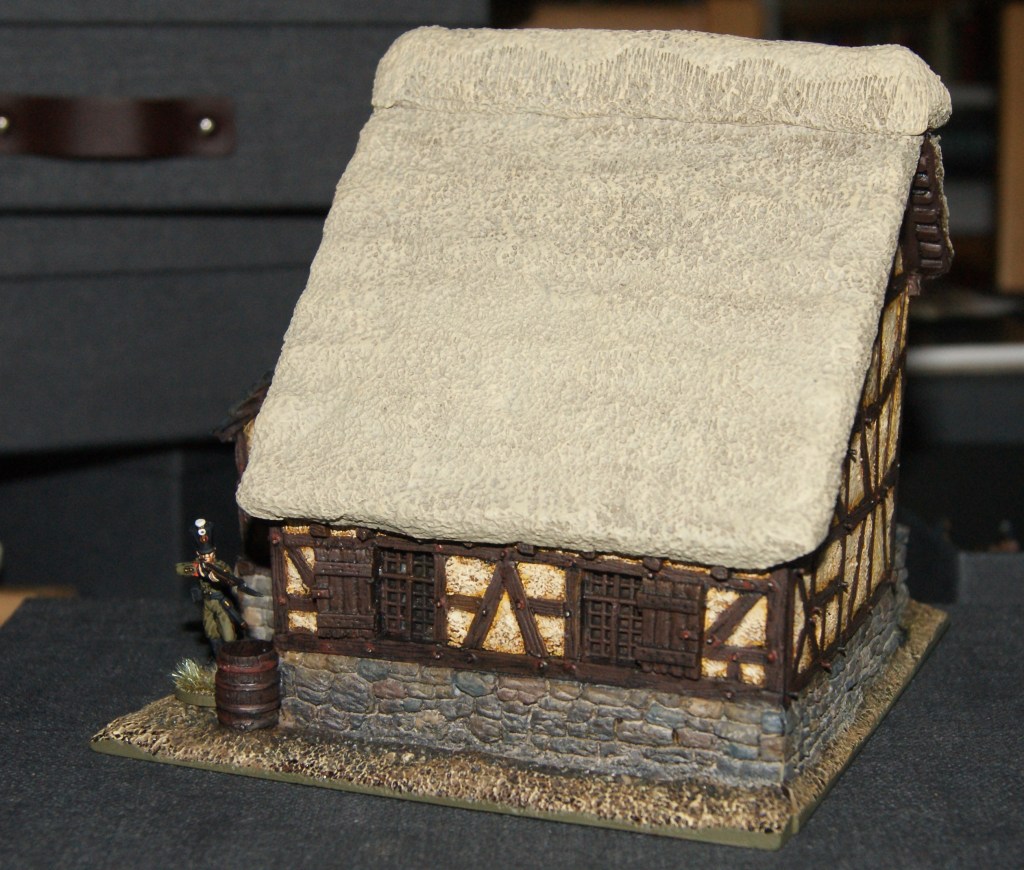
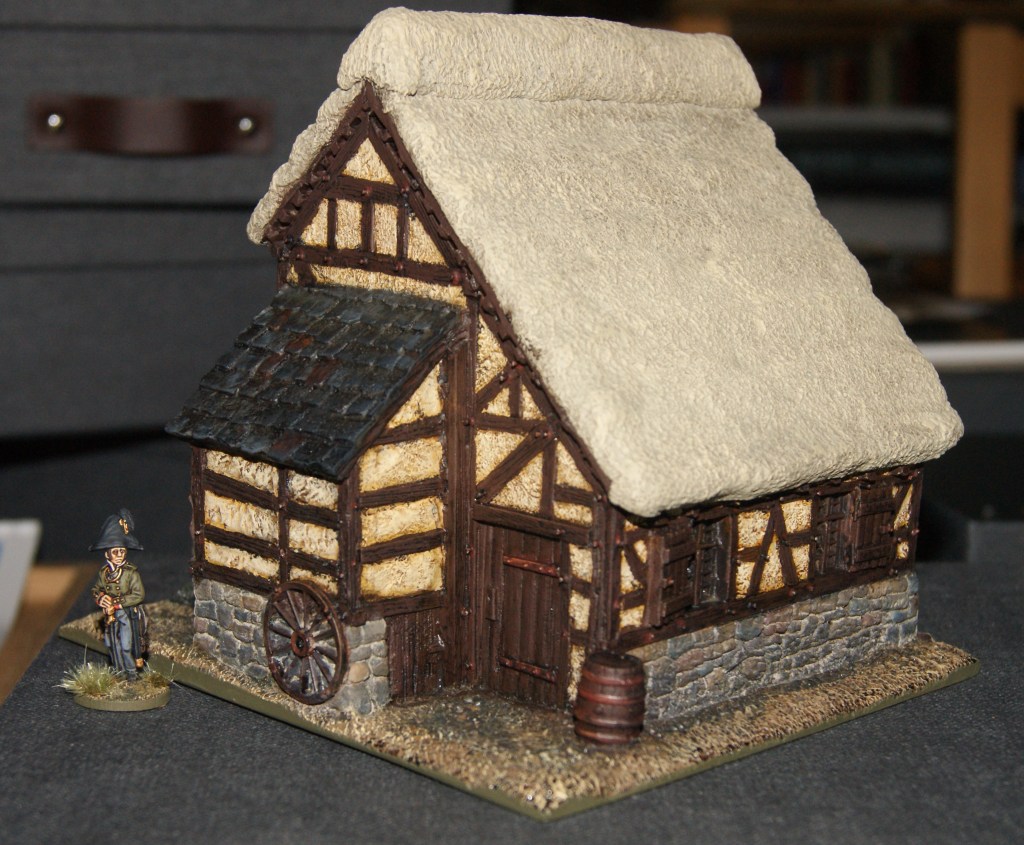
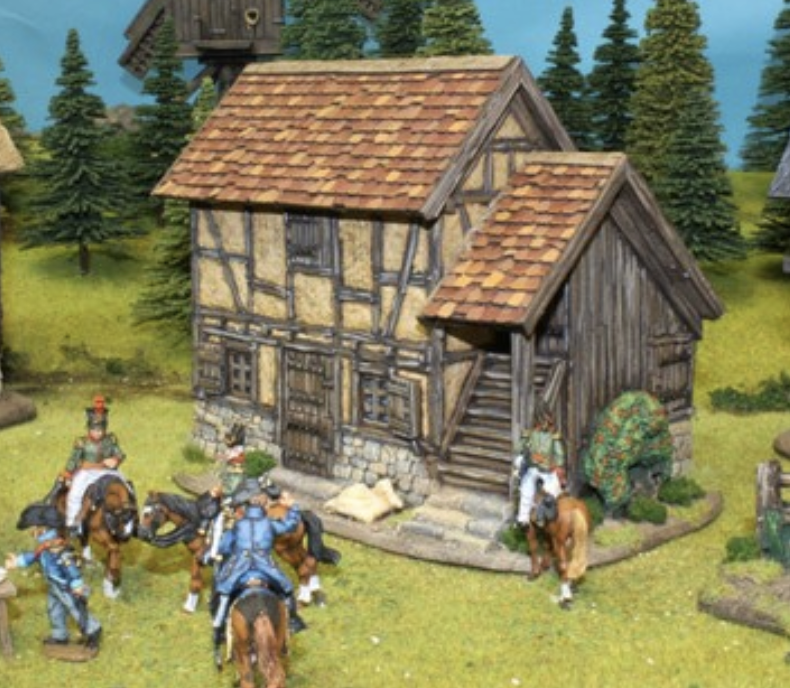
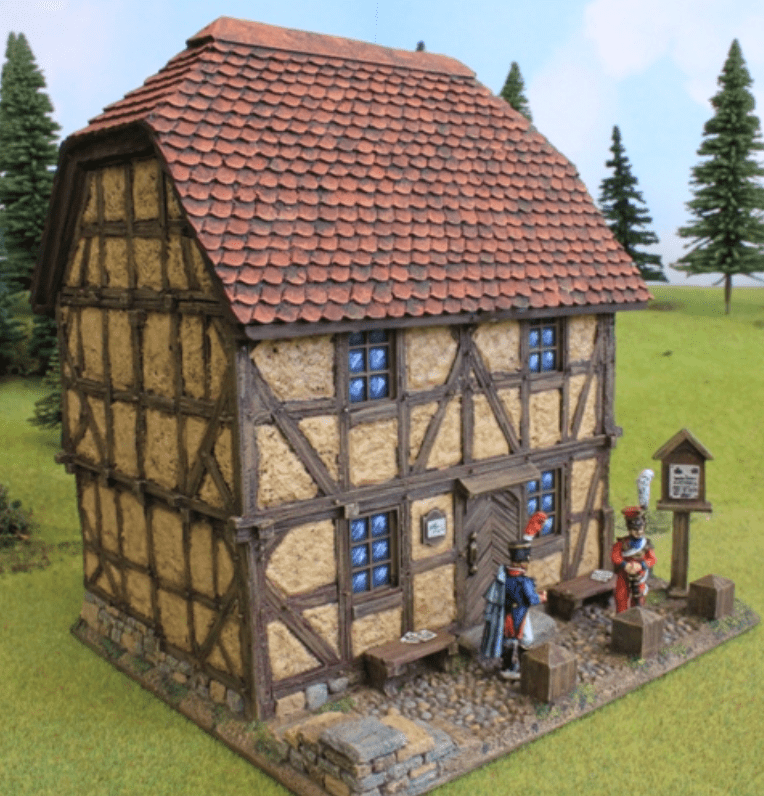
I have been busy continuing with my work on the resin buildings I acquired from Grand Manner shortly before they closed down. This time it is some kind of cottage. A beautiful model, but I do wonder if the designer hasnt forgotten a chimney? Even so, the model was a pleasure to paint, with no cleaning up to be done apart from a quick wash with washing up liquid before priming. There was some air bubbles on the detacheable interior, but I havent started that yet. I reckon that having the exterior on as many as possible of the buildings painted to a decent standard was a higher priority.
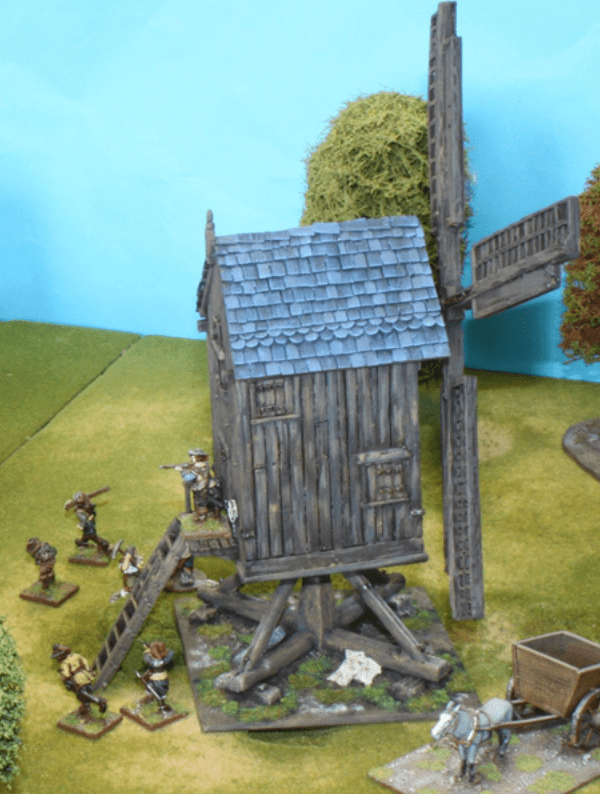
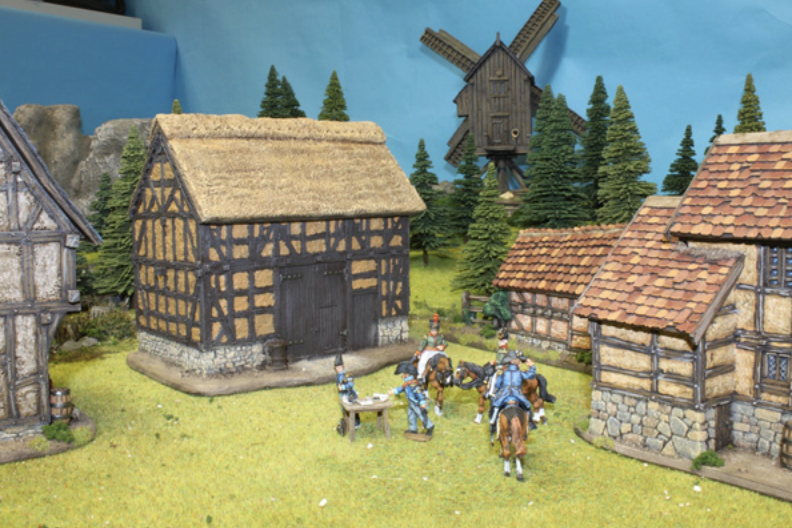
The first of the Grand Manner buildings Ive managed to finish is the humble (although quite large) Prussian barn. As I think you can see from the images above, the model is perfectly detailed, with excellent looking wooded frame and straw roof. I should also say that this model required next to no preparation at all, as there were no air bubbles or flash on it.
I fiddled a bit more than usual trying to find the best way to paint all that detail relatively efficiently. In the end this turned out to be a standard base coat-shading wash-highlight, with the highlighting being partly drybrushing. If you want to pick out the framing and give the buildings something of the paint job they deserve, this will have to take some hours to do, no matter how fast you are. One thing I did do to speed things up was use a spray varnish. I used Winsor & Newtons all purpose matt varnish, which worked perfectly. The only difference to the brush on variant was that this product results in a slightly less matt finish. But there was nothing of the dreaded frosting (which I have had with other brands!).
At one point, I started doing a second highlight on the wood, but I abandoned this halfway through the left hand side wall. This would just have taken too long, and would not necessarily have looked that much better. In the end, I am happy with the result, and hope to do the rest soon enough. Another building (the cottage) is already base coated.
It had to happen sooner or later. Until now I have based my 1808 Swedes (and Russians) on 20mm round bases mounted in slotted movement trays. Every single figure even has a magnet connecting it to the movement tray.
The problem is that even the smallest movement trays are too big. There is no way around it. I thought it was OK for a long time, but I now realize that it really doesnt look very good, particularly for figures in a marching pose. Close order infantry marched much closer together. Also, the magnetizing system doesnt work very well. The figures dont stick to the bases quite well enough. This can be pretty irritating when gaming. At first, I thought Id protect the figures by storing the one by one in foam trays, just like I do with ww2 figures. That didnt work either – imagine having to mount 500 figures into their movement trays before each game (and were often hard enough pressed for time as it is). So that only happened twice before I gave up the whole thing. And to be honest, it has turned out that I hardly ever remove the figures from the movement trays for any other purposes either.
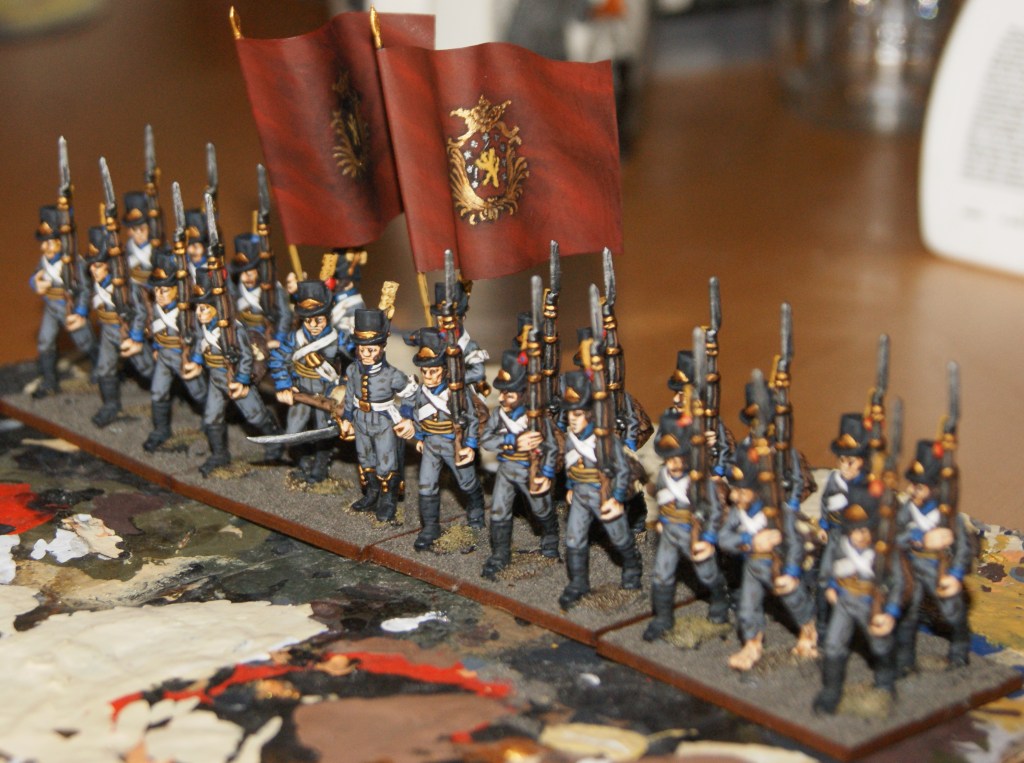
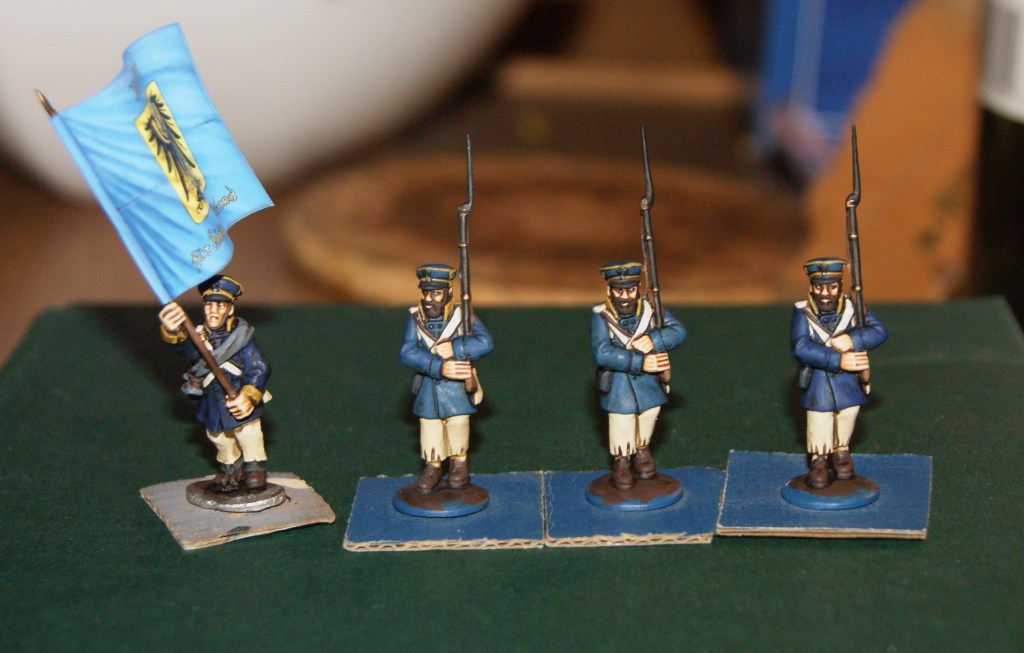
So, I decided to rebase the whole lot. Im doing them on 45x40mm bases, mdf by Warbases. Rebasing all my 1808 figures is almost 500 figures, and these are just the first 24 (23 actually!) of them. The good thing is that I can now add the correct company distinctions to the Swedish and Finnish infantry.
The downside is that I have to paint a few additional figures just to fill up the ranks, expanding what are now mostly 16- or 20-man units into 24 man units. In total, I dont need to paint much more than perhaps 100 figures or so. But itll take a while to go through the whole lot… It is also quite tempting to do larger units – but thatll have to wait! 4 bases of 6 (24 man units) is quite practical and pretty much the standard for Napoleonic wargames. But if I ever manage to paint enough figures, I can always expand from 4 bases to 6 per unit (36 man units), at least for some units.
Another thing I will add when I enlarge my units is a second flag for all battalions. I already have 2 flags per unit for the Russians, so this also had to be done at some point. The Swedish army used the exact same system of two flags per battalion as the Russians (i. e. first battalion one white (king’s) flag and one colored flag, second battalion two colored flags). The flags I paint by hand turn out really nice, but they do require some work. With this first unit (Åbo regiment, second battalion), the flag I had was the very first one I did a few years ago. I was a little worried that I wouldnt be able to match the old one, in terms of the exact color shades and the highlighting. But it worked quite well, I think.
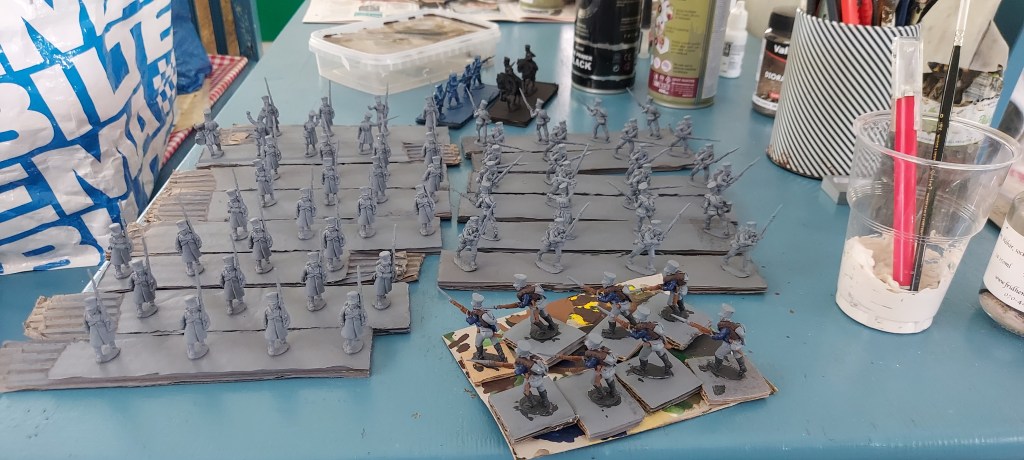
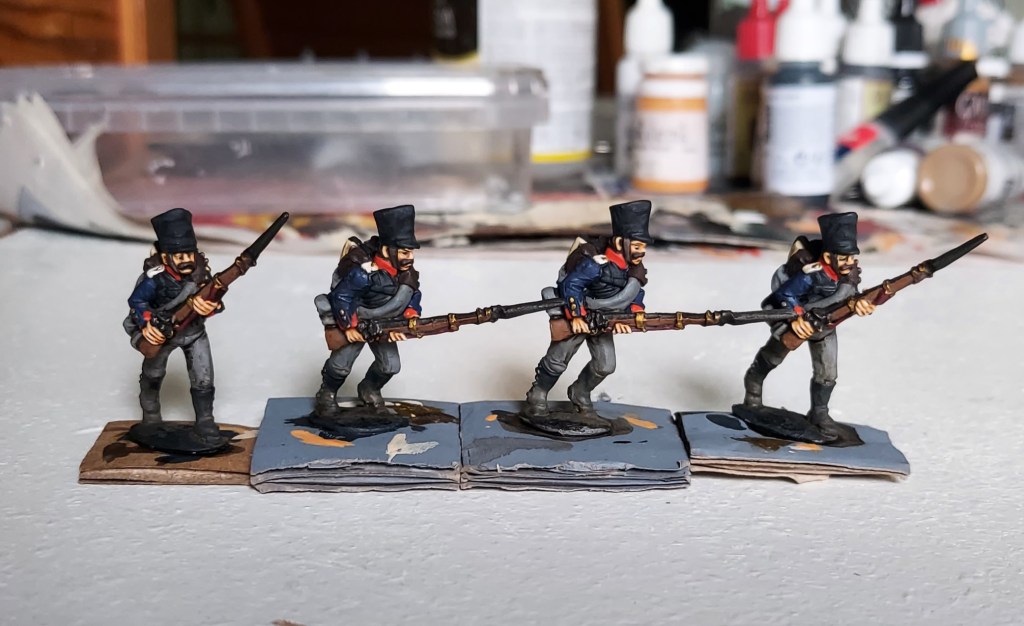
As I wrote in my last post, I havent been doing much painting lately for various reasons. In the last week though, I have been able to get back into it to some extent. I base-coated around 70 figures, all of them Prussians: a third musketeer battalion and a fusilier battalion, plus some skirmishers and two mounted colonels. I also managed to finish four fusiliers. With these Prussians, I paint to a slightly lower standard, and I can often do 4 or even 8 figures a day after preparation and a spray basecoat. When I am actually painting that is!
It’ll be a while until I can continue painting, but its a start. Together with the Prussians, I also plan to paint up four amazing-looking napoleonic buildings from Grand Manner, which I grabbed in their final sale. They are four half-timbered Prussian buildings (barn, cottage, night watchman’s cabin and the Wachau (Leipzig) meeting house) and not least a windmill (modelled after the windmill at Ligny, if I am not mistaken). Even though they were sold at a relative discount, they were still expensive. I had had them on my wish list for a long time, and now that the final sale came along, I couldnt resist them. These are the equivalent of the Rolls-Royces of wargames’ terrain pieces, with amazing detail both externally and internally. In fact, they are so detailed, it’ll be a major project painting them up. On the other hand, just one or two of these will make centrepieces for Napoleonic period games, and I suppose they work quite well for WW2 as well.
Pictures (from the GM website) of the buildings. I really hope I will be able to do them justice, they really deserve it!
That also means Grand Manner is closing down, as you may have seen (deadline for last orders is 19th of July!). However, there are only some items left in stock, and none of the ones I bought are available. Hopefully, this will only be temporary and the company taken over by someone else.
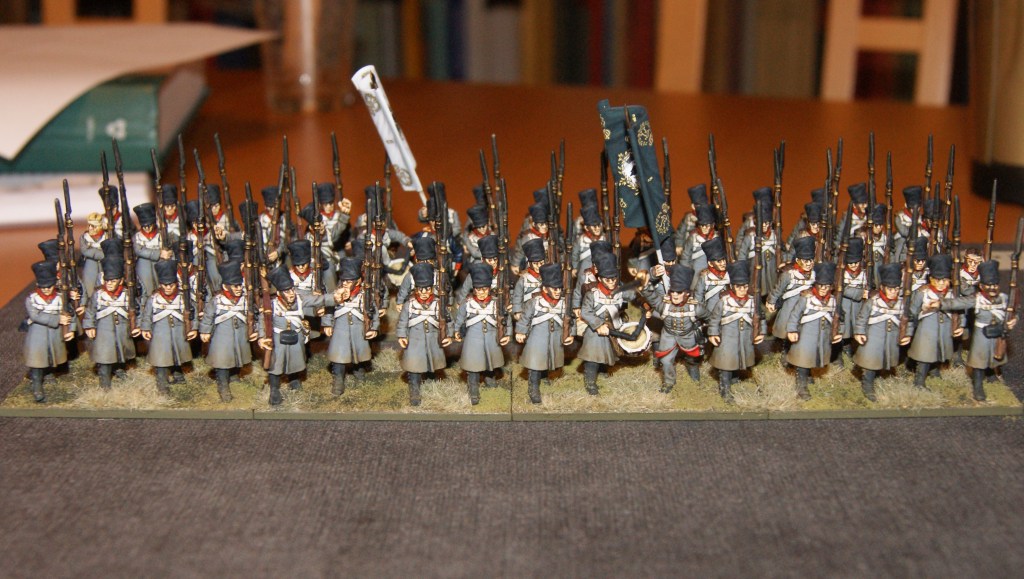
Havent posted anything in a while now – our apartement is being renovated and we have been living with relatives for more than a month. No painting! But as I hadnt posted this pic yet I thought I might as well do it. Its the first of two 32-man battalions made from my old Warlord Games figures, painted more than 5 years ago I think. These were just lying around gathering dust anyway, and now they can be used with my Prussians. Based in this way they will take up much less space. As I didnt have an even number of matching figures, I had to paint 8 new ones, which is also good, because now almost all of the old sprues I had lying around are used up! Another battalion is on the way, it lacks only 4 figures.
I have even more WG Russians, and a few Perrys too, painted in the same style. However, those will need to be complemented with large numbers of new figures to make up 32-man units (they have different shakos…). There is also some cavalry which need only a few models more to make up useful units, and they are likely to be much easier to rebase as well. At the moment I will prioritize the unpainted stuff I have before buying more of these.
I havent done much in the way of painting lately, mainly due to work and work travel. I did try my hand at some of the older Warlord Games Landwehr, as a friend had some of these lying around. Theres a variation of stuff in various states of disrepair, but much of it can be put to use.
First, I will use some of these marching types, mostly in plastic, but some in metal as well. They will complement the newer style WG Landwehr I already have. I must admit that the newer ones are much improved. But with Landwehr, there is a logic to have them not look very uniform, and I think they will mix quite well. When painted, there seems to be less difference than I first thought.
Ive now finished a second unit of 1813 Prussians. As the first, these are Perry metal figures with an officer by Calpe miniatures. In about two months, I have painted 80 Prussians. In fact, I had hoped to have done even more. But with the practicalities of life taken into account, its a good number, and almost a third of the infantry I have planned to do.
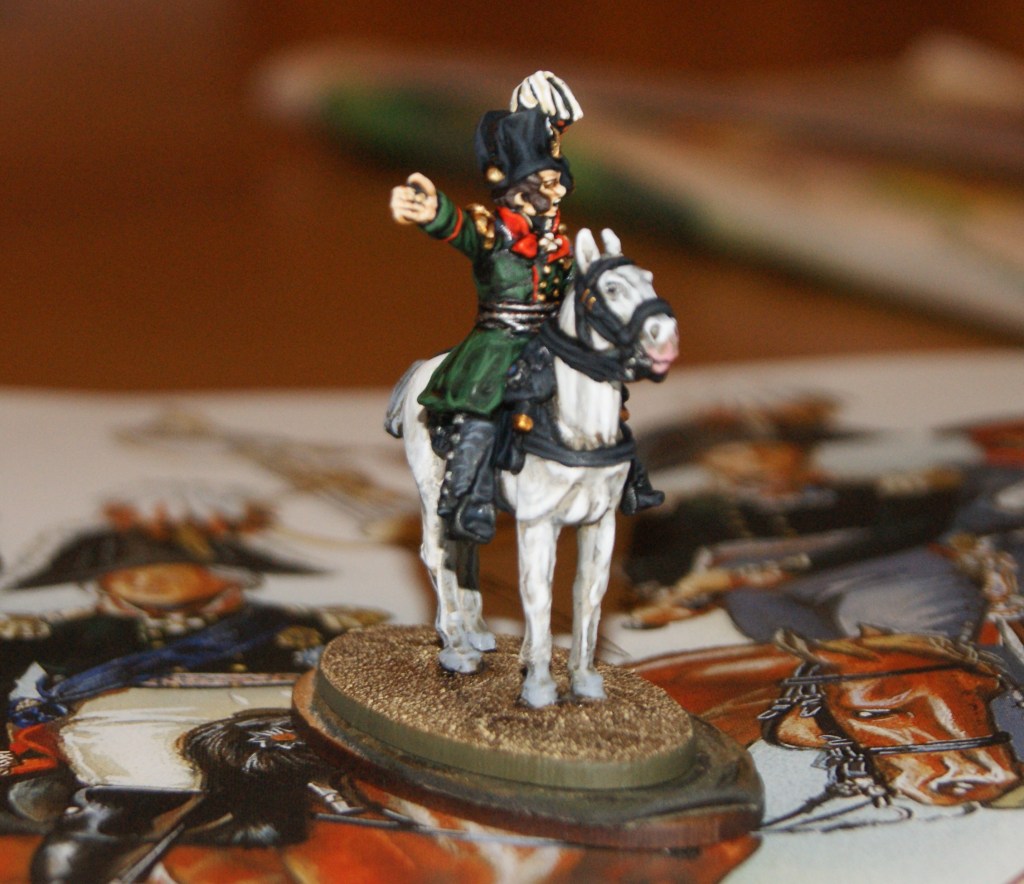
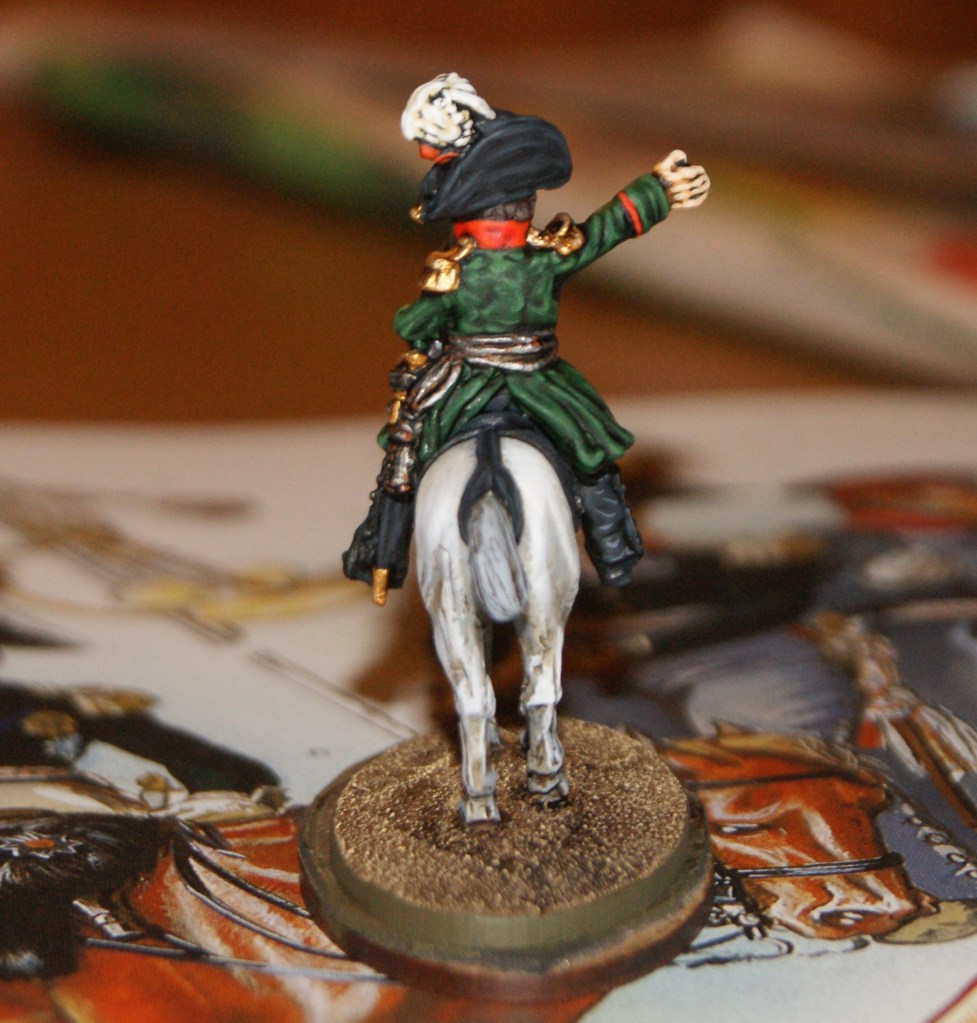
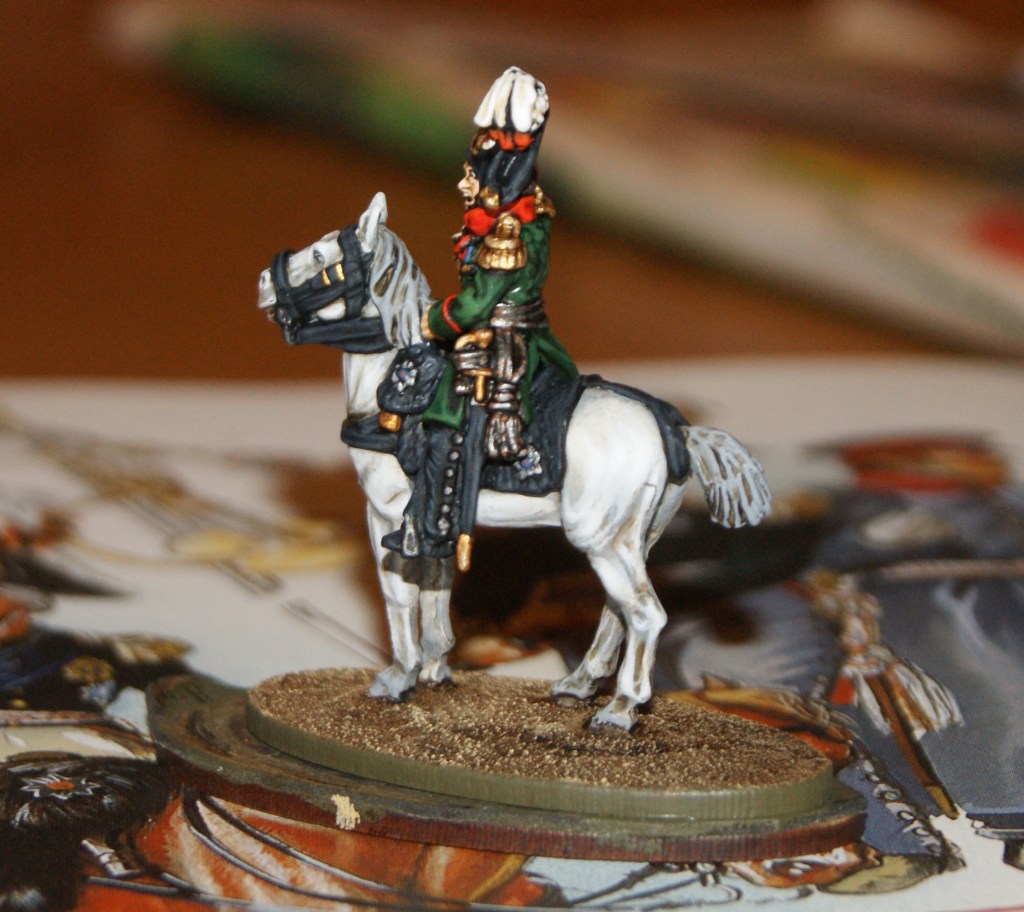
Another Russian general has been sitting half-finished on my desk for a long time. There is no question, these guys dressed pretty smart. Its a good thing that the Russian army in the Napoleonic wars had rather a surplus of generals, because I have rather a good number of them at the moment. It did indeed happen that a major general would command no more than two battalions, so that I would be on solid ground having very small brigades. This goes for both the 1808 campaign in Finland and the 1813 in Germany for example.
The first battalion is the first battalion, first East Prussian regt. Lets hope I dont lose interest and keep at it at least until I have enough to be worthwhile on the games table (that would be about a brigade, at minimum 4-5 infantry units).
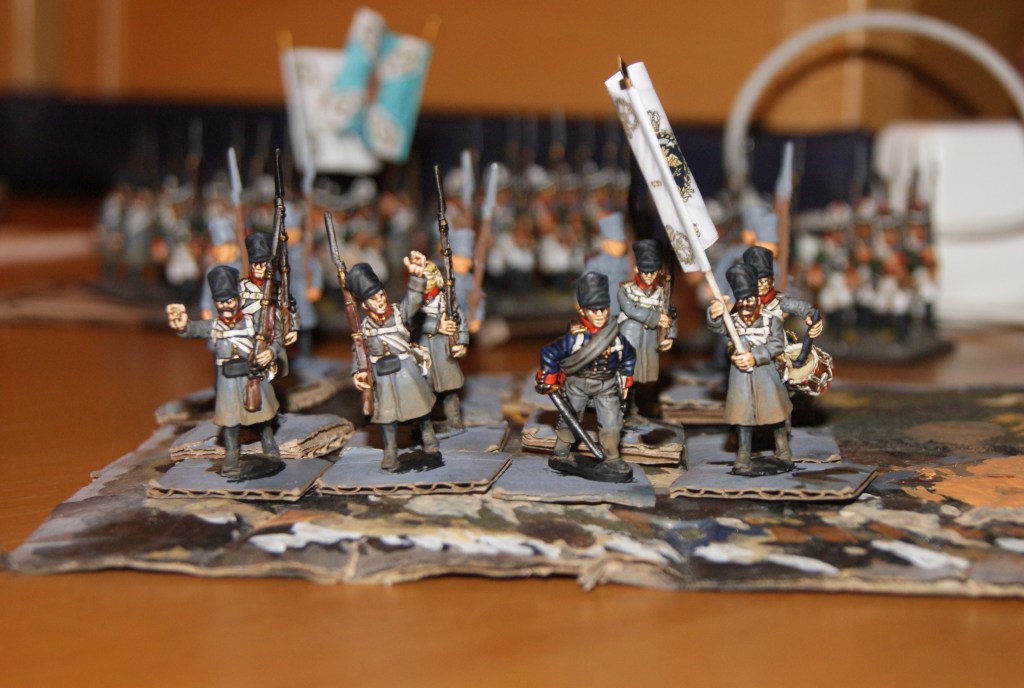
Not a very good photo, and it was taken before the varnish was applied. But these are the command group for my first battalion of Prussian line infantry, 1st bat., 1st regt., 1st East Prussian. The figures are Perry metals, with an officer by Calpe miniatures. The Perry long coated infantry are very easy to speed paint as I have described in previous posts. But there is only one officer figure, so the Calpe officers will give the units some variety.
The plan is to do around 8-10 battalions: 4 battalions of line (1st and 2d East Prussian); 1 (or maybe two?) of Fusiliers; 2–4 battalions of Silesian Landwehr; a battery of 6-pounders (3 guns). Most of the units will consist of 32 figures, with maybe one or two understrength units among the Landwehr. This will be about 200–250 figures in total, including a few skirmishers and commanders. When (if?) I get those done, next up will be the Mecklenburg–Strelitz hussars, I will need about 18–24 of them. At some point, half a battalion of volunteer jägers would be useful too.
As I am doing these, I am also re-basing a few Russians I painted a few years ago. To begin with, they are only 2 battalions of 32 men, but I have more that could be re-based although they would need to be complemented by some additional figures to make up full units.
The project is based on the 2d brigade of Yorcks army corps in the autumn of 1813. A “brigade” in the Prussian organization of that period was very large, equivalent of a French division of that period. This particular brigade consisted of 10 and one half battalions of infantry, 4 and a half squadrons of cavalry and one artillery battery.
At the moment, I have painted 40 figures, and I only started these around the beginning of february; even then, Ive painted a few other things in between as well. As long as I don’t lose interest, the infantry should be done by summer…















 Pancratist